
Turning Out 12th Grade Widgets
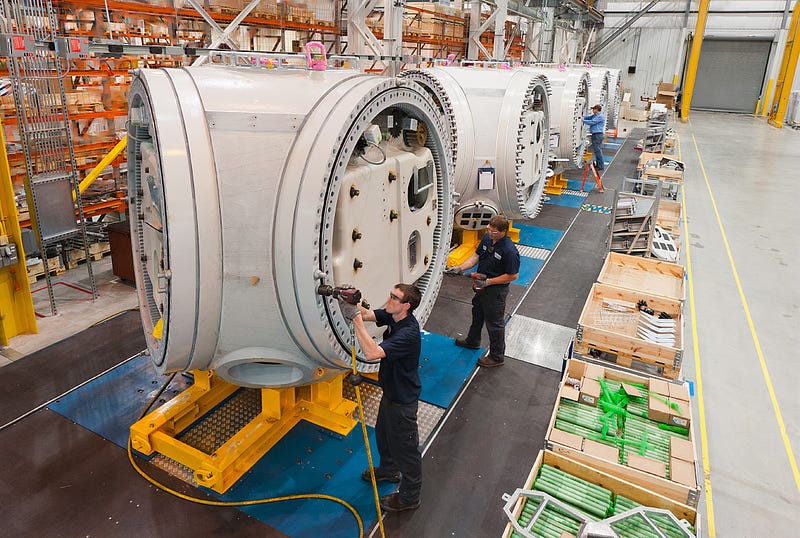
The American school system is really just a factory.
Among our founders, Thomas Jefferson advocated strongly for free public education. Over a hundred years after his death, his vision of universal, free and compulsory education finally happened.
Jefferson and later reformers like Horace Mann viewed universal education as indispensable to the maintenance of democracy. How could an uneducated people possibly govern themselves? If the common folks can’t understand government, how could they be expected to make good decisions?
Along came the industrial revolution, the modern era, and the information age. With the advent of mechanized society, we transitioned from individual agriculture and craftsmanship to organized efforts. Knowledge and expertise power production.
The nationwide focus on science, technology, engineering, and math (STEM) demonstrates our fixation towards preparing students to be productive workers. The United States Chamber of Commerce doesn’t call for increased civics education to improve citizen engagement, or for arts education to improve curiosity and spirit of inquiry. The chamber calls for more and better STEM education to fill critical jobs.
No room exists for the illiterate. Reading and math skills lubricate the assembly line and the construction site.
Everything needs labor
Starbucks needs baristas, the auto industry needs line workers, and universities need PhDs. There is no corner of the economy that runs itself. We look at labor as the Human Resources (HR) domain, but another perspective regards the labor supply chain with our education system as the factory that turns out labor units.
A simple formula produces goods and services: Material x Labor = Product. We think of manufacturing as making things. Simple. We take raw material, people do stuff with it, and we end up with iPhones or Cheetos.
This can even be broken down for each lower tier in the of process. We use labor and lower level materials to make the semiconductors that go in the iPhone or the cheese flavoring that goes into Cheetos.
In industry, this is what people mean when they talk about the supply chain. A connected series of lower tier materials combines into the final product, but we mustn’t forget that it takes labor at each level.
It turns out that we fabricate the labor widgets too
Children serve as raw material for the educational-industrial complex. We submit them to the education factory to be worked and tempered until they can fulfill their societal purpose.
Consider the concept of grade. The word traces to gradus, a Latin word that translates roughly equivalent to “step.” Our education system is a series of steps, first to twelfth grade. Each of the steps or levels indicates a certain amount of processing. We hammer and grind our children into the desired shape, the polish them to shine.
We can even consider the supply chain. Parents birth children and teach them rudimentary skills like letters, shapes, and colors. Sometimes they even go to Kindergarten knowing how to read.
The prospective widgets pass from parents to lower level factories to higher level factories. Elementary schools, junior high schools, and high schools, apply more and more processing. A billet of steel is gets its rough shape at a forge, then goes to a machine shop to for fine milling. Maybe the part will be galvanized or plated.
Even home-schooled children receive schooling. DIY children are typically competitive with formally schooled peers. We expect and require their parents to push them to the same standards.
Society would regard a raw child that never received any education at all as like a billet of steel that never went to the forge. The billet might be suitable for use as a doorstop or to add weight to the back of you pickup on an icy day, but not for much else.
We also sort the widgets for quality
Grade is also a verb; we grade things to indicate their quality. Sometimes the grading system is simple. Beef might be prime, choice, or select. Sometimes the grades are complex, like cotton that might be classified as ‘Light Spotted Strict Low Middling.’
In schools, we assign our students grades A through F to designate how fit each labor widget is for a given purpose. This allows us to separate our children into lots so we know which ones are good enough for the fryer at KFC and which ones we need to grind up into chicken nuggets. No wait, that’s chickens.
For convenience, we reduce academic performance across the widget’s entire manufacturing process by summarizing the material test reports from high school. This gives us a single index number, the Grade Point Average (GPA), with which we can judge the widget’s worth.
Highly graded students go to college for further refinement. Poor grades are rejected and used in less demanding applications.
More highly graded widgets cost more to produce, but are priced at a premium. Each diploma and degree commands greater prices in the marketplace. College graduates can earn nearly a million dollars more over their lifetime than lesser finished product.
When we don’t have enough high quality, highly finished widgets, we even import them. Every year we bring in tens of thousands refined widgets under the H-1b visa program, in theory capped at 65K per year. It’s expensive to import a high-quality labor producing unit, so employers would much rather we produce more STEM units at home.
Reinforcing civic values
There is no path back. We live in a society that demands ever more knowledge and skills. Children are raised with tablets and phones and computers. Functioning in the modern world requires an immense amount of knowledge and skills.
Companies hunger for intelligent, trainable workers. American science and math education can certainly be improved. Perhaps we could lean from the emphasis placed on these skills by other countries.
On the other hand, American ingenuity coupled with opportunity drove our economy forward throughout our history. While mediocre in math and science, we have scaled entrepreneurship.
We also cannot lose sight of the importance of training our youth to be citizens, not just workers. We need engineers that can that can think critically about society as they and their fellow Americans govern themselves.


