
Turn Data Science Into Competitive Edge
How to capitalize on your big data investment? Does investment in big data mean a competitive edge? I argue it is not, at least not yet. There is one more step to complete the picture: it is the success in the adoption and implementation of data science models and analytics that gives a competitive edge. In this post I want to share with you a few strategic perspectives:
- Model explainability and implementation eventually turn your big data investment into competitive advantages
- Use a series of adopted models, not just a model, to give a series of smart and informed business decisions. This will let you harvest the monetary fruits.
- Build a disciplined organization that follows the cycle of creating, explaining, adopting, and implementing new models to capitalize on the data investment.
- The bottleneck is model explainability. Use tools like the SHAP values to decompose your complex models to get the buy-in. See my posts “Explain Your Model with the SHAP Values” and “Explain Any Models with the SHAP Values — Use the KernelExplainer”.
If you are new to data science or want to get a 5-minute to debrief about data science, watch the video clip below.
Model Adoption Turns Your Big Data Investment into Competitive Edge
How do we turn data science into business value? Business values are created when data analytics are digested and acted upon. Data analytics itself, including data wrangling, prediction, or visualization, does not yet create monetary value. They are still the cost center of the company but not the revenue generator. Value is generated when business actions are taken according to data analytics.
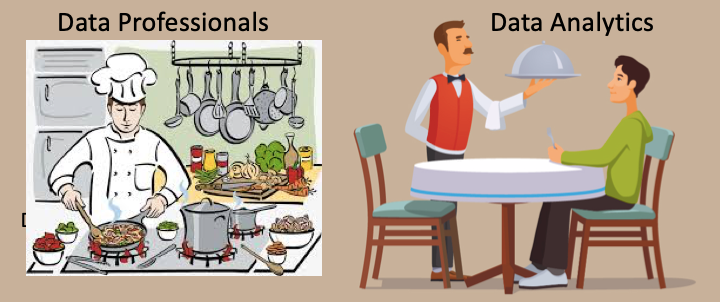
A friend of mine is the chef and the co-owner of a famous local seafood restaurant. One evening we visited his restaurant and we talked about his restaurant management. I asked him what he enjoys the most. He answered two: (1) the invention of good food and (2) conversations with customers. In his spare time, he researches various recipes, and experiments with other ingredients to make the tastes delicious. Once a new recipe is developed, he writes down the cooking procedure including how many minutes with the right temperature for his other chefs. He also talks to the customers at each table. He is well-read and can touch some other subjects. In our conversation, I was impressed that he can talk about the Kaplan-Myer curve in survival analysis. “Do you know we data scientists are like chefs?” I started this conversation. “We data professionals are like chefs, data are the raw ingredients like garlic or raw meat, and data analytics is the great dish presented to the table. Only when the food is digested the value is created, ” I proceeded. He was quite intrigued and nodded his head.
Just like a dish is presented nicely for customers to consume, we present data analytics with nice visualization. Machine learning models and analytics guide users to act. Our ultimate goal is that users will adopt it. What if a data science team focuses too much on the sophistication and advancement of the analytics but loses sight of the buy-in of the users?
Build a Series of Models to Guide Many Small Business Decisions

Competitive advantages are not created by one single, sophisticated predictive model but by a series of models. The series of models provide various scores that inform many small business decisions. These informed decisions eventually lead to business profit. We also need to sanctify the models so the guidance can be sound.
Build a Data Science Team that Upholds the Process Cycle to Create Values
Build strong collaboration among the data engineers, data scientists, and account managers. In today’s highly specified workforce, no one can do all the jobs simultaneously. A winning data science team should have talented data professionals and successful account managers. The data experts should be talented professionals like Michelin chefs and the account managers should be the top sales professionals. Organize your data science team to be close to the business. Develop each data professional to be a customer-facing role. This will keep them focused on the business value and avoid data silos. I agree with you that a data engineer or scientist needs isolated time to develop the models or inspect data accuracy. In our restaurant chef analogy, the chef still needs to spend time with the customers to get first-hand feedback. Learn from the customers how analytics is consumed. Actively pursue their feedback. Monitor how many dollars a model generates each month.
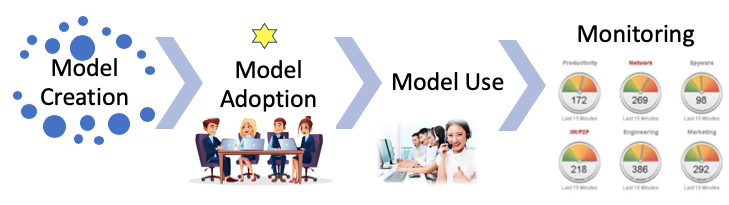
We know data science has its rigorous process. How does that work? How do you present your business value and scientific discipline to your clients? This article “Data Science Modeling Process and Consultative Roles” will walk you through the process and give you more consultative tips!
Model Adoption Is the King
Each of the models will be vetted by the field professionals. They want to know why your model guides them to the right instead of the left at a traffic intersection. Their concerns are reasonable: No one wants to hear advice from a “black box”, no matter how smart the black box is. Consider this: If you ask me to swallow a black pill without telling me what’s in it, I certainly don’t want to swallow it.
If a model cannot be adopted, it can not generate business value. Model adoption arguably is the most critical activity in the data science process cycle.
I have written two posts “Explain Your Model with the SHAP Values” “Explain Your Model with the SHAP Values” and “Explain Any Models with the SHAP Values — Use the KernelExplainer” on the use of the SHAP values. I show you how your team can unfold a highly-sophisticated model into plain language. The SHAP values, along with others such as LIME, are great ways to provide the model transparency that your field professionals are looking for.
Below I reference one image from that article. The model wants to answer what makes a good wine. It predicts the quality of wine by many wine factors. The SHAP values show the reason that the prediction is high is because of the positive forces (volatile acidity, sulphates, etc.). And there are a few negative forces (chlorides) pushing the score low.

There are many things to talk about in the above modeling cycle. In this article, I end the above discussion with the bottleneck — model adoption and offer the technical solutions. I will talk more about building a successful data science team. Stay tuned!


