
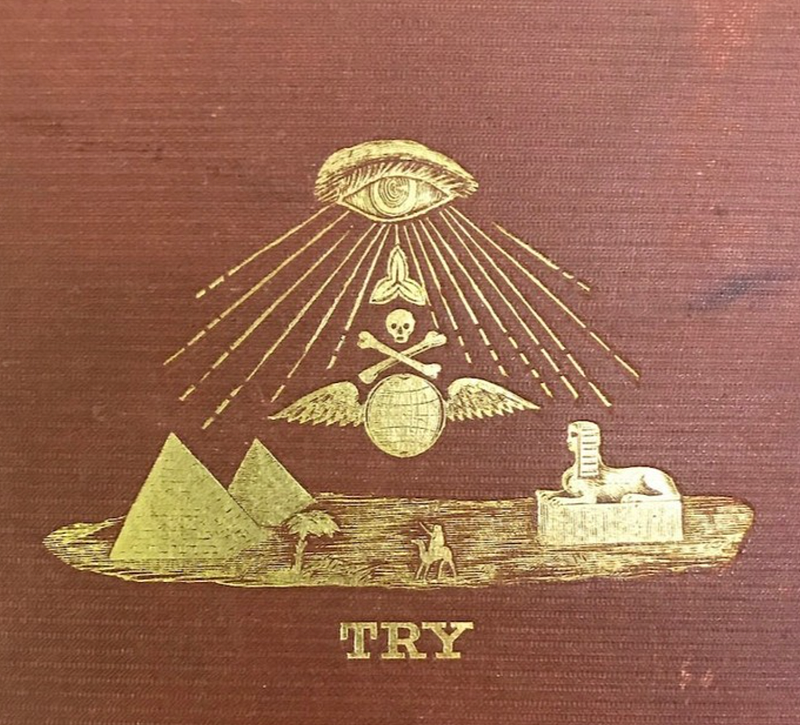
“TRY”: The Occult Legacy of P.B. Randolph
By the mid-to-late nineteenth century, modern occultism drew upon ideals, imagery, and drama of antiquity — remade in light of humanity’s hopes, wishes, and strivings in the Industrial Era.
Seen from one perspective, mechanistic forces appeared to rule the world. Darwin’s theories on the orderly biologic development of life were published in 1859.
But to a cohort of rebels, seekers, romantics, occultists, and esotericists, there existed a substory. To them, the individual was an unruly being possessed of self-determining qualities. One of the great figures on the modern scene to explore this view was American ceremonial magician Pascal Beverly Randolph (1825–1875).
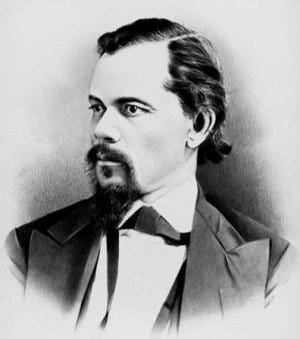
Randolph, a free man of partial Black descent, was born in 1825 in the notorious and dangerous Five Points neighborhood on Canal Street in lower Manhattan.
His father abandoned the family leaving Randolph and his mother to enter a poorhouse when he was six or seven. His mother soon died, probably of typhus, and he was left orphaned, raised variously by foster parents and a half-sister. Seeking to escape street life and pissant labor, the adolescent Randolph became an itinerant sailor. He was able to leave New York City and travel to the near-East and Europe.
He took immediate and burgeoning interest in the occultism of Eliphas Lévi and any related teachings he could find.
Here was a Black man, alive during slavery, orphaned since age six or seven, left to fend for himself in often-brutal surroundings. In his occult studies, he sought power, selfhood, and possibility. Randolph wrote, perhaps fancifully, of his journeys:
One night — it was in far-off Jerusalem or Bethlehem, I really forget which — I made love to…a dusky maiden of Arabic blood. I of her and that experience learned…the fundamental principle of the White Magic of Love; subsequently I became affiliated with some dervishes and fakirs by whom…I found the road to other knowledges…I became practically…a mystic and in time chief of the lofty brethren…discovering the elixir of life, the universal Solvent…and the philosopher’s stone. [1]
Starting at about age twenty-one, and extending across his career, Randolph founded, folded, and then re-founded his own occult orders.
One was the Brotherhood of Eulis, which had its earliest roots in 1846. Randolph reconstituted it in 1874. The name was drawn from the Greek god Eos, a personification of the dawn. This formed the basis for one of Randolph’s key books, Eulis!, published in 1874, a magickal discourse on the “Philosophy of Love.”
Another of his groups, founded in 1858, was Fraternitas Rosae Crucis or Fraternity of the Rosy Cross, first based in San Francisco and later in Quakertown, Pennsylvania, where it was eventually led by American occultist R. Swinburne Clymer (1878–1966). This led to a drawn-out series of feuds and disambiguation among American Rosicrucian orders over who represented the “real” tradition and hierarchy. For his part, Randolph claimed the term Rosicrucian from its Renaissance-era roots and remade it. He identified the Rosicrucian brotherhood not as a thing but an idea and named himself its titular head.
“Power cannot be bought with money,” Randolph wrote in his 1867 Guide to Clairvoyance, “I want the best souls to come to me. Such may be admitted to the Rosicrucian Brotherhood!”
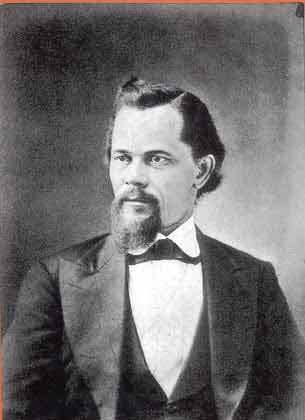
He produced his own books, eventually more than twenty, claiming some of his insights through clairvoyant perception, trance states, and drug use.
Randolph was among the first modern Westerners who employed drugs, notably hashish, to gain visions, insights, and alternate perspectives. He further participated in Spiritualism, séances, and — most importantly — became a pioneering teacher of sex magick or, as he called it, Affectional Alchemy.
Randolph also used the term (or his followers did) Magia Sexualis — the title of a posthumously published book, which seems to have surfaced in 1931. He taught that sex magick heightens the capacity to impose your will over events by focusing and concentrating intensely on what you desire at the point of mutual climax.
Unlike later systems, Randolph’s sex magick was prescribed expressly in partnership — and preferably marriage. Even still, Randolph was spuriously accused of disseminating “obscene” materials, for which he was briefly jailed — and severely financially strained — in 1872.
This is among the ways that what is called sex magick emerged on the modern occult scene. Today, this method is most commonly used in connection with sigil magick whereby the seeker turns a desire into an abstract drawing or symbol — a practice pioneered in its earliest form by British artist and occultist Austin Osman Spare (1886–1956) — and reaches an ecstatic state or climax while viewing the symbol, thus “charging” it as a representation and conduit of will.
In addition to sexuality, drugs, and his efforts at clairvoyance and séances, Randolph sought to employ the magickal uses of mirrors, a thread from Elizabethan magician John Dee (1527–1608).
He believed that gazing intently into a mirror and focusing on your desires could turn that mirror, at least within the psychology of the exercise, into a channel for what Schopenhauer called the light of speculative thought and hence a means of projecting your wish, similar to the climax of sex magick. For a modern iteration of this technique, see Claude M. Bristol’s 1948 book, The Magic of Believing.
In his quest to discover amplifiers of unseen forces, Randolph brought a do-it-yourself ethic and simplicity to magick.
Like many Spiritualists and mediums, Randolph was impassioned and active as a voice for abolitionism.
“In September 1866,” writes scholar of religion Hugh B. Urban, “the Southern loyalists convened in Philadelphia to support the republican cause, to seek recognition for their loyalty and to urge extending the ballot to the ‘loyal Negro.’ Randolph went there to deliver a fiery and famous speech that was widely reproduced throughout the newspapers of the day:”
I am not P.B. Randolph; I am the voice of God crying, “Hold! Hold!” to the nation in its mad career! The lips of the struggling millions of the disenfranchised demanding Justice in the name of Truth — a Peter the Hermit, preaching a new crusade against Wrong — the Genius of Progress appealing for schools; a pleader for the people…mechanic for the redemption of the world.
“Arguably,” Urban notes, “the most important contribution Randolph made to modern esotericism was his system of magical eroticism, or affectional alchemy. In sexual love, Randolph saw nothing less than ‘the greatest hope for the regeneration of the world, the key to personal fulfillment as well as social transformation and the basis of a non-repressive civilization.’” [2]
Randolph produced his writings and formed his organizations in a spirit of anarchistic self-determination. He had never attended seminary. He had no formal schooling, literary background, or credentialed pedigree. This was not Schopenhauer, Mesmer, Blake, or Shelley but a self-made man from the streets who felt that no license, training, or approbation (other than perhaps his own) was required to practice magick.
There was a daring to this man, an uncontained rebelliousness — yet also a deep sorrow. Randolph took his own life by gunshot wound to his head in 1875 at age forty-nine in Toledo, Ohio.
The circumstances are sketchy and sometimes disputed but Randolph apparently believed that his wife was cheating on him. In any case, Randolph, the unsettled seeker, was plagued by grief, betrayal, and debt.
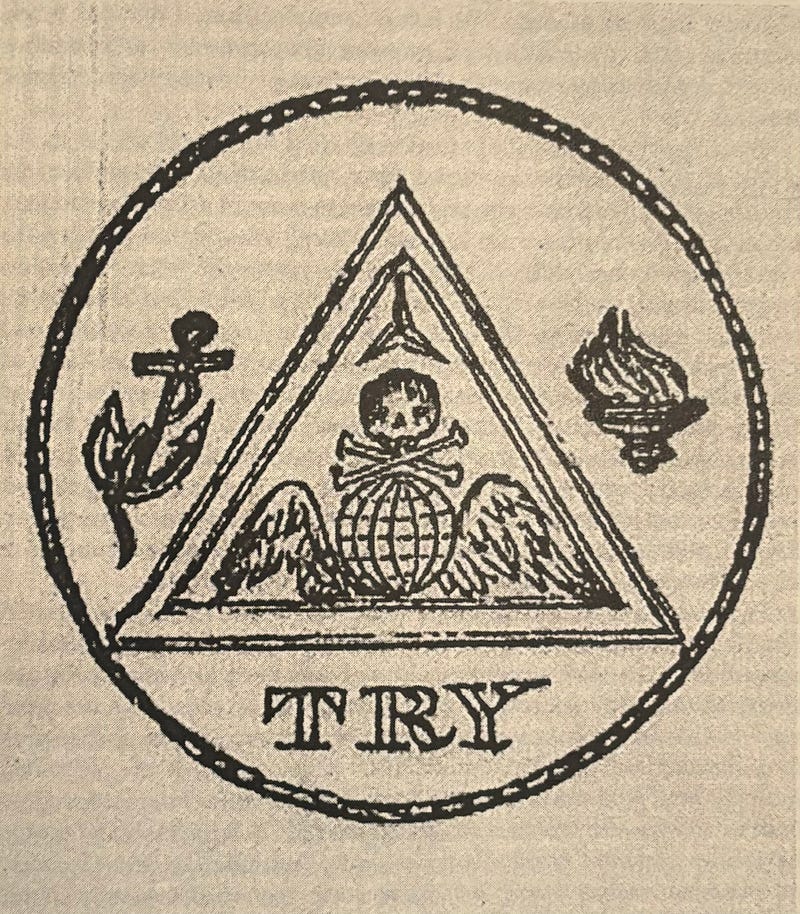
Randolph left a considerable legacy. In addition to his magickal work, this self-invented mage had a simple motto: TRY.
In his book Dealings with the Dead, written in 1861 or 1862, he wrote that an unseen intelligence named Thotmor told him: “Our motto — the motto of the greater order of which I was a brother on earth, — an order which has, under a variety of names, existed since the very dawn of civilization on the earth is ‘Try’.”
Randolph adopted it as his personal slogan. He further defined the principle “Try” through his term Volantia in Eulis!: “the quiet, steady, calm, non-turbulent, non-muscular exertion of the human Will.” [3]
The motto echoed the simple command issued to the hero of the Bhagavad Gita: “Fight, Arjuna.” It soon traced a strange and winding path of its own.
Although Randolph took his life in Toledo on July 29, 1875, a different, and perhaps related, drama played out in New York City in the preceding May.
A New Yorker and former staff colonel for the Union Army, Henry Steel Olcott, had recently met and befriended an extraordinary, world-traveled Russian noblewoman, Madame H.P. Blavatsky, with whom he was embarking on a series of occult experiments and studies.
In May of 1875, Henry pulled together a small circle of seekers into a group called the “Miracle Club.” Their plan was to study hidden forces, clairvoyance, Kabbalah, Egyptian geometry, Eastern spirituality, and reincarnation. The club, Blavatsky later wrote in one of her massive scrapbooks, was formed “in consequence of orders received from T*** B***” — or Tuitit Bey, one of the hidden adepts under whom she claimed tutelage.
Henry fretted that his fledgling group wasn’t getting very far. He believed the Miracle Club would not work out. The same month, he received a mysteriously timed letter. It was signed by the same Tuitit Bey writing “From the Brotherhood of Luxor, Section the Vth.” The unseen mentor told him:
Brother Neophyte, we greet thee.
He who seeks us finds us. TRY.
Rest thy mind — banish all foul doubt. We keep watch over our faithful soldiers. Sister Helen [Blavatsky] is a valiant, trustworthy servant. Open thy Spirit to conviction, have faith and she will lead thee to the Golden Gate of truth. She neither fears sword nor fire but her soul is sensitive to dishonour and she hath reason to mistrust the future…
Thou hast many good mediums around thee, don’t give up thy club. TRY.
It was Henry’s first of several phenomenally produced or “precipitated” letters from unseen masters, teachers, adepts — or Mahatmas — from the East, who Madame Blavatsky called her tutors.
In what is referred to as “Mahatma Letter №5,” dated around November 26, 1880, the master called Koot Hoomi told Theosophist A.P. Sinnett: “…bear in mind, that these my letters, are not written but impressed or precipitated and then all mistakes corrected.” Historian Michael Gomes, who has personally examined some of the archived letters, reports to me that this description is physically accurate, i.e., the penmanship left no indent on the page.
The message reached Henry in May of 1875, the same month that Eliphas Lévi died and about two months before P.B. Randolph’s death.
As instructed, Henry did try. His struggling Miracle Club formed the nucleus of a larger organization launched later that year, the Theosophical Society. It is no exaggeration to say that the occult group changed the world, spiritually, artistically, and politically, a topic a take up in a future piece.
This article is adapted from the author’s Modern Occultism (2023):
Notes
[1] Eulis! (1874), with thanks to Hugh B. Urban.
[2] Magia Sexualis: Sex, Magic, and Liberation in Modern Western Esotericism by Hugh B. Urban (University of California Press, 2006). Urban’s latter quote is from Franklin Rosemont’s foreword to Paschal Beverly Randolph: A Nineteenth-Century Black American Spiritualist, Rosicrucian, and Sex Magician by John Patrick Deveney (State University of New York Press, 1997), the sole biography of Randolph and a valuable resource.
[3] This is sometimes rendered alternately, possibly through elaboration of another writer: “It is simply a quiet power, and requires no muscular or nervous, but simply a still, mental force, to urge it into play, when it is feeble, as in most it is; it should be cultivated by thinking determinedly, at intervals, of one thing only at a time to the total exclusion of every thing, topic, or subject besides.” I encourage parallel study of the volume Meetings with Remarkable Men by G.I. Gurdjieff (1866–1948) in which the teacher refers to “the law-conformable result of a man’s unflinching perseverance in bringing all his manifestations into accordance with the principles he has consciously set himself in life for the attainment of a definite aim.”


