
Trump’s Final Act of Defiance
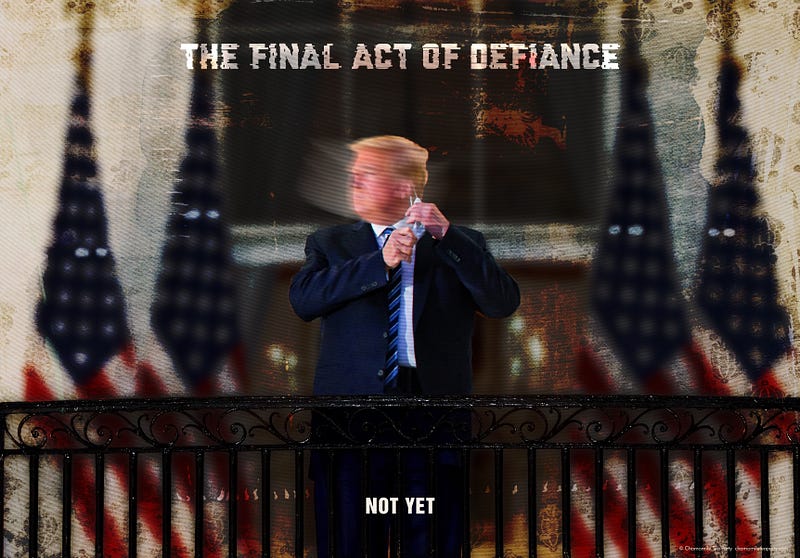
One might have thought after contracting COVID, Donald Trump would alter his behavior and his message: that the coronavirus is a disease to be taken seriously and prevention should be a top priority. But that hasn’t happened. His primary concern during his three-day stay at Walter Reed Medical Center was that he looked weak. That’s what viruses do to our bodies. But to Trump, weakness reflected a more deeply seeded issue. It made him look vulnerable: something he has feared for decades, growing up as the son of Fred Trump. He could never tolerate that. But with the looming election, this became a liability he had to bury.
During that time, his doctors gave daily updates. But the media questioned these rosy accounts, and it became apparent that his primary physician, Dr. Sean Conley, was not telling the public the whole truth. We have since learned that all staff attending to the president had to sign nondisclosure agreements. In “normal” times, Trump is a difficult man. As a patient, he did his best to control the narrative surrounding his illness. He tried to look robust and able-bodied. He tweeted that he felt “great,” better than he had 20 years ago. But that was the steroids talking. The White House released photos showing him at work in the hospital’s presidential suite. In reality, they were staged; he was signing his name to blank sheets of paper. On Sunday afternoon, he took a joyride to well-wishers standing on the sidewalk in front of the hospital. Seen only through a bullet-proof glass window of his hermetically sealed limousine, politicians and the media criticized him for leaving the hospital while he was ill and contagious and endangering the lives of the Secret Service agents who rode with him. Others’ safety took a backseat to his image.
Many remarked he did not look well and the wall of privacy the doctors built around his condition began to erode. It was clear the president had been on oxygen numerous times, indicating his oxygen level was below normal. Not a good sign for a COVID patient. We still don’t know when he first tested positive or when he will no longer be contagious. The White House won’t release those facts.
On Monday, October 5, President Trump announced he was returning to the White House. It’s clear the decision was his. As his helicopter landed on the South Lawn, he walked up the stairs to the balcony. As he reached the top, out of breath, he turned to the cameras and defiantly tore off his mask. Only his most ardent supporters believed he had been cured, as he had tweeted that day.
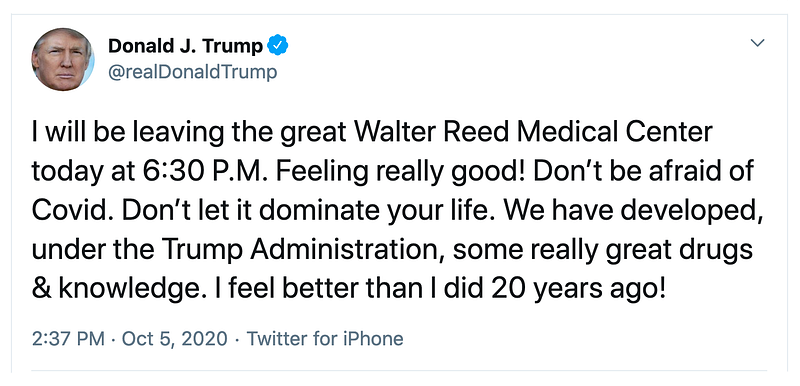
The disease has put a halt to his rallies. He is now in a new bubble, not one filled with his base, but a quarantine. He hasn’t left the White House since his return. Tweeting, a call to Fox Business News, and staged videos have been his only engagements with the outside. The West Wing is virtually empty. Over 34 staffers and other officials close to the president have caught COVID. He continues to refuse to wear a mask, putting those still working there at risk. Most egregiously, he tweeted “Don’t be afraid of COVID,” an irresponsible statement from a man who still has the virus and as leader of a country that has experienced over 210,000 deaths from the disease. He still wants to debate Joe Biden face-to-face on October 15. But, for safety’s sake, the debate commission decided the event will be virtual. He’s rejected that and plans to hold a rally instead. We still don’t know how much longer he will be contagious. He won’t release any information.
Where Donald Trump’s brazen behavior has, over the course of his presidency, been labeled “the new normal,” his actions since contracting COVID-19 have hit a new low. But Trump has always been in that altered state. Perhaps drug-induced from the beginning, it is built on a foundation of insecurity and privilege. Many have noted that the steroids he’s taking are responsible for his erratic behavior. And it has given the pundits and politicians license to voice their concern with greater urgency — the disease, the drugs, and the president’s denials have given critics permission to state what previously had become an undercurrent in this administration.
Nine months into Donald Trump’s presidency he defended white supremacists in Charlottesville by saying they included “some very fine people. Four years later, he has downplayed the pandemic and his COVID infection for his own personal gain. Steroids have only magnified what he already is and has been. Will this be his final defiance? Not yet.
This poster is part of a series of posters Jeff Gates does under the guise of the Chamomile Tea Party. Often taking World War II-era propaganda, he remixes them with new text and imagery about the rancor so prevalent in American political discourse. Download a high resolution copy of this poster for free. In fact, all Chamomile Tea Party posters are free to download under a Creative Commons license.
Follow the history of our country’s political intransigence from 2010–2018 through a six-part exhibit of these posters on Google Arts & Culture.