
Trump’s anti-Asian slurs mirror my family’s response to the December 7, 1941, attack on Pearl Harbor
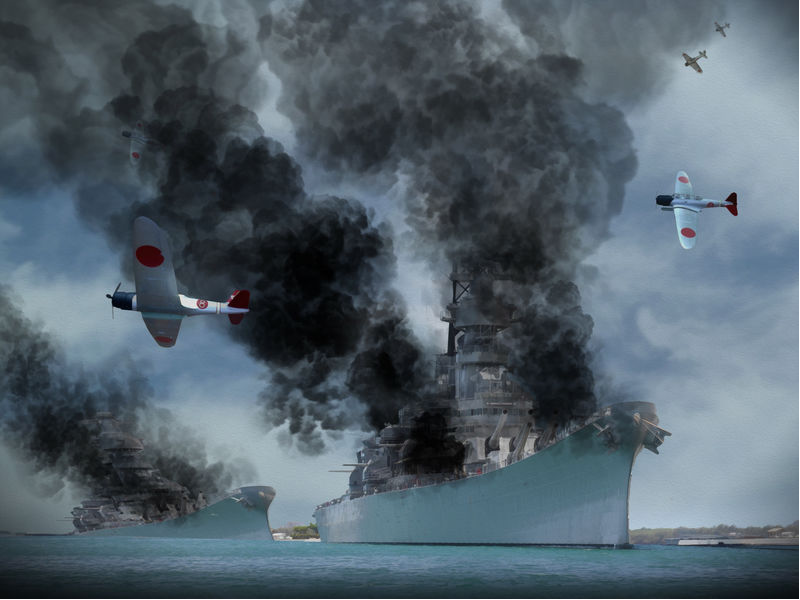
COVID-19 has inflamed American racism, fueled by Trump’s calling it “Kung Flu” and the “Chinese virus.” Asian Americans have found common ground with Black Lives Matter in their experience of discrimination.
George Takei, the Star Trek actor and civil rights activist, says this is history repeating itself: “Asian American hate is as old as American history and this country was swept up by suspicion and fear and naked, outright hatred” on the afternoon Pearl Harbor was bombed.
Takei spent years in a Japanese American internment camp when he was a child in World War II. He was one of the victims of racism. I was one with the perpetrators, though only an infant.
I was carried along in my mother’s arms as my father drove the river levee in Sacramento, California, hunting for Japanese.
News of the bombing had interrupted a radio broadcast of a football game in Chicago.
As my mother told the story to me years later: “A voice on the radio was saying, ‘Hello, NBC. This is KTU in Honolulu, Hawaii.’ The reception was full of static but we could make out he was saying they witnessed the bombing of Pearl Harbor by enemy Japanese planes. ‘This is no joke,’ he said. ‘It is real war.’”
My mother explained, “Hawaii was not that far away from California. What if we would be coming under attack, too? Your father was upset and excited.”
My father was raised in a Minnesota farm family that fished and hunted for meat to feed the dozen children. A photo shows his mother standing on a patch of snow-covered ground, a rifle cradled in her arms.
“We had to hunt for our supper,” went the story. “No free lunches, had to go out and ‘sling the lead,’ even the women sometimes.”
“Your father was a good shot,” my cousin told me years later. In the early 60s my father had “bagged” a big horn sheep in Alaska. A picture of him posing proudly with his trophy kill was published in the local paper.
California nativism and Asian exclusionary practices of the early 20th century burst forth in those first days after Pearl Harbor. Shouting “The yellow bastards,” people were united in the hope that the “Japs” would be wiped from the map.
The afternoon Pearl Harbor was bombed, my father’s oldest sister kept watch at the PG&E station, on the lookout for Japanese planes that might be headed for the West Coast. “Everyone was afraid,” Aunt Millie said.
Out of what I believe was a combination of racism, fear, patriotism and protecting his family, my father loaded his Winchester Model 70 bolt-action rifle with cartridges. His neighbor Jack loaded his Winchester 54. The men sat in the front of my father’s ’37 Plymouth, their weapons tilted upright against the dashboard.
My father drove along the Sacramento River levee road, he and Jack scanning the little truck farms growing onions, carrots, and melons on tiny plots alongside their route.
My mother and her friend sat in the back seat, cradling their crying babies. Years later when I heard this story from my mother, she said she didn’t think the local Japanese farmers were dangerous the way the men did, but she agreed “we could not be subjugated by a foreign power.”
The U.S. met the first day of World War II with incredulity and outrage, with a quick, harsh, nationwide outburst. National Guard units were on guard duty at the Tower Bridge crossing the Sacramento River. There were police cars driving the Japanese sections of town but no people were out.
No one ever stopped my father, a white man who was out hunting for Japanese. He drove up and down the levee roads and into the little towns of Florin and Walnut Grove for a couple hours before he went home and put his gun away, without finding any human targets. For that I am so grateful.
Reports came in all afternoon and evening. President Roosevelt’s voice filled the airways reviewing the facts of the “dastardly” attack that would live in “infamy.” He went on to say he would recommend Congress declare war on Japan.
Not long after, Roosevelt signed an executive order that mandated the uprooting and internment of 120,000 people of Japanese ancestry along the West Coast — U.S. citizens and their immigrant parents alike. George Takai was among those interned in that horrible manifestation of systemic racism.
AUTHOR’S NOTE: I belong to “The Silent Generation,” born before the Baby Boomers. We work hard and keep quiet, raised to be seen and not heard. “If you can’t say something nice, don’t say anything at all,” we were told.
Here’s to breaking the silence.
This is the first in a series by a white woman, to make visible what it has been like to hold up part of white privilege’s sky. I invite your posts on what it has been like for you.
https://www.cbsnews.com/news/asian-americans-bias-racism-2020/