
Trump Attacks Transgender Health Care
Access to care is hard now. Religious ‘liberty’ is set to make it worse
Transgender people have serious problems accessing quality health care. The Trump Administration is about to make it even harder.
Think physicians and other medical professionals honor their Hippocratic oaths and treat their patients equally and neutrally? The Center for American Progress (CAP) wants you to know that’s not true — not with LGBTQ people at least.
They conducted a comprehensive survey in 2017 and found that 8% of gay people report being refused medical treatment because of their sexual orientation.
That’s bad enough, but a full 29 percent of transgender people said a doctor or other health care provider refused to see them because of their actual or perceived gender identity. Twenty-one percent said a doctor or other health care provider used harsh or abusive language when treating them.
I know personally how that works —
A young transgender friend of mine suffers from a serious genetic disorder. Living until recently in the American south, he struggled to obtain the care he needs just to maintain quality of life. He was afraid to talk to his doctors about his transgender identity, because he needed them too badly. Discrimination for my friend literally means risking his life.
His dreams of medical transition were just that, impossible dreams. He recently moved thousands of miles from his home, partly so he could access non-discriminatory health care.
It’s not supposed to work like that, but it does, and the Trump administration is seeking to protect doctors who want to deny care to trans people for religious reasons.
Religious-rights groups have lobbied for change —
The Department of Health and Human Services (HHS) is preparing to roll back protections for transgender patients, empowering health care workers to refuse care based on religious objections, according to recent reporting in Politico.
Religious-rights groups and conservative states have lobbied for the changes, even though patient advocates and public health groups are alarmed, warning HHS that the rules will significantly reduce vulnerable populations’ access to medical care.
Physicians oppose the new rules —
Dr. James L. Madara, MD, CEO of American Medical Association puts it this way:
The AMA believes the Proposed Rule would undermine patients’ access to medical care and information, impose barriers to physicians’ and health care institutions’ ability to provide treatment, impede advances in biomedical research, and create confusion and uncertainty among physicians, other health care professionals, and health care institutions about their legal and ethical obligations to treat patients. We are very concerned that the Proposed Rule would legitimize discrimination against vulnerable patients and in fact create a right to refuse to provide certain treatments or services. Given our concerns, we urge HHS to withdraw this Proposal.
Transgender advocates are seriously alarmed —
The National Center for Transgender Equality fears the rules will clear the way for providers and insurers to refuse transition-related care based on religious beliefs. Perhaps even more ominously, they warn the rules will make it easier for providers to refuse routine care for patients based on their gender identity.
Their fears are based on current reality —
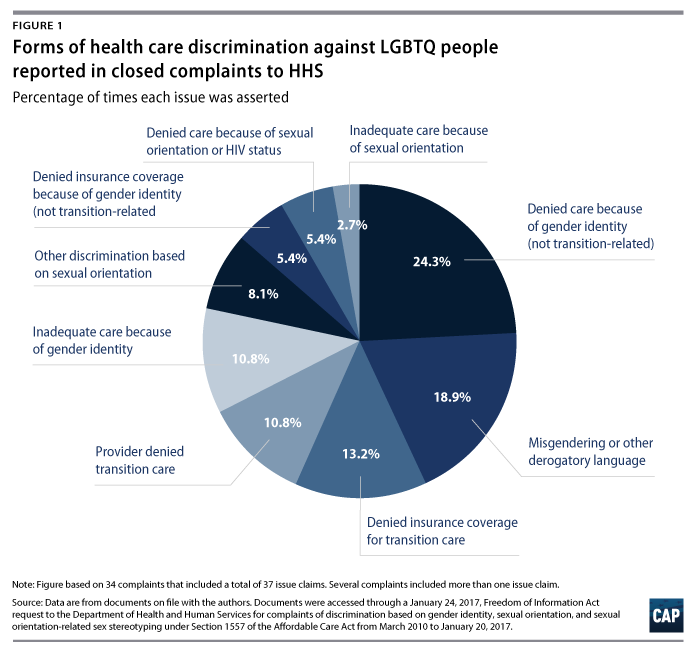
CAP obtained HHS documents in 2018 through a Freedom of Information Act request. They found the bulk of transgender patients’ complaints to HHS between 2012 and 2016 focused on discrimination when seeking general care, not gender-transition care.
Religious liberty? Since when is religion about hurting people?
The Trump Administration is responding to Evangelical and Catholic Christian complaints that their religious rights are being violated — that they’re being persecuted because they aren’t allowed to exclude LGBTQ people.
As part of that narrative, the Administration created a ‘conscience division’ within the HHS civil rights office last year. This year they’re seeking a larger budget and bigger staff for that division, while shrinking the traditional civil rights division and seeking to slash its budget.
The numbers say that doesn’t make sense. HHS received close to 7,600 civil rights complaints in fiscal year 2018. According to CAP, only 10 of them involved religious-liberty or conscience-rights protections that required formal investigation.
Despite the numbers, HHS is about to implement the new rules —
People like my young transgender friend are going to face more stark choices in life. Can they live at home near family and friends, or will they have to seek out more progressive parts of the country where medical professionals won’t be likely to discriminate against them?
We shouldn’t have to live with choices like that, but Trump and conservative Christians have a stranglehold on American politics at the federal level and in many states.
It’s a scary time to be LGBTQ. The Texas legislature, for example, is working on a law to allow any licensed professional to deny services to LGBTQ people — without risk of losing their license.
Will things get worse? It looks like they probably will.
We must restore some sanity to the American political system in the 2020 elections. According to a recent Gallup poll, a large and growing majority of Americans agree that LGBTQ people should be treated equally. It’s time for the majority to take a stand against Trump and conservative Christians.
It’s time for change.
In closing, here are CAP’s detailed numbers about LGBTQ health care. I hope you can take a moment to browse them. I hope you find them as shocking as I do.
Among lesbian, gay, bisexual, and queer (LGBQ) respondents who had visited a doctor or health care provider in the year before the survey:
- 8 percent said that a doctor or other health care provider refused to see them because of their actual or perceived sexual orientation.
- 6 percent said that a doctor or other health care provider refused to give them health care related to their actual or perceived sexual orientation.
- 7 percent said that a doctor or other health care provider refused to recognize their family, including a child or a same-sex spouse or partner.
- 9 percent said that a doctor or other health care provider used harsh or abusive language when treating them.
- 7 percent said that they experienced unwanted physical contact from a doctor or other health care provider (such as fondling, sexual assault, or rape).
Among transgender people who had visited a doctor or health care providers’ office in the past year:
- 29 percent said a doctor or other health care provider refused to see them because of their actual or perceived gender identity.
- 12 percent said a doctor or other health care provider refused to give them health care related to gender transition.
- 23 percent said a doctor or other health care provider intentionally misgendered them or used the wrong name.
- 21 percent said a doctor or other health care provider used harsh or abusive language when treating them.
- 29 percent said that they experienced unwanted physical contact from a doctor or other health care provider (such as fondling, sexual assault, or rape).


