
True Vision Behind Elon’s Mars Mission
Elon’s vision is truly daring & fantastic. His company’s remarkable progress may redesign the future but is far away from inhabiting Mars.
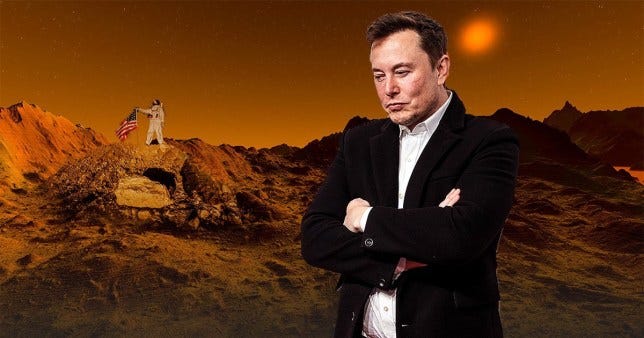
Have you ever wondered how this planet is becoming unfit to live over time? What if we could leave this planet to start out our life in a neighboring planet? What if Mars could be the new human home? These questions very frequently pop up in my mind whenever I read about audacious & visionary projects of the real-world ‘Iron Man’, Elon Musk. Elon has a dream of making Mars habitable & bring the human race to the red rocky neighbor for a sustainable future.
But another set of pressing questions arise, is the mission promising anyway? Could we ever make Mars a planet propitious to support human life? Is it feasible to germinate a human embryo on that planet? Are there any chance of human survival on that infertile land? Tons of perplexing questions are yet to be answered but a dream can’t be bound by any barrier. Without insightful data & facts, the questionnaire with uncountable number of questions can hardly be answered. Philosophical arguments come in rescue when scientific logics fall short to respond to such eye-brow raising queries. Let’s delve deeper for better insights why the project is a true dare & what vision may be underlying within it.
Why do we need a second planet to live?
I find this question absolutely intriguing. Human beings emerged approximately 6M years back on Earth. Many civilizations were established, many civilians lived a healthy life & many civil wars were fought. But all of those legacies just got annihilated one after another. Our civilization can’t be thought to be immune & our inhuman eco-unfriendly activities are going to make the destruction imminent.
Climate change, fuel scarcity, intensifying pollution are some elemental problems the species is presently facing with copious other ones, like overpopulation & deforestation. So, the anxious mind likes to believe in finding an alternative. If an auxiliary home is found, the civilization & the successors can be saved from getting destroyed.
Is Mars habitable?
The first question that may pop up in an individual’s mind is this: ‘Is Mars capable of harboring life?’ The question is straight forward with some vague as well as contradictory answers.
There are several facts already discovered that nullified the possibility altogether. Let’s check out a fraction of those facts. Cosmic ray intensity is quite high on surface which essentially ionizes Martian atmosphere. That can decompose potent compounds needed for life. The surface contains toxic perchlorates which turns lethal when work in tandem with intense UV rays. Martian atmosphere is too thin to breath, only 7–14 mbar of pressure compared to Earth’s 1 bar (or 1000 mbar). Water content is too salty & that is not conducive to sprout life seeds. Along with these chemical inducted impediments, some planetary factors contribute too. Low gravity, unfertile & rocky crust, lack of magnetic field keep life surviving possibility in Mars at bay.
There is a silver lining too which scientists are counting on. Mars has some comparable features with Earth. Temperature & sunlight radiations are to be highlighted in this context. In Mars Simulation Lab (part of German Aerospace Center), when Martian conditions were nearly simulated in a cubicle, some bacteria strains (especially cyanobacteria) were found to be thriving. Earth creatures, which are tolerant to harsh conditions & anaerobic in nature, may be able to survive in subsurface regions on Mars. Also, NASA-devised Curiosity rover found some organic compounds which are essential to support life but NASA refrained from substantiating the claim of alien life presence that might have been speculated from the evidences accrued.
Space exploration stems centuries back but modern era of planetary research wishes to dig deeper remaining at a closer proximity. A plethora of mission has already succeeded as well as failed in past century & equipped with fast-paced tech growth, scientists are setting deadlines to send humans to scrutinize stellar bodies. Moon & Mars are present within the reach of modern technology & human beings are dreaming about ‘Making Life Happen’ in Mars with the hope rooted on the silver lining.
What is success possibility of Elon’s mission?
In terms of contemporary space odyssey, companies are also moving at a faster pace having hand in hand with space organizations. One such established well-known company is SpaceX, a brainchild of Elon Musk. The dream Elon is pursuing, is too daring to be materialized. Fostering life in Mars is apparently next to impossible with the progress of science up to 21st century. One may argue, what we believe impossible today, would be possible tomorrow. They may pick an example from history too. If nature wished humans to fly, she should have given them wings. But Wright bros championed the idea of airplane which don’t need humans to have own wings to fly.
But the idea turns out to be true when it comes to human led innovation but not when human beings go on to defy rules of nature that are rudimentary to life-creation at the first place. If Mars was able to nurture lives, plausibly it could have become a lively planet like Earth after 4.6B years of its creation. It’s also a probability that Mars may become habitable someday but that slice of space-time bread is too far from the one of ours. If that occurs at time in remote future, high likelihood is that it’ll be obeying nature’s rules to conceive lives. Humans may remain incapable to impregnate an infertile celestial womb. Human minds are too small to respond to their existential questions.
Does the mission have enough potential to change the future of human race?
Nonconformist dreamers dream bizarrely big dreams so they can bring the reality close to it, if not achieve it. Enthralling philosophy of people like Elon Musk is that, they set a goal with a deadline after 6 months which is likely to require at least 10 years of time to get successfully accomplished. The endeavors are quite unlikely to succeed within such minuscule timeframe but these people end up staying much ahead of their peers.
SpaceX was founded because Elon wanted rockets to be cheaper & reusable. It would facilitate in economic space transportation & maneuvers of inhabiting Mars. The company has a proven track record with a handful of extraordinary achievements, laureled with the tag of ‘first company’ (non-governmentally funded) to launch a spacecraft to orbit sun (Falcon Heavy), ‘first company’ to recoup a spacecraft after orbiting the Earth (Dragon), ‘first company’ to reuse a rocket (Falcon 9) & ‘first company’ to send astronauts to ISS, to mention a few. The company appears to be a fruitful commercial venture which can push technical limits in space conquest to an unprecedented level.
Colonization of Mars is a truly bold idea which seems ‘less possible to materialize’ in foreseeable future. Lack of air, lethal degree of radiation, low gravity may not bother a handful of creatures to live a prosperous life there, but human beings ain’t such creatures who can survive in such aggravated conditions. If humans wish to thrive on Mars, a couple of challenges would need to be addressed the first with utmost importance. They’d have to figure out pure water resources, shield themselves from high energy cosmic rays, create artificial sustainable atmosphere & finally, cultivate the land for large scale food production.
SpaceX is already reimagining the rocket science & making unparalleled progress to bring down space travel expenditure. It has already revolutionized the industry & is striving for betterment of galactic technologies. Despite that, replying upon those pragmatic arguments & facts, Elon’s visionary project appears dubious about Mars colonization but it’ll surely change & redefine how the future of present civilization would look like on this planet.