
Troubling news from the ocean. Hammerhead sharks are disappearing from some of their habitats.
In the Gulf of California, there’s a decline in the number of hammerhead sharks. Surprisingly, the cause isn’t the noise generated by boats or diver interference, as previously assumed.
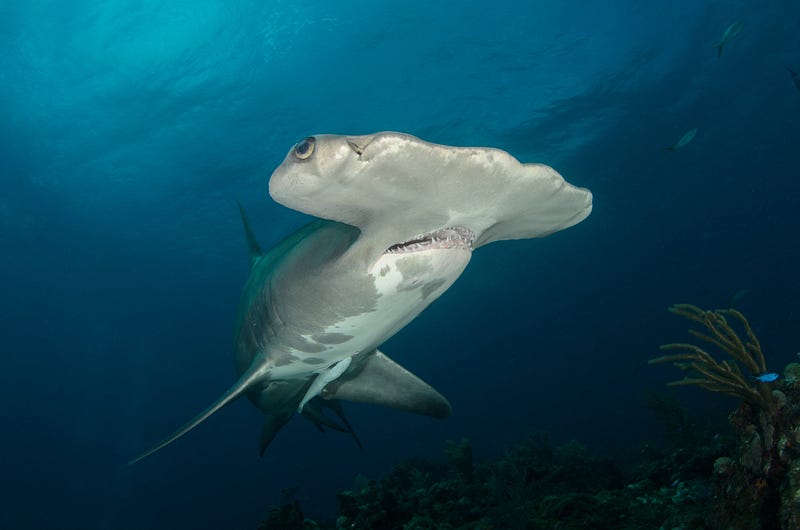
Hammerhead sharks belong to a family of cartilaginous fishes characterized by their distinctive hammer-shaped heads, which give them their name. They inhabit coastal zones of the Pacific, Atlantic, and Indian Oceans. Larger specimens of three species — the scalloped hammerhead (Sphyrna lewini), great hammerhead (Sphyrna mokarran), and smooth hammerhead (Sphyrna zygaena) — are considered potentially dangerous to humans.
Fishing is decimating shark populations.
A recent study published in the scientific journal ‘Marine Policy’ revealed the disappearance of a specific hammerhead species from the southwest part of the Gulf of California. Researchers highlighted that this is a consequence of large-scale fishing.
Scientists analyzed data provided by divers, spanning the last 50 years. They discovered that the population of scalloped hammerhead sharks has declined by up to 97%. This decline was observed around the underwater mountains of El Bajo. Similarly, in the Las Animas underwater mountains, the number of individuals dropped to zero. Both areas are off the coast of Mexico.
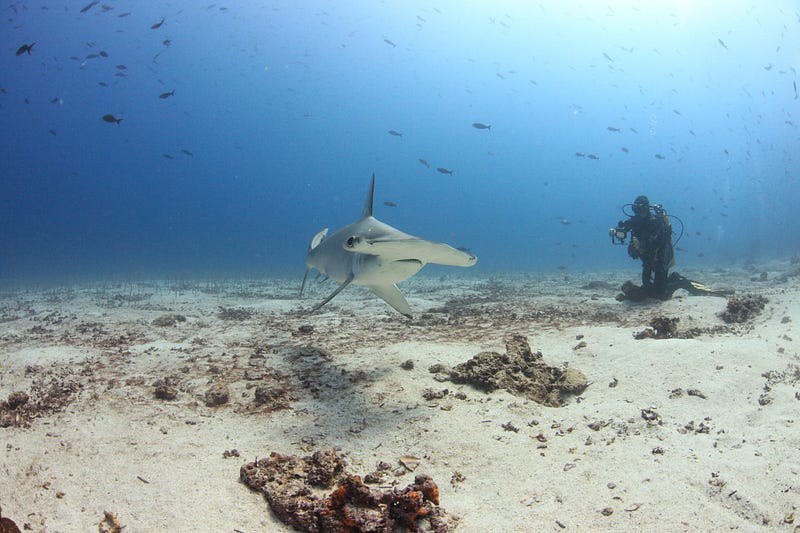
Scalloped hammerheads have vanished from certain areas of the Gulf of California.
The study notes that the Gulf of California has seen a widespread decrease in fish populations due to fishing. However, the scalloped hammerhead has suffered the most.
‘This species is pelagic, forming large schools around underwater mountains where they seek shelter during the day,’ wrote the researchers.
‘The El Bajo underwater mountain near Espíritu Santo Island and the Las Animas underwater mountain near San José Island in the southern Gulf of California have long been popular diving spots for observing S. lewini. In our study, we utilized local divers’ knowledge to determine changes in the population of S. lewini from 1970 to 2020,’ the article states.
Scientists raise alarm as in 2010, only five hammerhead sharks were spotted around El Bajo. In the same year, Las Animas had no recorded observations. For comparison, 50 years earlier in the same region, an average of 1000 sharks were seen near that underwater mountain.
‘This study demonstrates the importance of gathering local ecological knowledge to document species population declines, especially in the case of S. lewini, which is currently classified as “critically endangered” in the Red List of Threatened Species published by the International Union for Conservation of Nature,’ the researchers assert.
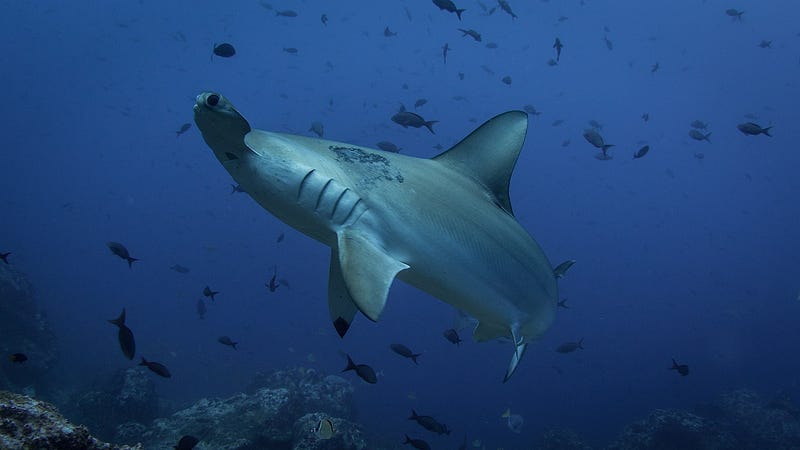
Increased species protection is needed against poaching and fishing.
Adult scalloped hammerheads reach lengths of 2.5 to 5 meters and weigh up to about 400 kilograms. These sharks have olive, grayish-brown, or brown coloring, with their ventral sides usually white. They primarily forage at night, preying on smaller fish and invertebrates.
The species is mainly targeted for its fins and liver oil. In the Caribbean, locals often hunt them for their meat. Fishing remains the primary reason for the critical state of this species.
Kathryn Ayres, the lead author of the study, emphasized that some previously believed the decline in the number of individuals around underwater mountains was due to increasing boat noise and intrusions from divers. However, the latest analysis showed that these factors had minimal impact on the hammerheads’ disappearance.
‘In other areas protected from fishing, such as the Revillagigedo archipelago in Mexico, divers still encounter very large schools,’ said Ayres. ‘Though the hammerheads no longer swim around divers and often flee from them, the species is still widely present in those areas,’ the researcher stated, expressing hope that more natural habitats of critically endangered species would receive similar protection.
Attention all readers!
As content creators on Medium.com, we face minimal compensation for our hard work. If you find value in my articles, please consider supporting me on my “Buy Me a Coffee” page. Your small contributions can make a big difference in fueling my passion for creating quality content. Thank you for your support!

