
Trippy BAM Art Installation is a Remote Vacation in an Hour. Or less. Or more.
“Sun & Sea” now at BAM delivers reality— on a sandy stage
Before you even enter the cool Brooklyn space, the new opera/art installation by Lithuanians Rugilė Barzdžiukaitè and Vaiva Grainytė and Lina Lapelytė manages to subvert expectations by playing with them. On offer is an opera set on a beach, but while the title is “Sun and Sea” — those are the two items truly not present in this hyper-realistic staging of a shoreside bunch of blankets with people on them. That happen to sing a lot.
The sand is real — the marketing copy and every other review will tell you exactly how much perfect sand has been delivered. But here’s what else is real: the books, the magazines, the sunscreen, the towels, the tattoos, the salads, the imperfect bodies, the water, the kids playing badminton, the beach games, the coloring books, crossword puzzles, potato chips, the chess game, even a dog and a real NYC wire beach-garbage can at a tilt, half full of beach trash. It’s a zoo where the humans are on exhibit.
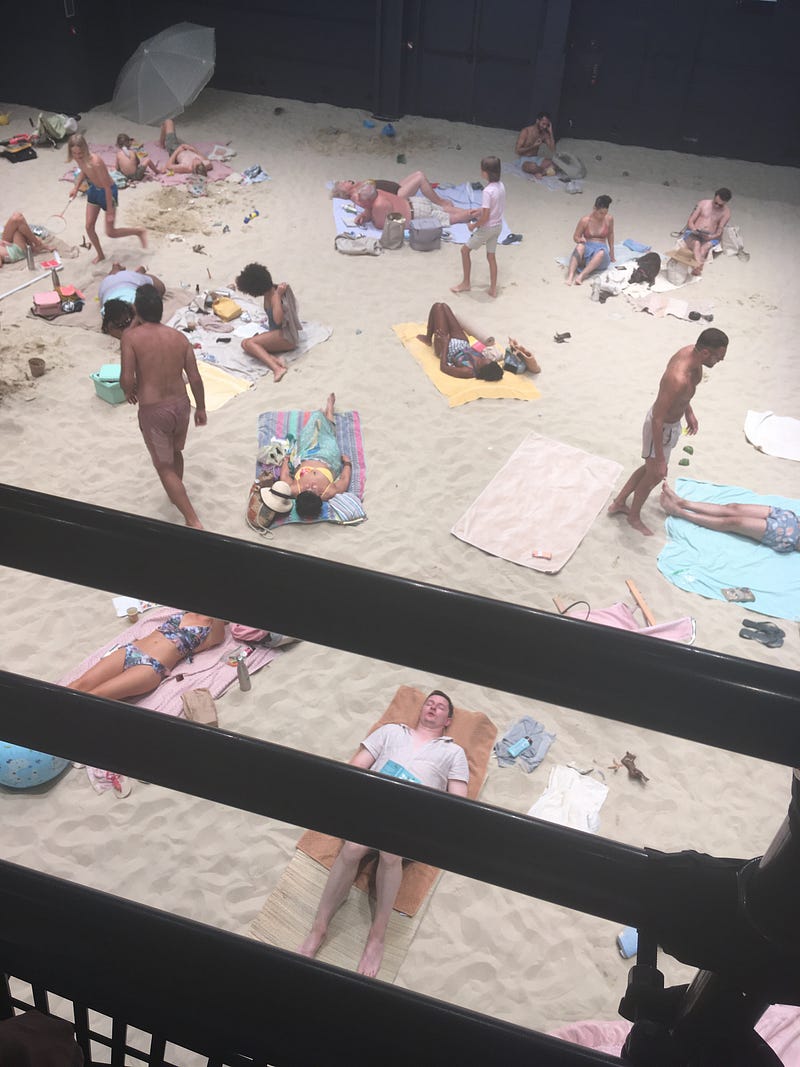
The experience of this installation is everything that defies description — it’s a “please see this yourself” type of event. And I do — I encourage you to see it. BAM Fisher hall. You get a timed entry ticket and stand on a balcony, looking down on an hourlong repeating cycle of solos and ensembles that describe humans on a beach. Stay as long as you like. Walk around if you wish. Or don’t. Figure out who the 12 singer are. Think about the supers and try to make out their improv dialogue. Listen to the various languages. Or give in to the magic! Look at the beach below you. Imagine their stories. Wonder what they do when they aren’t singing. Look at the audience across from you. Imagine their stories. Wonder what they do when they’re not at fancy art installations. It is the best of voyeurism. The best of art. You see yourself. In everyone. Beach and audience, singer and not. Everyone is you.
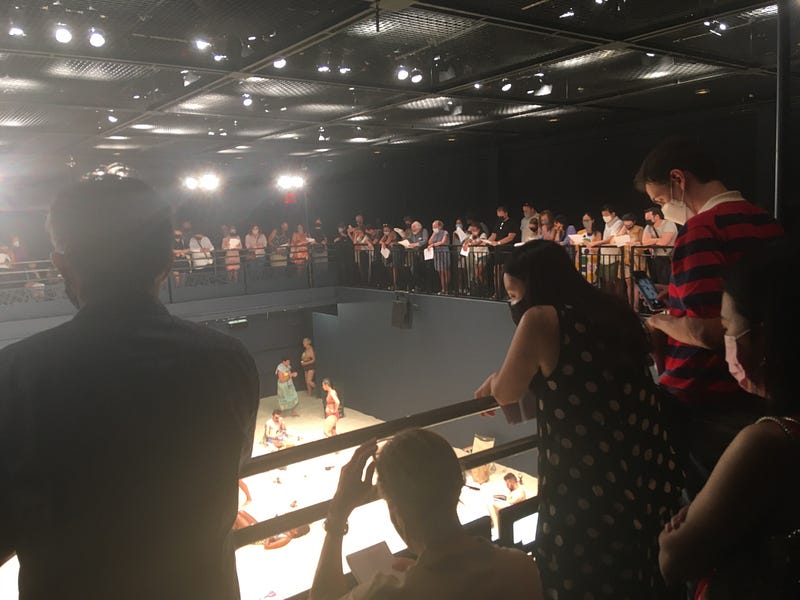
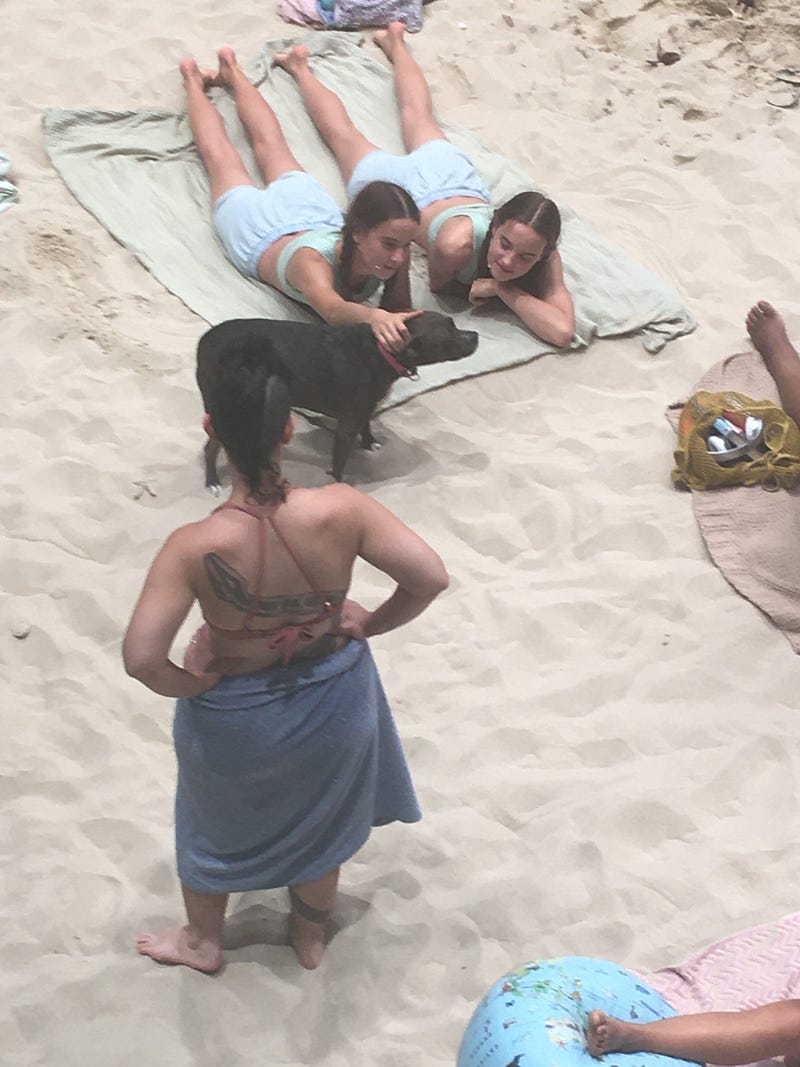
And like the best of art (and voyeurism) you also see the rest of the world in these individual stories: Your neighbor. That one vegan. Your nana. That woman and her shockingly well behaved dog. The kid and his brother. It is a cycle that is both completely mundane and completely transcendent. (Haven’t we all been the exhausted guy wishing he hadn’t lost his temper? Haven’t we all been the woman wishing people would just walk the five feet to throw away their garbage?)
Audiences who walk in always seem to bark a little laugh when they first identify a lyric — the lyrics, like the title and the show itself, encompass both the hyper individual and poetic and the completely mundane: “hand me my glasses, try the other bag” with a little environmental: “this season, the sea is as green as the forest” and “our swimsuits are filling up with algae” — but the lyrics are not the point.
Or maybe they are: maybe the point is all of it. Boredom. Opposites. Highbrow art meets utter indifference. Here you have opera that is simultaneously short (one hour; very few notes) and endless (it’s on for four hours!) and you can stay as long as you like — it’s fascinating to watch the actors find “believable reasons” to leave the stage for a break. (I saw “need a swim” “grabbing some food” and “gonna take my kid to the bathroom” but there were many others)
The improv is where the piece transcends. Since I speak Lithuanian, I could easily understand the little kid begging his dad “prašau!” to eat the cheese-and-cracker the kid had made. (Dad took it but never ate it.) But was that real (the kid REALLY wanted his actual dad to try the cracker) or was it improv (the kid-in-show wanted the actor playing his dad to eat something but that actor needed to sing soon?) In general, as a Lithuanian, I loved hearing the familiar accent under the beautifully translated words. (The singing is entirely in English until a German-accented woman reads the warning on a bottle of sunscreen in four languages) — and it’s not just Lithuanian. Some are native Americans and possibly British and there is also an Italian accent and a few others to be found. But that was just a little personal fun for me as a polyglot. Most viewers will be delighted that the words of the piece are easy to follow “lava! lava!” and anyway, if you wish, you can follow along on either the paper libretto or on your phone.
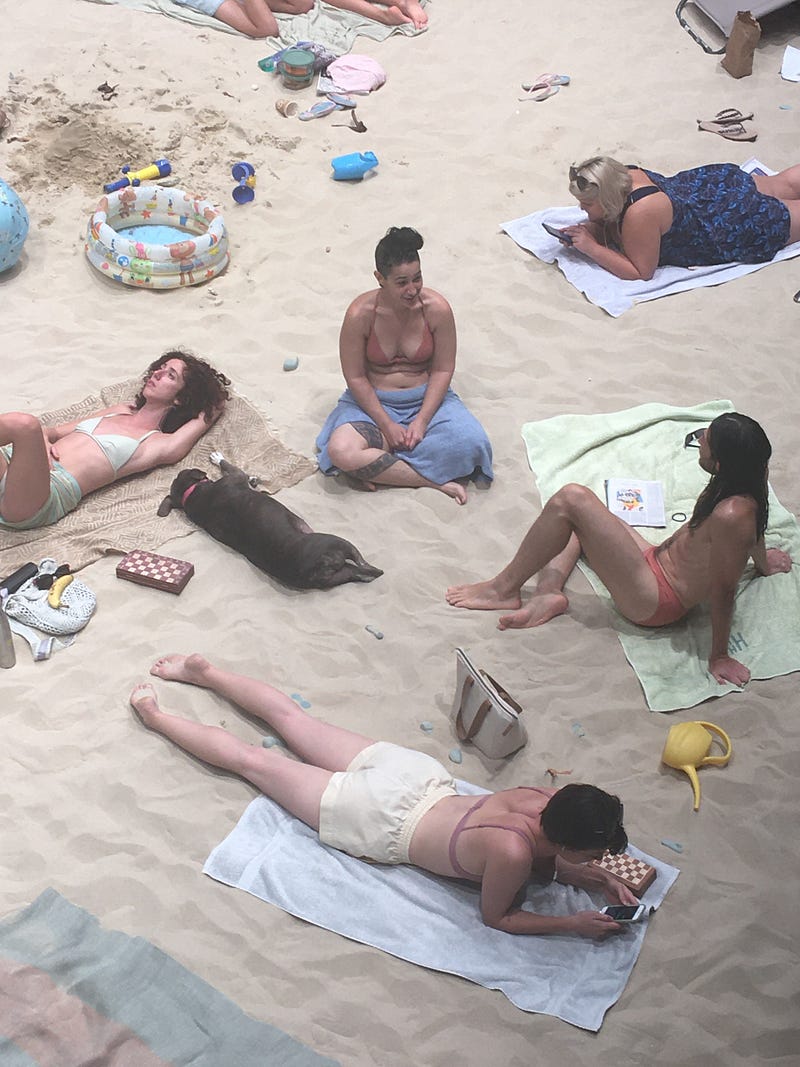
The most moving number was a duet sung by identical twins “I cried so much when I learned…” about impermanence, mortality, the end of the world, and duplication. And how 3D printing and plastic might save the world by being the only permanent thing left at the end of the end.
(I told you, just GO, you could have bought a ticket by now.)
This is also an opera where nearly all of the singing revolves around one dominant open chord — like an immobile Phillip Glass suspension, nearly the entire score centers on a style that I think of as Lithuanian folk singing: pure, clean tones without vibrato. Not in a tonal scale but more like a mode. Almost no harmonies except folk-harmonies (open fifths, some sixths, some thirds, very few progressions). Incredible repeating intervals (the vocal control of being able to sing this whole score while prone is fairly fantastic in and of itself). There is a bit of antiphonal singing. But mostly each aria/recitative (hard to tell the difference) consisted of a repeated simple motif with a single background electric organ note or a triad or slow arpeggio on the same electric organ alternating with choruses of unison or a cappella solo singing.
And it is beautiful. Haunting. The music throws you immediately into a lazy summer day (or an art film!) where nothing ever changes and the air is too still and everything is boredom and you have nothing to think about except your own inner, hidden, ordinary pain.
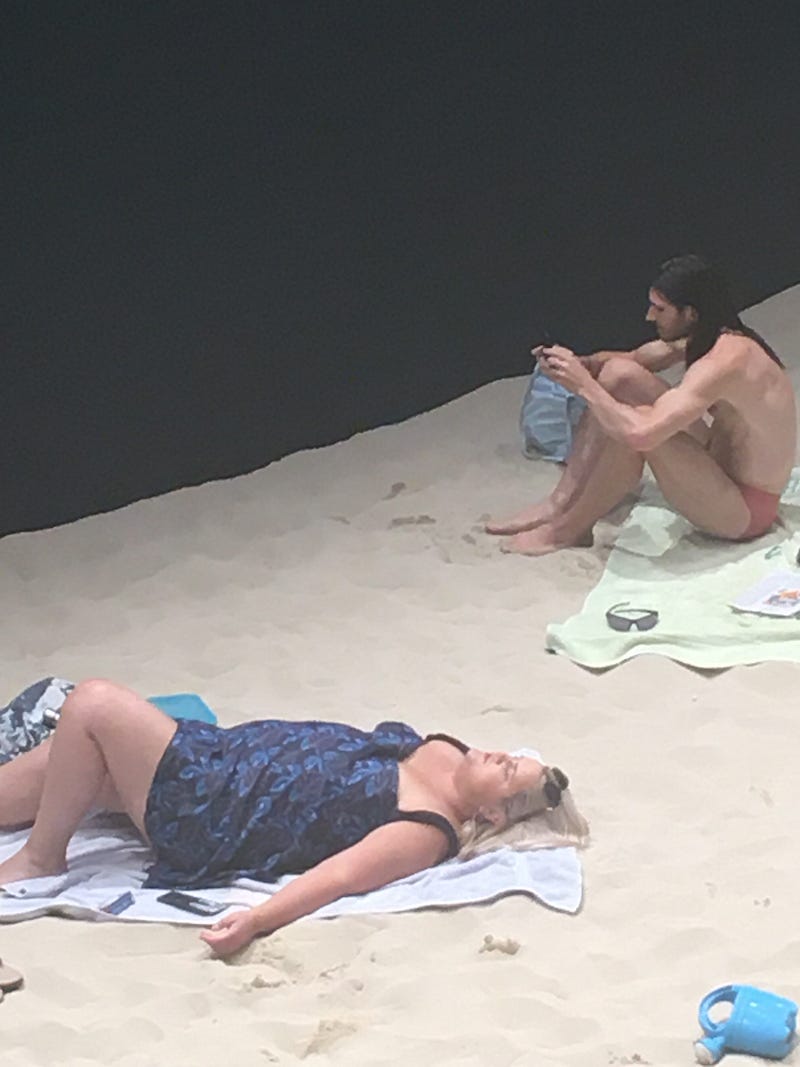
The solos are about this pain. The trauma of long ago loss, the sadness of boredom, the horror of embarrassing social moments. The waiting forever for things that don’t happen. The fear of the end of days. The small microtraumas of ordinary people.
It is not drama as there is no conflict. It works because the beach is the beach. Adagio. Endless. You, the audience, watch the world of the beach, just as you, the vacationer, do on a real beach. As audience, you wonder about these people down there. You sort them into principals and extras. You wonder how they got the kids to behave. Then you see one or another kid misbehave (or that dog, what a good dog, how does that dog sleep so peacefully?) and you wonder if any of this is scripted or real. Honestly, if your legs don’t give out, you could watch this all day.
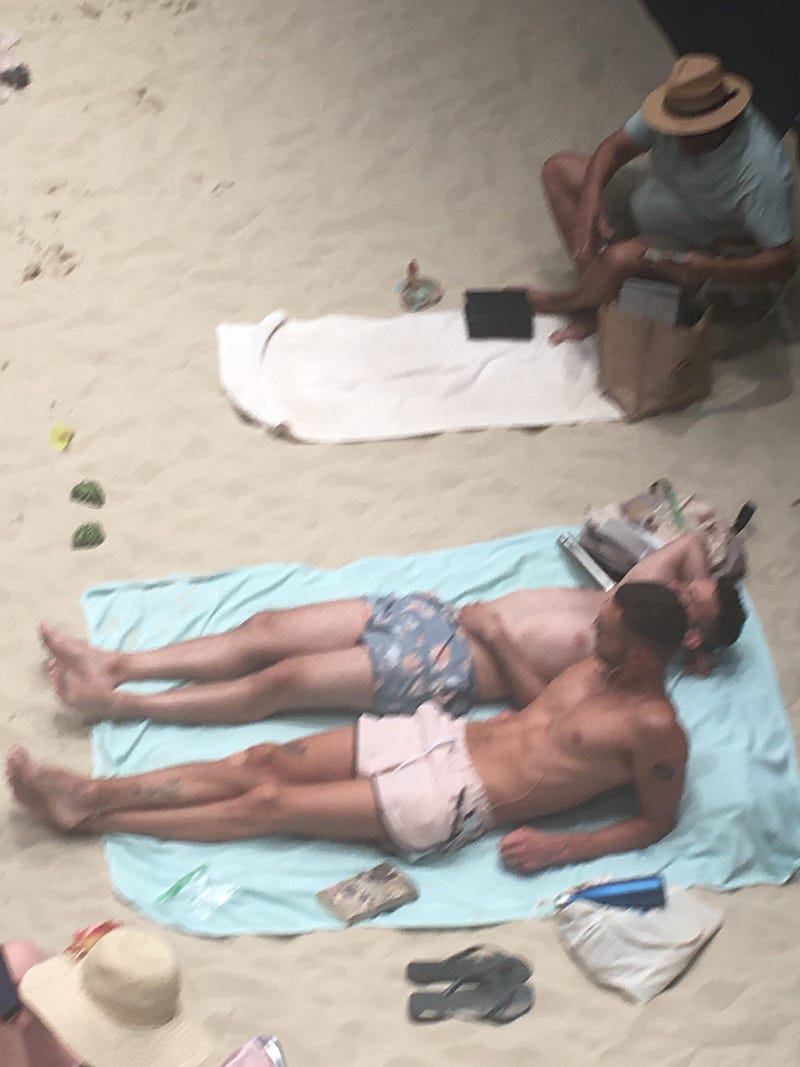
Carte blanche people-watching. With lovely ethereal music. All ages from about 8 to 80. All body types. Some cool tattoos. Lots of hair things going on. Some possible real families. If you can’t make it to the Cayman Islands, this is an hour (or more. Or less.) well spent. It will transport you.

Sun & Sea is playing currently at BAM Fisher. https://www.bam.org/sun-and-sea for more info. Follow me on Twitter @mmdevoe and Facebook.org/mmdevoe