
Life Discovery: The “Trilogy” Strategy for Knowledge Creators
Using a simple technique to curate your knowledge enterprises

This article is about Life Discovery Activity and the Anticipatory Activity System Framework.
The Life Discovery Activity focuses on 1) Detecting Potential Contradictions and 2) Exploring Potential Themes in order to enhance a person’s life development. In order to cope with potential contradictions, we need to adopt objects as Means for solving problems. In order to develop potential themes, we need to adopt objects as End as creative spaces.
Today I am going to share a simple technique called the “Trilogy” strategy for curating a knowledge enterprise. I have been using the technique for many years.
Knowledge Creators tend to find various ideas and opportunities, however, it’s so hard to capture these potential ideas and turn all of them into real knowledge products.
In Life Discovery: The “Experience — Theme” Ladder and Meaning, I talked about the hierarchy of life experience and suggested the following model for knowledge creators.
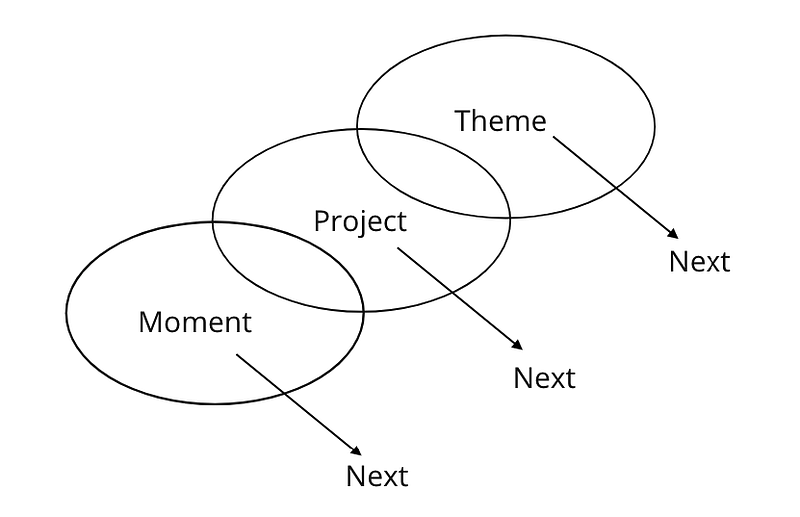
For Life Discovery Activity, we can discover potential things at three levels:
- Moment: What will happen in the next moment?
- Project: What should I do for the next project?
- Theme: What would be the next cultural theme?
The above three questions are also suitable for the Anticipatory Activity System Framework. Now we can apply the framework to three different time scales.
- Moment: Perceiving Creative Actions
- Project: Objectifying Creative Ideas
- Theme: Exploring Potential Themes
You can find more details in the original article.
Today I’d like to share a technique for thinking about the next project for knowledge creators: the “Trilogy” Strategy.
The “Trilogy” Strategy
According to Wikipedia, “A trilogy is a set of three works of art that are connected and can be seen either as a single work or as three individual works. They are commonly found in literature, film, and video games, and are less common in other art forms. Three-part works that are considered components of a larger work also exist, such as the triptych or the three-movement sonata, but they are not commonly referred to with the term ‘trilogy’.”
For example, The Lord of the Rings is a good example of a Trilogy.
- The Fellowship of the Ring (2001)
- The Two Towers (2002)
- The Return o the King (2003)
In the past years, I have been applying the “Trilogy” strategy to my creative projects and learning challenges. Below is the newest one.
The Project-centered Approach
On Jan 18, 2022, I created the new version of the Project Engagement Toolkit (2022) which is a project-oriented toolkit for theory-based reflection and study. It is a major outcome of the Activity U project because it connected the following two theoretical approaches of Activity Theory together and offers a series of tools for practitioners.
- The Activity System Model (Yrjö Engeström, 1987)
- Activity as Formation of Concept (Andy Blunden, 2010, 2012, 2014)
Originally, I used “Project Engagement” as the name of Part 3 of the book Project-oriented Activity Theory and it refers to a set of my own ideas for expanding Andy Blunden’s original approach “Project as a unit of analysis of Activity” and “Activity as Formation of Concept”.
In 2021, I moved in the direction of supporting knowledge workers and creators. I realized that the Project Engagement Toolkit has its own significance for practitioners. It is not a pure application of Activity Theory.
In Thematic Space: The Project Engagement Toolkit for Creators, I discussed my “Project” thematic space and highlighted the following three points:
- First, the Developmental Project Model is an independent framework.
- Second, there is a concept called Projectivity behind the Module 4 Zone of Project and the Module 5 Developmental Project Model.
- Third, I also adopted Howard E. Gruber’s Evolving Systems Approach to the study of Creative Work (1974,1989) for module 6.
Originally, the Project Engagement toolkit was born from the work of Project-oriented Activity Theory. Now, it is an instrument for practitioners.
The Life-as-Project approach continuously expands my “Project” thematic space. It seems that I am building a Project-centered approach.
The “Trilogy” Strategy for the Project-centered Approach
Last month, I used the “Trilogy” Strategy for the Project-centered Approach and planned the following three books as the outcome of the approach.
- #1. Project-oriented Activity Theory (done)
- #2. Life Discovery: The Life-as-Project Approach (doing)
- #3. Cultural Projection Analysis: The Project Engagement Approach (to do)
Project-oriented Activity Theory is a theoretical book that aims to connect two theoretical approaches: The Activity System Model (Yrjö Engeström, 1987) and Activity as Formation of Concept (Andy Blunden, 2010, 2012, 2014).
Life Discovery: The Life-as-Project Approach aims to adopt Activity Theory to discuss Life Discovery. It can be considered as an application. The main focus of Life Discovery is Life Discovery Activity and its Canvas.
Cultural Projection Analysis returns to Project-oriented Activity Theory but focuses on the method. Originally, I used “Project Engagement” as the name of Part 3 of the book Project-oriented Activity Theory. Later, I developed the Project Engagement Toolkit and moved to a method called Cultural Projection Analysis. This book will focus on an empirical research project which is guided by the method of Cultural Projection Analysis.
Project-oriented Activity Theory (Done)
This book is a by-product of the Activity U project. Activity Theory or the “Cultural-historical activity theory (CHAT)” is an interdisciplinary philosophical framework for studying both individual and social aspects of human behavior. Activity Theory is an established theoretical tradition with several theoretical approaches developed by different theorists. Originally, it was inspired by the Russian/Soviet psychology of the 1920s and 1930s.
A major development of Activity Theory during the past decade is Andy Blunden’s account “An Interdisciplinary Theory of Activity”. Andy Blunden is an independent scholar in Melbourne, Australia. He works with the Independent Social Research Network and the Melbourne School of Continental Philosophy and has run a Hegel Summer School since 1998.
In order to develop the notion of “Project as a unit of Activity” as a theoretical foundation of the new interdisciplinary theory of Activity, Blunden adopts Hegel’s logic and Vygotsky’s theory about “Unit of Analysis” and “Concept” as theoretical resources. The process is documented in four books: An Interdisciplinary Theory of Activity (2010), Concepts: A Critical Approach (2012), Collaborative Projects: An Interdisciplinary Study (2014), and Hegel for Social Movements (2019).
Andy Blunden doesn’t use “Project-oriented Activity Theory” as an official name for his approach. Originally, I used this term to refer to Blunden’s approach. Later I realized the name becomes an issue because my articles present my interpretation of Blunden’s approach.
The book is divided into the following five parts:
- Part 1: The Landscape of Activity Theory
- Part 2: Andy Blunden’s New Approach
- Part 3: Project Engagement
- Part 4: Life as Activity
Part 3 can be considered as a dialogue between Activity Theory and Ecological Psychology because I add “Projectivity” and “Zone of Project” as two theoretical concepts to expand Andy Blunden’s original approach. Some theoretical resources behind “Projectivity” and “Zone of Project” are adopted from Ecological Psychologists.
The most important difference between Blunden’s original approach and my interpretation is that his vision is developing a general interdisciplinary theory of Activity as a meta-theory. However, my vision is to adopt his meta-theory and develop some frameworks and models for practical studies.
You can find more details here.
Life Discovery: The Life-as-Project Approach (Doing)
In 2021, I moved in the direction of supporting knowledge workers and creators. I realized that the Project Engagement Toolkit has its own significance for practitioners. It is not a pure application of Activity Theory.
On Jan 18, 2022, I created the new version of the Project Engagement Toolkit (2022). In Thematic Space: The Project Engagement Toolkit for Creators, I discussed my “Project” thematic space and highlighted the following three points:
- First, the Developmental Project Model is an independent framework.
- Second, there is a concept called Projectivity behind the Module 4 Zone of Project and the Module 5 Developmental Project Model.
- Third, I also adopted Howard E. Gruber’s Evolving Systems Approach to the study of Creative Work (1974,1989) for module 6.
Originally, the Project Engagement toolkit was born from the work of Project-oriented Activity Theory. Now, it is an instrument for practitioners.
The Life-as-Project approach continuously expands my “Project” thematic space.

In Feb 2022, I worked on the Life Discovery Project and it led to the following things:
- The Life-as-Project Approach
- Life Discovery Toolkit (v1.0)
- Life Discovery Canvas (v1.0)
On Feb 13, 2022, I published Life Discovery: The Life-as-Project Approach and suggested a strategy for developing a Project-centered approach:
Project as A Multiple Dimension Concept
This simple strategy creates a new thematic space for creative exploration. In The Life Discovery Canvas (v1.0) — Part 1: Theoretical Background, I highlighted the following six basic principles of the Project-centered approach for Life Discovery Activity:
- Being by Doing
- Engagement as Method
- End as Means
- Discovery as Development
- Performance as Experiment
- Curativity as Creativity
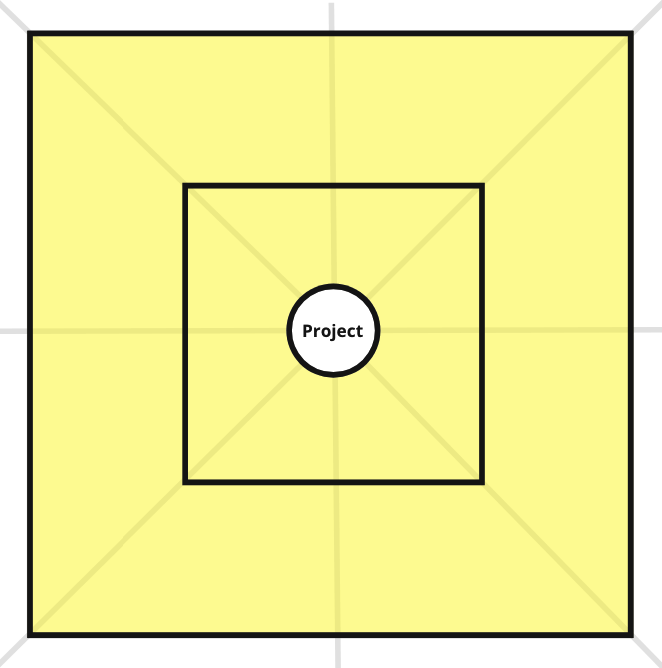
Last week, I realized that I can edit a new book titled Life Discovery: The Life-as-Project Approach.
Cultural Projection Analysis: The Project Engagement Approach (to do)
Last year, I started an empirical research project about an adult development program that was initiated by a friend of mine. I’d like to call the program SSL which stands for Shaper & Supporter Lab. Anyway, it is just a codename.
The program was designed with three components: 1) Life Purpose Awareness, 2) Personal OKR Practice, and 3) Peer Review and Feedback. My friend also adopted the Building In Public approach to sharing her goals, challenges, progress, and discussions with others on social media platforms.
I use the Project Engagement approach to guide my research about the program. The approach uses a method called “Multiple-level Project Engagement”. I reflect on the following levels:
- The “My Friend — Members” Engagement
- The “Member—Member” Engagement
- The “I — My friend” Engagement
This method is what I called the “Cultural Projection Analysis” of Project-oriented Activity Theory. You can find more details here: Activity U (X): Projecting, Projectivity, and Cultural Projection.
As mentioned above, the program has three components: 1) Life Purpose Awareness, 2) Personal OKR Practice, and 3) Peer Review and Feedback. We can roughly understand it as a Life Discovery project.
In Jan 2022, the SSL (Shaper & Supporter Lab) program launched its new version of the developmental service. I realized that I can apply Project-oriented Activity Theory and the Project Engagement toolkit to study its development.
Last month I joined the SSL program’s digital setting which is based on an enterprise collaboration platform and started researching the whole program. The founder of the program shares videos of their learning workshops with me on a private channel.
I moved from the outer space of the project into the inner space of the project. If we apply the Cultural Projection Analysis method to discuss this moment, then it is about Secondary Projecting.
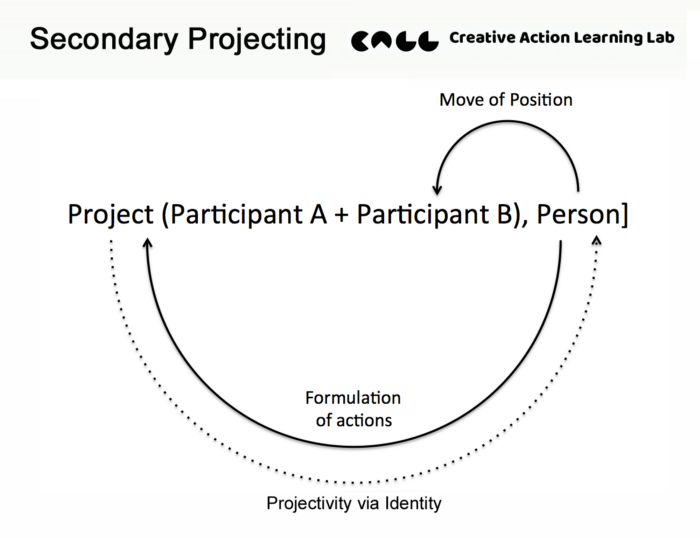
According to Project-oriented Activity Theory, at the phase of Objectification, an established project starts attracting people as its participants. Once a project is initiated, it offers Secondary Projectivity for other people to recognize the potential action opportunities of participating in the project. For the Second Projectivity, its sense-maker is the Identity of an established Project.
The above diagram shows an abstract model of secondary projecting with two people and one project. Participant A is the first person who initiates the project while Participant B is the second person who recognizes Secondary Projectivity and participates in the project.
The core of spatial logic is the synchronization of the formulation of actions and move of position. The second person moves from the outside space of the project into the inside space of the project while he actualizes the Secondary Projectivity of the project by taking real actions.
Here we have to pay attention to the spatial boundary of the project. Before becoming Participant B, the second person only can perceive the secondary projectivity of the project through its sense-maker Identity of Project because he is not in the inside space of the project.
Last week, I realized that I should consider a new book for the Project-centered approach. The new book could focus on the SSL program and the Cultural Projection Analysis method.
You are most welcome to connect via the following social platforms:
Linkedin: https://www.linkedin.com/in/oliverding Twitter: https://twitter.com/oliverding Polywork: https://www.polywork.com/oliverding Boardle: https://www.boardle.io/users/oliver-ding


