Trigger Warnings in the Creative Writing Workshop
What is their role in creating?
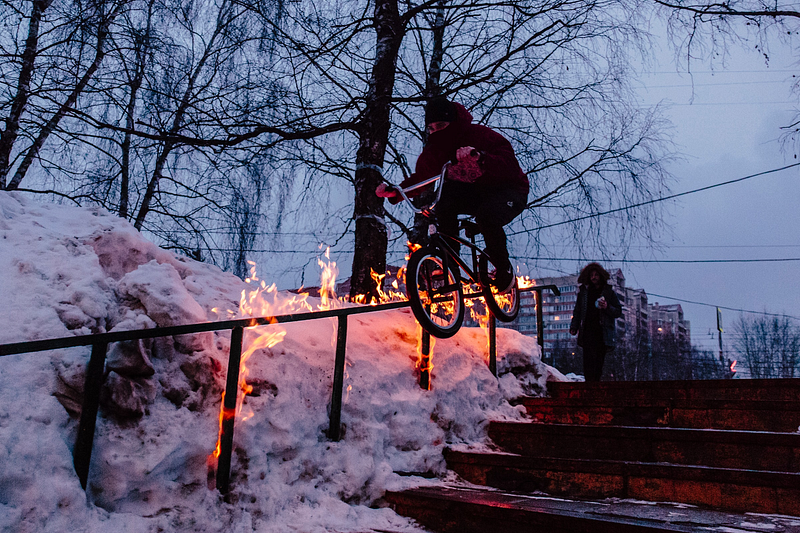
This, above, is the photo I was looking for when I typed “extreme life” into Unsplash. It was the twelfth possibility in the line up of photographs.
But in first place, upper left-hand corner, was this:

Food won top spot. And if you have a deathly shellfish allergy, okay. But I wonder why.
I could say, “Don’t order the crab!” But I might be missing something. A story could tell me what I am missing. Life is filled with the subtle, and sometimes we do have crabs thrown at us.
Some stories need to be written. Some stories are pain-filled to write, and to read.
TRIGGER WARNING
The following article is going to involve flames. Later. I’ll let you know.
I am in my mid-50s, and in the past 5 years have been through more than I could have imagined just a half dozen years ago: caregiving a spouse diagnosed with ALS, losing him, losing my father to the same disease 18 months later (what are the odds?), moving homes, guiding three sons through what it means to lose a parent, risking a new relationship, and more — too much for here.
Here’s the thing: I have made it through, am making it through, only because — I believe — of all the other challenging stuff I went through in my teens, my 20s, my 30s. Now, with the hindsight of age itself, I am starting to see how this works. It’s a process of building. Building soul, building self, building resilience.
I watched my mother go through the ALS/caregiving journey with my father, at a slower pace than that at which my spouse and I traveled. My mother has never had or created the opportunities I have had to develop independence and stamina. And the experience was so much harder for her. (Age notwithstanding.)
Of course, it is close to impossible to weigh and measure such matters. The variables are so many. And many go through much more than I. But it is simplistic to think that putting warnings on reading material for adults is a reasonable thing… How did we get here? I ask myself daily.
What are we talking about when we say “safe spaces”?
This is the conversation, in class, and in our faculty meetings. As of these past several years, it is now a given: we are to accept the need for Warnings, and for creating a “safe space.”
Safe for whom? The students in the writing workshops? The readers who will read their work? Me, as a non-tenured instructor?
Safe from whom? or from what?
I have learned that nothing is “safe” about life. Even these months of lock-down — each of us in our home — is not safe. And what is “safety” in the life of a creative?
No one told me about the light
Part of caregiving for me was the many nightly trips to the bathroom with my spouse, which meant struggling to push him with a walker over a ramp, and then helping him down and up to the toilet.
There was a particular light in the hallway that I left on before we retired each night, so I would not have to do it while dealing with multiple trips, each progressively exhausting.
After he passed away, months later, I could not stand to turn on that light. I found myself going down that short hallway in murkiness, stumbling at times. But I could not turn on that light.
When I moved away from that house, it was the light I was relieved to be free of. If someone had told me that a year before, I would not have thought it possible.
So on one hand, I understand the drive for warning. But this experience also tells me that it is impossible to know, to understand, just what might trigger. (A crab, for instance?)
Do I need warnings that “in this story, someone turns on a hall light!”? Imagine: a night-light. Childhood safety symbol.
Forget flames.
Well meant intent
Each of us carries individual pain. The intent behind trigger warnings is well-meant. But do we need it, or is it useful? And I ask the question again, do we need it as writers teaching writers?
As all writers, reader, editors, and others know, it is not just the stuff of “story” but it is also how it is told. So something that “triggers” a reader might not be the thing itself, but how it is written. Words are evocative. We just don’t know what they are evoking. We can’t tell how, either. That is the magic of writing, and magic can be both benign. And malignant.
Writers cannot be second-guessing their stories and the telling of them. For every person for whom the story might elicit something negative, there are many readers who, for many reasons, may need the story. We cannot create with this level of fear.
Put it down
The beauty of reading is that one can always close the book and set it down. I am not being facetious; I mean that sincerely. So much harder to have absorbed an image in an art gallery, or to leave one’s seat and race out of the movie theater. But all a book asks, to bring it to an end, is to close it.
Of course, in a classroom and learning situation, in which one is expected to read a manuscript or text, and possibly be examined on it, it is not always possible to “put down.” I do believe a flexible, sympathetic instructor can find a way around this if need be. Or, recognizing that all instructors are not the same…a student may need just to make a call. But I also believe this is a rare case; to create an atmosphere of fear and anxiety, for such rare event, is not logical. Somehow, we’ve lost the flexibility to acknowledge dealing with an individual’s pain and questioning of what is offered in the classroom, and we’ve created a blanket response, which serves few, and even does harm to what we are supposed to be doing in the classroom.
I am concerned that this has blown to a size that is now blocking paths to knowledge and learning, both in the classroom, and living life itself: each experience in our lives creates who we are, including the negative. (No, I am not condoning actions, and not condemning reactions. I am not that simplistic. But life is also about acceptance of our selves — as in, the sum of our existence; to fight that will leave us utterly depleted.)
Complexity (or flames again)
Life is so very complex; try as we might we cannot simplify. Acceptance, means living with paradox, and can mean actively seeking gifts of life to find balance. And on some level, I feel that trigger warnings and “safe” spaces are all about our attempts to reduce and simplify the unwieldy, hurtful, and downright bloody awful of life…all the stuff that artists pull apart and examine. All the stuff that is the raw materials with which we work when we create stories and articles, poetry, screenplays and song lyrics.
Subtitle: What is their role in creating?
The nature of creating and the nature of warnings are at odds. Trigger warnings have a role in creating “safe” spaces, and in appearing to maintain mental well-being. And it’s possible that, for a time at least, the warnings might give a sense of safety and health. But…that still leaves us with the question of their place in a creative space.
So maybe the creative writing classroom or workshop is no longer about creating. In the years in which I have been teaching, 1996 to present, it feels less and less about creating, and a lot more about tiptoeing about.
We need to decide: is it creating? or is it safe? Is it possible to bring these two together? How?
Strongest literature
Some of our strongest literature has come from the extremities of life — a life lived at some edge. This produces powerful work that has traditionally fed human life, work by which readers measure choices, morality, power. The growth of self. The discussion of the big questions. The exploration of answers.
Ironically, literature offers us a safe space to explore these ideas. Readers can “try on,” they can rehearse. For readers who have experienced trauma, they can reflect, measure, grow…without having to go to an edge in quite the same way as round one. In this respect, writers are out there in the world, doing some important work — this is our role, or part of it, surely.
Next generation
Where will the next generation of such explorers be? or go? Artists are these people: we go in, we go deep. And sometimes it hurts. As practicing artists we know that even behind the seemingly innocuous story can be an experience of betrayal, sadness, hurt, trauma…it can be there. (It usually is, let’s face it.) Experience births the questions that birth the story. Pain is something that can translate to artistic energy. Maybe creating the “safe” in a writing class lies in acknowledging this reality. Because it is the reality.
There used to be a sense in the writing workshop, of openness, of vulnerability, of exploring, of mastery and bravery. Of human experience and joy. Now there is a sense of timidity, apology, fear. And holding back.
Someday, I’m going to be ready to write a story about the simple act of turning on a light switch. In the meantime, I think about what that will mean, I read others’ stories, and I gather strength.
Forged in flames, we go on.