
Life Lessons from The Happiest Man on Earth: Auschwitz Survivor Eddie Jaku
Based on his Memoir, The Happiest Man on Earth
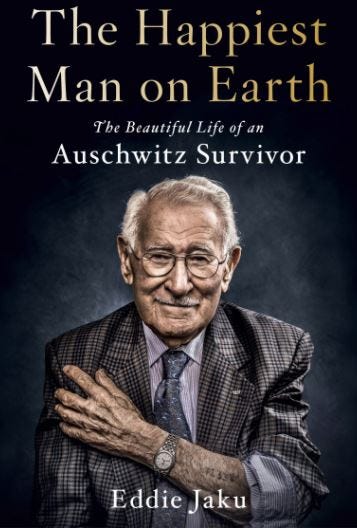
“The Happiest Man on Earth”, this bold title and beaming cover photo drew me to this book.
A hell-camp Auschwitz survivor proclaiming to be the happiest man on earth. Is it an oxymoron?
Sure, I’ve read and seen many Holocaust stories and movies. Exemplary tales of bravery, strength, and resilience of the human spirit amidst monstrosities. But none had claimed their survival based on happiness. Except, for Eddie.
It’s 2022 and our world is still reeling under a never-ending pandemic. Needless to say, we’re all seeking hope and inspiration wherever we can find it. Yet, our challenges are trivial compared to the horrific atrocities faced by the holocaust survivors.
So, what makes Eddie Jaku audaciously declare he’s the happiest man on Earth?
I was compelled to read his book and find out.
Who is Eddie Jaku?
Abraham Salomon Jakubowicz (Eddie Jaku) was born in Leipzig, Germany, in a Jewish family. He grew up surrounded by the warmth and care of his loved ones. Upon finishing high school, his father, a stickler for education, sent him to a special boarding school to study mechanical engineering. With the growing hostile political climate in Germany, Eddie was forced to attend school under a false, non-Jewish identity. He spent five tough years in this school, working as an apprentice by day and studying at night. Eddie hated his boarding school life — it was harsh and lonely.
It’s only later in life that Eddie realized that his education was the very reason, he survived the hostilities of the holocaust. Education literally saved his life.
Kristallnacht, the Night of Broken Glass changed the course of his teenage life when Nazi SS thugs looted the city and sent him and his family to their first concentration camp. The next seven years of his youth were spent shuttling from one camp to another. The Nazis stripped him of his name, belongings, family, and home, but they could never break his spirit.
His memoir poignantly details day-to-day life in concentration camps. Each new camp was more formidable than the previous. His final destination was Auschwitz — The Death Pit. Despite living in the hellish depths of misery there, he survived and vowed to spend the rest of his life as the happiest man alive. It was a conscious but not easy decision.
What helped Eddie Survive the Concentration Camps?
“Don’t walk behind me, I may not lead. Don’t walk in front of me, I may not follow. Just walk beside me and be my friend.” — Anonymous
1. His Education & Skills — Though studying mechanical & precision engineering in the harsh boarding school environment was grueling, the skills he mastered there, saved his life. When the Nazis learned that he was skilled at making and handling specialized machinery, they labeled him as an Economically Indispensable Jew (EIJ). On three occasions, just steps away from entering the dreaded gas chambers, he was miraculously pulled out at the last minute when the guards noticed he was listed as an EIJ. In the seven long years he spent in different camps, as long as he worked and was profitable to the Germans, they did not kill him.
2. His Family — Eddie’s father always taught him to treasure his family and moral values above all. This love for his family and the hope of reuniting with them kept him alive through the multitude of aggressions he faced in the prison camps. Sadly, he lost his parents to the death throes at Auschwitz, but his sister miraculously escaped.
3. His Friend — In life, all you need is one good friend. Eddie found his true friend and support in Kurt Hirschfeld. They met at the concentration camp. Through their shared journey of tackling the harsh camp life, Kurt became his source of strength. Be it helping him find extra food, taking care of him when he fell sick, providing moral and emotional support, or preventing him from committing suicide, Kurt remained a loyal friend throughout.
Life after Auschwitz
When the war ended, Eddie finally escaped the physical horrors of Auschwitz, but not the mental trauma. That took years of nurturing and healing.
He reunited with his sister and friend Kurt and together they began a new life in Belgium. A city where he also met and married a beautiful Jewish girl, Flore.
Flore was Eddie’s salve helping him recover from his mental anguish. Though they shared the same religious and cultural background, they were completely different personalities. Flore was a social extrovert while Eddie, a recluse. He shied away from all social engagements and trusted no one.
Happiness still hadn’t found its way into Eddie’s heart.
It was only when his son was born that something shifted inside Eddie. When he held his infant son for the first time, he realized how lucky he was to be alive, to be a father, to be free, and to have a new family — a wonderful wife, sister, and his best friend. What else could a man ask for? This is the happiness he was seeking. It was around him. He simply did not see it.
At that moment, holding his child, he understood that no one was going to come and rescue him from his mental misery. Though he was freed from the prison camp years ago, the shackles of mental pain still held him hostage.
When the realization dawned that he was given another chance in life with his new family, it released his pain. Eddie was finally free and, on the road, to becoming the happiest man on earth.
From then on, Eddie vowed to change his attitude, make new friends, and share his survival story to encourage others. He joined a local Jewish Welfare Museum and supported other struggling holocaust survivors. Each day he pledged to give something back to others, even if it was just a kind word or a smile. This attitude of giving made him happier and Eddie’s family and fortune grew with time.
He lived till the ripe age of 101 and peacefully passed away on October 12, 2021, leaving behind a beautiful family of children, grandchildren, and great-grandchildren to carry on his legacy.
Lessons from Eddie’s Life
People change with circumstances — Eddie shares that the antisemitic riots in Germany weren’t just triggered by the Nazis but to his utter dismay, it was also fueled by ordinary citizens, lifelong family friends, and close neighbors he grew up with. When they joined in on the violence and looting against Jews, Eddie’s faith and trust in humanity broke. He witnessed, firsthand that people change with circumstances.
Eddie often wondered if the course of history would be different;
If these ordinary people had stood up against the oppressive Nazi regime instead of joining them.
If they had dared to stop the violence instead of perpetrating it.
If they had been strong enough to overcome their own weakness and stop the Jewish massacre.
Had they done that, it could have saved 6 million Jewish lives.
But they did not.
History was shrouded in darkness because ordinary people were weak and unable to stand up for their fellow countrymen.
Tomorrow will come if you survive today — Surviving camp life meant living each day as it came. Eddie learned this early on that after a hard day’s work, instead of running around the camp searching for his family or extra food, he had to conserve every ounce of energy by resting. He adopted the torchlight effect of living in the present moment and surviving today with the hope of being alive tomorrow.
No matter how difficult our circumstances or life may be. We can only tackle it by facing it one day at a time. Before you know it, the clouds will lift, and the struggle will end.
Your moral values matter — Character comes out in the dark. The concentration camps were heinous places that revealed the true character of people.
Eddie saw many Jewish people betray their own kind by reporting them to the Nazi guards in exchange for extra food or favors. It pained him to see them fall so low. Many others stole their fellow camp prisoners’ precious piece of bread, their only meal of the day. But on the flip side, he also witnessed the kindness in humans in the form of Jewish Doctors, and prisoners themselves, risking their lives to treat or cure a fellow prisoner and saving them from dying.
He also recounts how some German guards were more humane than his own fellow Jewish members. Risking their own life, they would sneak in extra food for Eddie or help him plot an escape.
Through seven years of suffering countless miseries, Eddie survived the harsh camp life because of the kindness of a few good humans who maintained a high moral character despite the circumstances.