Trial Period
A former publisher and his subordinate form an unlikely friendship whilst working for a herbal remedy company.
An observation from unemployment purgatory: Modern job advertisements generally fall into two categories.
The first is the impenetrable corporate nonsense ad. Filled with interminable waffle about “scaling”, “pipelining”, and “drilling down”, they sound more like dentists or oil prospectors, and necessitate an immediate Google search to try and decipher what the bloody hell a KPI or B2B might be. In such ads, I don’t understand why everyone wants to “disrupt the space”, “disrupt the narrative”, or “disrupt the concept”. When did the working world get so disruptive?
The second kind involves vague invitations issued by tech-obsessed, bearded hipster entrepreneurs, who beam with an eerie Stepford-employer demeanour. They offer an unending supply of ethically sourced coffee, unlimited holidays, beanbags, and spaces to have “uncomfortable conversations”. It sounds less like they’re advertising a job, and more like they’re asking you to join a cult.
Having recently been made redundant after twenty-five years in a publishing job, I need to decide which way to leap. Into the vat of corporate bullshit, or into some dodgy Silicon Valley wannabe start-up, helmed by a trust fund brat, spending Daddy’s inherited millions.
Not that I begrudge people their wealth. I’m not one of those incessant over-caring activist types who blither on about the gap between rich and poor. I swear if I hear the term late-stage capitalism one more time, I’m going to do something violent. I can’t bear the whiny, sanctimonious, condescending drivel that bleeds from social media these days. By contrast, I suppose I adhere to the stereotype of blissful apathy that is assumed of my generation.
As my children frequently point out, Generation X had great music. Whilst scanning job ads on Linked In, my nine-year-old son Lee scuttles into my office from the sitting room, where he has been watching classic music videos online.
‘Can we go and see Michael Jackson in concert?’
‘No, sorry he’s dead.’
Lee looks disappointed. ‘Why are so many great singers dead?’
‘It’s tradition for great pop stars to die prematurely. Anyway, you don’t want to go with your forty-five-year-old father to a concert. You’re supposed to go with friends when you’re a teenager.’
‘Teenagers are annoying, and music today all sounds the same.’
Lee wanders back to the sitting room. I laugh. When I was growing up, parents were the ones muttering about how all modern music sounds the same. Now my wife and I are the ones listening to Ed Sheeran or Ariana Grande in one room, whilst our boys listen to David Bowie or Guns n Roses in another. In some ways, the internet has been an influence for good.
It’s my children who occupy much of my thoughts amid this attempt to restart my career in middle age. I don’t want their quality of life to suffer, so with great reluctance I have given up trying to find a creative role, and am instead focussed on transferable management skills. I had a decent salary in the middle-management position I occupied in my previous job. I also loved my work, running a department that made recommendations on which manuscripts to publish. Unfortunately, the company was deep-sixed when acquired by Americans in a hostile takeover. They did to that publisher what Mondelez did to Cadbury, which I think paints a sufficiently vivid picture. I still haven’t forgiven Mondelez for messing with the Crème Egg recipe. Bastards.
I stare out of the window at the quiet street on the estate where we’ve lived since Lee was born. He and his twelve-year-old brother Michael used to love it when I’d bring home manuscripts of the children’s novels we were thinking about publishing. I would read to them, and sometimes they had piercingly insightful criticisms. I’ve had to explain I won’t be doing that anymore.
A thrush twitters around just outside the window, on our front lawn. Bleak skies rumble overhead, threatening rain. Gritting my teeth, I continue to scour Linked In, wondering if any of the jobs I apply for will find favour with the Algorithmic Overlords. I don’t like the idea of working for a company that would cynically outsource CV assessment to artificial intelligence, but there is so much of that these days that I don’t really have a choice.
Michael and Lee. Do it for Michael and Lee.
One job I apply for is fairly local, at an industrial estate in Abingdon. I’d have to make the drive from Oxford, but it’s only a twenty-minute commute. I fit most of the criteria, so I send my CV. The company is called Forest and makes herbal remedies. The job involves managing and writing “content”, which means everything from bottle labels to press releases, web articles, search engine optimisation, and so forth. I hate the way these days all forms of writing get clustered together under the umbrella term of “content”, but complaining about it won’t put food on the table. My wife Grace has a part-time job in a travel agency, but our savings are dangerously low. Time to suck it up and find anything that will pay.
Grace walks in and smiles. ‘How’s it going?’
‘Just applied for another job. Fairly decent salary. Local too.’
‘But not doing what you love.’
I shrug. ‘Not really, but what choice is there?’
‘I still think something you love will come up.’
I scoff, but Grace continues to smile. I love her optimism, and her robust ability to live in the moment, no matter what dark clouds might gather on the horizon. Her hazel eyes shine beneath those gorgeous long dark curls.
The scent of curry wafts from the kitchen.
‘It’s Saturday,’ Grace says. ‘Why not leave this, and come and help me cook dinner instead?’

A couple of weeks later, I sit before a panel of four, in a conference room at Forest, bracing myself for the usual banal interview questions. Do I work better as an individual or as part of a team? Where do I see myself in five years? In the case of the former, no one ever answers truthfully, because prospective employees understandably want to hedge their bets. Thus the answer is always “both”, which tells the interviewer precisely nothing. In the case of the latter, the question is open to a variety of let-me-get-my-crystal-ball sarcastic retorts, and the answer is unknowable, no matter how brash and confident the interviewee might feel.
I’m pleasantly surprised by the clear, simple, straightforward questions. To my astonishment, at the conclusion of the interview, they offer the job, which I gratefully accept. CEO Hayden White, a grey-haired, grey-suited man with a no-nonsense demeanour, informs me of the next steps.
‘We’re employing you for a three-month trial period before we confirm your employment.’
‘I understand.’
‘You’ll be working with Jennifer Farley. We considered her for this role, but she’s too inexperienced to be promoted yet, so you will be her boss. Since you previously had as many as a dozen people answering directly to you at any one time, I assume that won’t be a problem?’
‘That’s absolutely fine.’
Martha Long, the young, blonde, severe-faced HR representative next to Hayden White chimes in.
‘Jennifer Farley is going to show you around the premises. She’ll be here in a moment.’
‘Thank you.’
The two other members of the panel remain silent. One is a young man in a black suit, the other a young woman in a brown pencil skirt and white blouse. The man is dark-haired with bright blue eyes and unsettling pallid, gaunt features. The woman has long red hair, green eyes, and a more colourful complexion. Both maintain the same stare they’ve fixed me with throughout the entire interview. The other members of the interview panel declined to introduce them, and I’m intrigued as to who they might be.
‘We can’t quite match the salary from your previous role, but in view of your experience, you’ll get the upper end of what was posted in the job advertisement,’ Hayden continues.
‘That’s wonderful. I appreciate it.’
‘How soon can you start?’ asks Martha.
‘Tomorrow, if you like.’
‘Splendid. I’ll prepare an induction and health and safety briefing.’
A slightly nervous knock is heard from the other side of the conference room door.
‘Come in,’ Hayden says.
A young black woman in her mid-twenties casually dressed in jeans and a orange blouse enters the room. She lingers near the doorway, fiddling with a ring on her finger.
Hayden motions for her to come forward.
‘Jennifer, this is your new boss, Dennis River. Dennis, this is Jennifer Farley.’
‘Hi,’ I say, getting up to shake her hand. She has a surprisingly strong grip.
‘Hi,’ Jennifer says. ‘I’m supposed to show you around.’
‘That would be great, thank you.’
‘It will give the pair of you a chance to get acquainted,’ said Hayden. ‘Afterwards, Jennifer please show Dennis out. He’ll be starting with us tomorrow.’
Jennifer escorts me from the conference room, out into a corridor that turns left and leads back to reception. We pass through, and I smile at Sally, the young receptionist I met when I arrived. After heading through a door to the left of the reception area, we enter another corridor with offices on either side. I’m introduced to several people in the finance, sales, IT, and web departments, all of whose names I’ll doubtless forget after this initial whirlwind tour.
Eventually, Jennifer shows me into our office; a large, open plan area with shelves, two desks with computers, and a window overlooking the car park.
‘This is us, and that’s your desk.’ Jennifer indicates the desk furthest from the door.
I stand behind my new desk, nodding. ‘This will be perfect.’
‘That’s where my old boss sat anyway,’ Jennifer continued. ‘We can always swap desks if you’d prefer. Or else, we could move the furniture around.’
‘No need to do that, unless you particularly want to?’
‘Actually… No, it’s probably better if you leave it as it is.’
Jennifer looks away. I sense something is bothering her.
‘What happened to your old boss? Did they leave, or did they get promoted or something?’
‘He got another job. You should see the laboratory, the factory floor, and the warehouse.’
‘Of course.’
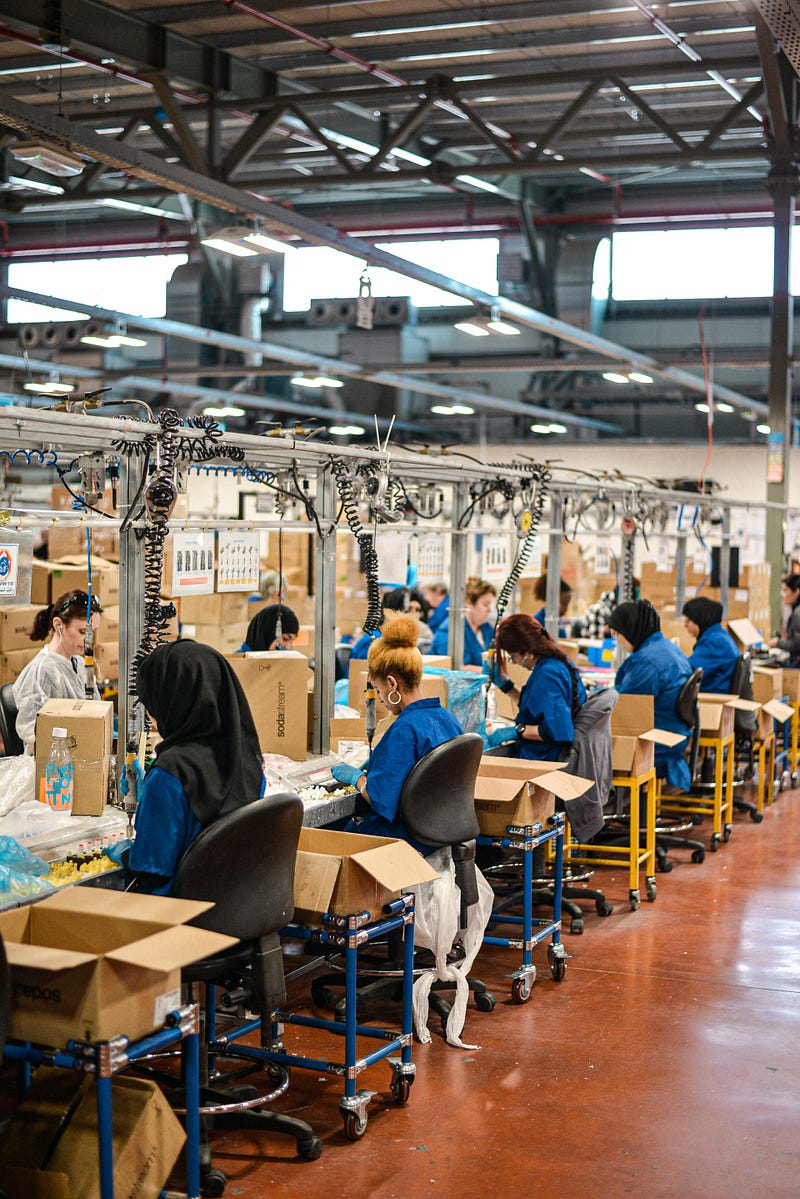
Jennifer leads me from our office, left along the corridor, and out into a cleanroom preparation area. Here we put on special overcoats, plastic caps, and latex gloves, in order to pass into the cleanroom. Once ready, Jennifer opens the door into the production line area and escorts me onto the factory floor. Several small bottles pass through machines, being filled with remedies, and having their tops screwed on. Workers perform manual checks as they pass along conveyor belts to be properly sealed.
‘Forest produces about fifty different varieties of herbal remedy,’ Jennifer explains. ‘They’re subdivided into various pseudo-spiritual categories like Finding the Best Joyful Version of the Inner You or Facing Your Fears with Your Personal Inward Truth.’
I detect cautious cynicism. She’s testing the waters to see how I’ll react.
‘I get to write about their supposed health benefits,’ Jennifer continues, ‘or come up with advertising campaigns, blogs, press releases for new lines, and so on.’
‘You mean we both get to write about them.’
‘Yeah, of course… Sorry, wasn’t sure how hands-on you’d be. My last boss approached the job more as an oversight role. Making sure I did the job properly.’
‘Well, I can assure you, I don’t consider myself qualified to manage a department unless I am able to do every job in it myself. Of course, I don’t necessarily expect to be the best at any given task. I daresay you’re much better than I am as a writer. But I still need to know I can do whatever tasks I’m paid to oversee. So you can expect me to roll my sleeves up and dive in.’
I wonder if I’m coming off as pompous to Jennifer. She fixes me with a dubious stare as if she doesn’t quite believe me.
‘Yeah, well… That’s great, thanks.’
After showing me around the factory floor, and the laboratories on the floor above, we return to the cleanroom, take off our caps, gloves, and jackets, and head back along the corridor. We pass reception, meander through a few more winding corridors, and end up in the warehouse.
Several employees assemble cardboard boxes filled with smaller boxes of remedies, putting them together in packing areas working from printed orders. Jennifer leads me through an opening on the right that leads to another warehouse area, one with a mezzanine floor, where the remedies are kept in stock.
‘Inventory from the factory floor is stored here,’ Jennifer says. ‘It is carefully rotated by the guys in the warehouse, who take what they need based on orders.’
I glance around, noting a couple of employees with clipboards on the mezzanine floor. My eyes follow them as they wander to the left, and I notice another door, leading to a further section of the warehouse where the lights are off.
‘What’s in there?’ I ask.
‘Oh… Just overflow stock. If we produce too much of a particular line, and our order projections are off, we use that place to keep the extra.’
‘Should I go and take a look round?’
‘There’s no need. No one really goes in there much, to be honest.’
‘Why not?’
‘I just told you why not.’
From the look in her eyes, I can tell there’s another reason. Mildly intrigued, I decide not to push it for now.
I watch a few of the warehouse staff larking about, flicking elastic bands at one another. One is caught in a triangulated crossfire, beautifully orchestrated, with two elastic band snipers lurking above on the mezzanine floor, and two more on the ground floor. Jennifer stifles a laugh, looking at me to see how I react.
‘Bruce won’t be happy if he catches them pissing about like that,’ she says. ‘He’s the warehouse supervisor, just over there.’
Jennifer points to an office just off the warehouse, with a panoramic glass window. A stocky, bald man sits behind a desk at a computer, glancing up every so often to keep half an eye on his staff. However, those flicking elastic bands are just out of his eye-line.
‘He won’t catch them,’ I say. ‘They’re out of his field of vision. Very clever.’
Jennifer lets out another nervous laugh, as though unsure whether I find the elastic band fight funny. I try to put her at ease.
‘That was a fantastic shot when they got that guy in the crossfire,’ I say.
Jennifer nods. ‘There’s one more place you should see.’

We run the gauntlet through the elastic band shoot-out zone, and out of the warehouse through a door on the right-hand side, beneath the mezzanine floor. We pass into another, emptier storage area containing pallets, boxes, and shelves. At the centre of this storage area is a pentagon-shaped structure with no windows. The pitched roof isn’t particularly high, but it ascends at a steep angle, so it would be difficult to climb. Indicating this bizarre structure — a small building within a building — Jennifer rolls her eyes.
‘One of Hayden’s pet projects,’ she says. ‘A sound-proof meditation pod. He calls it the temple.’
‘A meditation pod?’
Jennifer nods. ‘Want to see inside? It isn’t normally locked.’
She tries the wooden door, which opens. On the other side is a five-sided room, with candles, cushions, New Age artwork, and a lingering aroma of burnt incense. A few minimal runes decorate the magnolia walls.
‘Those are Wiccan,’ Jennifer explains. ‘I looked them up.’
‘Is Hayden into all this stuff?’ I ask.
‘Not really. This is mostly for investors, so they think we’re really authentic, and for our website. This place looks good in advertisements. We’ve done a few photoshoots in here with models we dress to look like they’re doing yoga, or like green witches casting woodland spells. All very trendy and eco-friendly. Gaia. Mother-Earth stuff. You get the idea.’
‘All good fun, until the evangelical Christians try and boycott you for practicing witchcraft.’
‘True, but we don’t do that much business in the Bible belt. Most of our product is sold here and in Europe. If we did, we’d change our marketing strategy.’
‘All very interesting,’ I say.
‘May I ask, what did you do before you got this job?’
‘I worked at a publisher for about twenty-five years, Haines & Bancroft, before they were bought in a hostile takeover. The new American owners restructured rather aggressively, and I was made redundant.’
‘I’m sorry. What did you do?’
‘My department decided which manuscripts to recommend for publication.’
‘Sounds fun.’
‘It was.’
Jennifer looks as though she is about to say something else, but instead tells me the tour is over and escorts me from the premises. I thank her, say goodbye, and tell her I look forward to seeing her tomorrow.
That evening at dinner, I explain to Grace, Michael, and Lee how I was offered the job on the spot, about Jennifer, and the tour of Forest’s offices and warehouse. When I explain about the temple, Michael’s eyes light up, and his imagination goes into overdrive.
‘I bet they make human sacrifices in there, late at night,’ Michael says.
I laugh. ‘Hardly. From what I understand, they just built the place for PR. To tie in the whole herbal remedy thing with something that looks mystical.’
‘I’m telling you Dad, they use the blood of the people they sacrifice in their herbal remedies, to control people’s minds.’
Grace grimaces. ‘Michael, we’re eating! And you’re scaring Lee.’
‘No, he isn’t,’ Lee protests. ‘Maybe that’s why the temple is sound-proof?’
‘I’m more interested in Jennifer herself,’ Grace says. ‘Why didn’t she want to go into the dark part of the warehouse?’
‘That’s where they keep the human sacrifice equipment,’ Michael says. ‘Ropes, daggers…’
‘And mops and buckets for cleaning up the blood,’ Lee adds.
Grace ignores the children’s gruesome remarks. ‘I wonder what Jennifer’s old boss was like?’
‘She seemed keen to get off the subject when I asked what happened to him. I wonder if she’s sad he’s gone?’
‘Perhaps the opposite,’ Grace says.
The following morning I arrive a full ten minutes early. I wait in the reception area, chatting to Sally, who is also in early. She is kind and welcoming, asks about my previous job, and tells me she is pleased I managed to find work again, after being made redundant.
Jennifer arrives five minutes late, looking breathless and distracted. She apologises and leads me to the office, where I begin to set up my things. I tell her not to worry, but she insists on recounting the full story of how her bus got caught in traffic, and how new roadworks have snarled up the route. Thinking it best for her to get this out of her system, I let her finish before speaking.
‘Jennifer, I need you to understand something from the outset, if we’re going to work together. I really couldn’t care less how late you are, if you take long lunches, or if you leave early.’
Jennifer frowns.
‘As long as you do your job brilliantly, you can have all the flexibility you want. This isn’t a shop job, where you need to be here for customers.’
‘I suppose not,’ Jennifer says. ‘Sorry, it’s just I’m not used to this. Richard, my previous boss, he was very strict on timekeeping.’
‘Well, I’m not, so you don’t need to apologise or explain to me, OK?’
Jennifer smiles but still eyes me dubiously, as though I might be lulling her into a false sense of security. Sounds like her previous boss was a bit inflexible. I try to put her at ease with a joke.
‘Am I going to be endlessly compared to Richard? Like in Rebecca?’
Jennifer laughs. ‘That’s one of my favourite books.’
‘Fond of gothic mystery?’
‘More fond of horror, to be honest.’
I grimace. ‘Don’t much care for it, personally. I get scared too easily. We didn’t publish horror, back at Haines & Bancroft.’
I decide not to reminisce any further. Instead, I turn to professional matters.
‘Can you tell me about our current work pile?’
Jennifer is about to answer, but Martha Long from HR enters our office, informing me I need to go through an induction and health and safety training. This tedious process ends up taking much of the morning. I really cannot understand why it is necessary to read through pages and pages of obvious safety instructions. Anyone who by my age doesn’t know sticking your fingers into an electrical socket isn’t a good idea, doesn’t deserve to have lived that long.
Still, to be fair, other bits of the health and safety training would be important if I were working on the factory floor. It isn’t all mindless bureaucracy, and I know health and safety legislation has saved lives over the years. We’ve certainly come a long way since the Industrial Revolution, and being a little bored for a few hours is a small price to pay in comparison with the horrifying alternative.
I catch up with Jennifer just before lunch and run through some of the projects currently on her desk. Various new lines are about to launch, and require text for labels, blog posts, press releases, and website copy, so it’s quite a busy time. No wonder they wanted to hire someone quickly.

I’m thrown in at the deep end that afternoon, as there are various social media posts to be written with which I don’t have the greatest experience. Jennifer is immensely helpful and makes good suggestions regarding keywords and phrases for search engine optimisation. All of this stuff wasn’t something I dealt with in my previous job. The marketing department was responsible for such things. I did write a lot of blog posts for the website, but these were mostly on writing technique, and advice for budding authors.
By the end of the day, I can’t understand why they didn’t simply give my job to Jennifer. She is more than qualified. She could have hired and trained her own assistant. There is little if anything I can teach her about this job.
Perhaps that’s why her previous manager merely presided in a largely pointless and overpaid role. Perhaps being an arsehole about timekeeping made him feel useful. I know his type. I’ve worked with a few myself; the kind that elevates passive-aggression into an art form with comments like “Part-Timer” when someone leaves work on time. These remarks can always be defended as jokes, so people never make a fuss about them. But they are corrosive and demoralising. Who-can-work-more-overtime machismo culture always pisses me off. Eager participants in this absurd contest demonstrate their “commitment” with simple tricks like deliberately sending work emails late at night, whilst ignoring the families they claim to be working so hard to support. They are idiots because no one ever lay on their death bed wishing they’d spent more time at work.
The next two weeks pass in a blur of hectic work. Jennifer continues to be an excellent colleague, and I spend surprisingly little time with my immediate boss, Hayden White. That is, aside from the interminable weekly management meetings: A tidal wave of irrelevancy over a ludicrously protracted period. Despite this, Hayden doesn’t seem to be the micro-managing type, which is all to the good. I’m too snowed under with work to send productivity reports every ten minutes.
There was a board meeting a couple of days ago. I was called in for a brief moment and asked to introduce myself. Those present included the green-eyed, red-haired young woman, and the pale, dark-haired young man who sat in on my interview. Regarding the latter, Jennifer tells me his name is Tyrone Paste; an apt surname given his complexion. She also tells me to try and have nothing to do with him, but wouldn’t say why.
One morning, I arrive a little late. Jennifer is already here, as her leather jacket is on her chair, but she isn’t in the room. Assuming she must have gone to get a cup of tea, I check my inbox. An email from Hayden is marked urgent. I open it to find the label for one of the new valerian lines in the samples he was sent yesterday contains text from an older elderberry-based remedy. About two hundred bottles have already had the incorrect label applied in the factory.
After replying to tell Hayden I will fix the error immediately, I pick up the phone and call the factory floor, instructing them to stop production until they get the revised label. It turns out Jennifer has already spotted and fixed this. The corrected label is now being printed and used. I also send an email to the warehouse, asking them to return the bottles with the erroneous labels to the factory, where they can be steamed off and the correct labels applied.
Thinking it would be wise to follow up my email with a call to Bruce, I give him a call on his extension. No answer. He isn’t answering his mobile either. I decide to pay him a visit.
Whilst crossing the warehouse, I overhear a conversation taking place out of sight, behind a pile of boxes, between Jennifer, Bruce, and one of the warehouse temps; a young man called Jack.
‘…isn’t any excuse for this,’ Bruce says. ‘You’ve wasted everyone’s time with this mistake, and I expect your boss will have something to say about it.’
‘And now I’ve got to start again on all these orders,’ Jack says.
‘I said I was sorry,’ Jennifer replies. ‘The factory already has the new label. We just need to make sure none of these get shipped out by mistake.’
I stride around the corner, and Jennifer and the others come into view. Bruce continues to tell off Jennifer, indicating a nearby pile of boxes.
‘Time wasted. Orders delayed. Unhappy clients. And who gets it in the neck?’
‘I do,’ I say. ‘The label mistake was my fault.’
Jennifer and the others turn to me.
‘Your fault?’ Bruce says.
‘My fault. Hayden’s already spoken to me about this, so if you want to blame someone, blame me.’
Bruce looks confused. ‘But you didn’t… Jennifer said…’
‘Jennifer is mistaken. She thinks the error was hers, but it was mine.’
‘Well…’ Bruce looks as though he’s had the wind taken out of his sails. ‘I’ve just been saying, it means a lot of work unpacking and repacking these orders correctly. Plus we’ve got to take the bottles with the wrong label back to the factory.’
‘I know what’s involved. I apologise. Now blame has been correctly assigned to me, perhaps it is best if we all get back to work and correct his error as swiftly as possible. That’s what I’ve assured Hayden we will do.’
Jack grunts and mutters something I don’t quite hear, other than the word black. Jennifer’s expression is one of outrage.
‘What did you just say?’ she exclaims.
‘Nothing,’ Jack mutters.
‘That’s not true. You just called me a stupid black bimbo. I heard you, clear as a bell.’
‘I didn’t say that,’ said Jack.
‘I heard you too,’ I say.
Bruce looks from Jennifer to me, to Jack, and back to me again. He rolls his eyes and addresses Jack in exasperated tones.
‘Jack, you can’t say things like that. Now get on with unpacking those orders.’
Jennifer’s expression of rage becomes tearful. Before I can say anything else, she rushes off across the warehouse, suppressing a sob. Seeing red, I turn to Bruce.
‘I want to speak to you in your office.’
‘Dennis, this is hardly the time. We’re very busy, and…’
‘Now Bruce.’
Seeing I mean business, he nods. We cross the warehouse to his little office with its large glass window, enter, and close the door.
‘I want that temp fired,’ I say.
‘Dennis, for God’s sake…’
‘Fired. No discussion. I will not tolerate my staff being racially abused. Also, for the record, I will not tolerate my staff being given a dressing down by other managers, especially publicly, and especially in front of temporary staff. Do I make myself clear?’
‘Oh come on! We both know that cock-up with the label was really her fault. She’s useless at her job. Turns up late all the time too, Richard said.’
‘I don’t care what Richard said. The labelling error was my fault, and I want Jack fired. You can get another temp easily enough, and it isn’t as though we are ruining Jack’s career. But make sure you tell him why he is being fired, and perhaps he’ll learn an important lesson.’
‘What are you, some kind of bloody activist? How dare you tell me what to do with my staff!’
‘If you don’t fire him, I will go to Martha, and make an HR issue out of this. What Jack just said was racist abuse. We all heard it.’
‘I didn’t.’
‘Probably because you didn’t want to hear.’
‘Look, I’ll have a word with Jack and make sure it doesn’t happen again. The kid was just letting off steam.’
I shake my head. ‘I want him fired. No compromises.’
‘Dammit Dennis, how long have you been here? Do you really want to start making enemies?’
‘Jennifer deserves to be treated with respect and courtesy, the same as anyone else. The law rightly protects her from racist bullying. I want Jack out of this building within the next half hour, or I go to HR.’
Bruce shakes his head. ‘You’ve barely been here two weeks. You’re still on probation. You don’t tell me what to do with my staff.’
I’m about to reply when I hear the door open. Tyrone Paste enters, an unconvincing expression of concern on his face. After closing the door he addresses us both.
‘I happened to be passing and glanced in here. Judging by the body language, this is a disagreement.’
‘It’s between the two of us,’ I say, unhappy about a board member sticking his nose in.
‘He wants me to fire one of my temps for making a stupid comment about Jennifer that could be viewed as racist,’ Bruce says.
‘It was racist,’ I say. ‘He called her a stupid black bimbo.’
Tyrone considers for a moment, then nods. ‘I have to agree with Dennis. Regardless of the circumstances, that kind of remark can’t be tolerated. I think you know the right thing to do Bruce.’
Bruce glares at me, fuming. But before he can respond, Tyrone speaks again.
‘Dennis, might I have a word in private?’
Tyrone indicates the door. We leave an apoplectic Bruce and walk to a quiet corner of the warehouse.
‘Thank you for backing me up,’ I say.
Tyrone nods. ‘Let’s just say, your predecessor and I used to have an understanding, and I want to honour that arrangement by continuing it with his successor. We’d help one another out, from time to time. Since I’ve done something for you, perhaps you can do something for me?’
‘What is it?’
‘I understand you have a photoshoot soon, in the temple?’
‘Yes. Jennifer thinks it would be a good idea, for some of the new lines.’
‘I’d like to be present during the shoot, to give my input.’
I’m not sure I like this idea.
‘I’m a bit of an amateur photographer and would like to maybe pick up a few tips. You won’t notice me. I’ll just blend into the background. Alright? Thanks, Dennis.’
Without waiting for an agreement, Tyrone strides off. I stand there with a mixture of bemusement and irritation. Clearly, Tyrone isn’t interested in doing the right thing as far as firing Jack is concerned. Why does he want to be present during the photoshoot?

Sensing the curious glare from other warehouse workers, who doubtless saw our heated gesticulations through the glass wall, I return to my office. Jennifer isn’t there, which is understandable. I suspect she might be talking with Sally at reception. I’m still seething at Jennifer’s mistreatment, but try to push it out of my mind as a two-word email pings into my inbox from Bruce.
It’s done.
I sigh and continue with my work. Twenty minutes later Jennifer returns to her desk. She smiles at me but says nothing. I’m pleased. Verbal gratitude shouldn’t be necessary for what ought to be the bare minimum in a courteous working environment.
After resolving the incorrect labelling, we spend some time researching models to decide which to select for our photoshoot in the temple. I ask why we aren’t using any male models. Jennifer informs me that herbal remedies are mostly marketed to women and that the board doesn’t want male models used in our advertising. However, when I mention Tyrone Paste will be coming to pick up photography tips, Jennifer frowns.
‘Why did you agree to that?’
‘I didn’t. He just invited himself.’
Jennifer rolls her eyes. ‘Yeah, he does that kind of thing. Likes to remind people of his power. He often harasses Sally. Gets a bit handsy.’
‘Why does Hayden put up with it?’
‘Tyrone’s father is a significant investor, and told Hayden to appoint him to the board.’
‘I see. Well, perhaps he won’t be a problem during the shoot.’
Jennifer shook her head. ‘Trust me. He’ll be a problem.’
As we continue looking at models, and laughing at some of the more absurd names in the Forest line of herbal remedies (Nipplewort, Shagbark, and Sticky Willy have us in juvenile guffaws), Jennifer asks an unexpected question.
‘How did you know if a book would sell?’
‘In my last job? The truth is, I didn’t know for certain. But I could tell if a book was well-written and engaging.’
‘I see. I ask because I’ve written a novel.’
I’m surprised. ‘A novel?’
‘Don’t laugh! Everyone laughs when I say that.’
‘I’m not laughing. What’s it about?’
‘It’s a horror story.’
‘I see. Not really my thing.’
‘But if you were to read it, would you be able to tell me if it was well-written and engaging?’
I sigh, wondering how to respond. This is a question I’ve often been asked over the years. People want me to look at their literary pet projects, hoping they’ll become bestsellers. I’ve always politely declined, saying I’m too busy. It’s so much easier than telling them the truth. But looking into Jennifer’s eyes, I sense she is sincere, and that sugar-coating the facts would be a mistake.
‘If I read your novel, I will almost certainly eviscerate it. The reason I will do this is because you deserve to know just how bloody difficult it is to find a publisher that will take it. Agents and publishers see thousands of manuscripts, and most of them range from mediocre to utter rubbish. The tiny percentage that shows promise are mostly disregarded for other reasons: Too similar to previously published works, another book in the same genre on the list for that year, not wanting to take a risk on an unknown… The list goes on and on. Only a tiny fraction of the good stuff ever sees the light of day.’
‘Then how come there’s so much mediocre crap out there?’ Jennifer asks.
‘Because it sells, and was probably written by a celebrity, or by an established author. Sometimes who you know is a factor as well.’
‘Yeah, it’s good when someone has your back,’ Jennifer says.
I sense a compliment but refuse to dwell on it.
‘Look, Jennifer, there’s no point reading your novel if you just want me to tell you how brilliant it is.’
‘I don’t. I want constructive, critical feedback, so I can send it to publishers. I know it would be a massive favour.’
‘I’m not sure how quickly I could get to it.’
‘Doesn’t matter. Even just feedback on the first couple of chapters would be great. That’s what agencies ask for, so I don’t see why you would need to read the whole thing if you think the first bit is crap.’
I sigh. ‘Very well. Send it to my home email. I’ll give you the address. Just don’t say I didn’t warn you because I will be merciless.’
Jennifer beams.

A month passes. Although Bruce remains cool with me, there is no more unpleasantness regarding Jennifer, whose work is as excellent as ever. Not just at Forest either, but also her manuscript. Although I find it blood-curdling, and can’t read it before bed without the risk of nightmares, it proves surprisingly gripping. Needs a polish of course. I give Jennifer an in-depth developmental edit and tell her to cut down on adverbs, but her novel is a diamond in the rough. Has she got a hope in hell of placing it? Probably not, but there’s a small chance, which is more than I expected.
I admit it feels good again, working with an author on a novel. I always enjoyed the process, and have missed it. By contrast, work at Forest is dull, but I’m not complaining as it pays the bills.
Jennifer is more relaxed around me. She opens up a little, telling me about her family and her boyfriend Shaun, who works as a nurse. They hope to get married in about a year, although Shaun has yet to pop the question.
I’ve noticed on more than one occasion members of the warehouse staff dislike going into the dark area to the left of the mezzanine if they can help it. Jennifer is equally reluctant, so one afternoon, I decide to question her about it.
‘You’re right,’ Jennifer says. ‘No-one here likes to go in there, because that’s where she was found.’
‘Where who was found?’
‘Sarah Lucas. She used to work upstairs, in the lab. We were friends. But she committed suicide.’
‘I’m sorry.’
‘She didn’t seem depressed. It was so peculiar. Then again, people often say suicidal people can be really good at hiding their feelings. I was just surprised she decided to commit suicide at work.’
‘Perhaps she didn’t want her family to deal with the trauma of finding her body,’ I suggest.
‘Whereas she was quite happy to traumatise work colleagues? No, I don’t buy it. Besides, that indicates a clear thought process. I don’t think suicidal people generally think through such things.’
‘How did she die, if you don’t mind my asking?’
Jennifer clears her throat. ‘She was found hanging from one of the steel beams. She’d made a noose, climbed a stepladder, then kicked it away. Horrible way to go. The smell was vile. Underneath her, there was a puddle of… Well, you know what happens to a person’s bowels when they’re hanged.’
‘Wait… You found her?’
‘Yes. That was a fun day, I can tell you. If the shock of finding her there wasn’t enough, I also had to deal with the police.’
‘I’m sorry.’
‘Hayden was kind about the whole thing, and gave me some paid time off, but Richard Stern was typically miserly about it. Didn’t even try to hide his irritation at having to do my work whilst I was away and gave me a hard time about it for weeks afterwards.’
‘Your old boss was called Richard Stern? What is it about this place and apt names?’

Jennifer laughs. ‘Richard was a bastard. Would throw me under the bus if anything went wrong, and take credit for anything I did right. I couldn’t stand being around him all day, so I’d often sneak up to the labs to chat with Sarah. But he’d follow me up there, and stand in the doorway, huffing and puffing, shooting me dark looks.’
‘Oh, good grief…’
‘Couldn’t take the slightest criticism either. He thought he had a monopoly on excellence, but I refused to be a sycophant. When he was wrong, or I had a better idea, I tried to tell him. But he didn’t want to hear.’ She sighs. ‘Perhaps I shouldn’t slag him off all the time.’
‘It’s the right of employees to hate their bosses. You shouldn’t feel bad about it. Slag me off if you like, but have the decency to do it behind my back. I expect craven sycophancy to my face.’
Jennifer smiles. ‘Guess I’d better brush up on my craven sycophancy.’
‘It might serve you well, one day if you have to sit in on the management meetings I have to endure.’
‘My heart bleeds for you.’
We both laugh.
‘You know, one of the temps said he’d heard noises in that part of the warehouse, and wouldn’t go in,’ Jennifer says. ‘Claimed it was haunted after Sarah was found. Bruce went in there to prove him wrong, but he got freaked out because there were eerie noises. Thumping sounds, wails, that kind of thing. It turned out one of the temps heard Bruce was superstitious and planted an iPod speaker on the shelves in there that was set up to play ghostly noises. Bruce went ape-shit when he found out.’
I chuckle. ‘Elastic bands, ghost pranks… That lot certainly enjoy larking around.’
‘I suppose it passes the time in a pretty boring job. Besides, Sarah loved a prank. She would have found that hilarious. If she did come back from the dead, I wouldn’t put it past her haunting that warehouse to freak out Bruce.’
‘What about you? Are you superstitious?’
Jennifer thinks for a moment. ‘I’m open-minded, and I’ll be honest: Since Sarah died, I’ve felt the hairs on the back of my neck a few times in this place. What about you? Do you believe in ghosts?’
I laugh. ‘Hell, no.’
‘Well, I’ll tell you who is: Hayden White. He’s had a few interesting customers come and visit that part of the warehouse. Exorcists, Paranormal investigators, New Age gurus… All sorts. They’ve tried to get rid of the bad aura they reckon lingers in there. I’ve sensed it too.’
I sigh. ‘Look, Jennifer, just because you happen to write scary ghost stories doesn’t mean you’re living in one.’
Jennifer fixes me with an odd stare. ‘It’s funny. I think in the West we’ve become far too closed-minded. The Enlightenment did a number on us. Made us stop believing in the spirit world.’
‘Oh, come on…’
‘My grandparents, they think very differently. But they lived in Uganda before they came here. Trust me, in Africa, the spirit world is as real as your local post office.’
‘Actually, my local post office always seems to be shut, so I’m not sure it is real.’
‘I can see you’re a hopeless case.’
‘There’s only one hopeless case in here that I can see.’
Jennifer laughs.

A week later, Jennifer and I supervise the photoshoot in the temple, with three young models dressed in a variety of expensive designer clothes, and a freelance photographer, Max. The models we’ve chosen, Stacey, Valerie, and Harriet, aren’t horribly emaciated like some of their ilk. We shoot them in New Age-y meditative poses, next to candles, runes, sticks of incense, and so forth. The final advertising images will feature pack shots of the various new bottles next to the models.
Tyrone Paste is present throughout the shoot. He stands at the back of the temple, observing in silence. I suspect it’s too much to hope that he might remain quiet. Sure enough, at the end of the shoot, he addresses me.
‘I want that girl. The black one.’
He points to Stacey, who looks a little surprised.
‘You want to shoot more photographs with her?’ I ask.
‘Yes. The other two can go, but I’ve ideas for this one.’
‘This one has a name,’ Jennifer pipes up. ‘Stacey, are you alright shooting a few more photos?’
Stacey nods.
I turn to Harriet and Valerie. ‘Thank you both for your time.’
They gather their belongings, and Jennifer sees them out. Tyrone stares at Stacey, appraising her in a way that causes me some discomfort. According to her portfolio profile, she has only just turned eighteen.
‘Stacey, how do you feel about a nude shoot?’ Tyrone asks.
‘No,’ I say, unable to believe my ears. ‘Don’t worry Stacey, he’s just kidding.’
Tyrone shakes his head. ‘I’m not kidding Stacey. Your beauty staggers me.’
Stacey’s eyes widen. ‘Er… I don’t think…’
‘We’ll pay you a large four-figure bonus.’
‘No,’ I repeat. ‘Tyrone, this is my shoot. We’re done.’
‘No, we aren’t,’ Tyrone says.
Max glances at his watch. ‘Look I’m sorry, I’ve another appointment I need to get to this afternoon, and I can’t do…’
‘It doesn’t matter,’ Tyrone interrupts. ‘I’ve been watching long enough to get the hang of what you do.’
Max lets out a derisive snort. ‘You’ve learned to be a professional photographer by viewing one shoot?’
‘It’s really not that difficult. In any case, the camera on my phone is just as good as your fancy set-up with all its lenses. If you’ve got to leave it doesn’t matter. I was hoping to direct this part of the shoot myself in any case.’
Stacey looks uncomfortable. I sense she wants to say no but worries Tyrone might be powerful enough to cause trouble for her career.
I’m shutting this down.
‘We’ve got the shots we need. We’re done.’
Tyrone ignores me. ‘Stacey, what we really need for this campaign is something a little bold. It will be tasteful. Arty. But we need something striking. What do you say? This will be a huge boost to your career. Once you’re on billboards, you could be the next Naomi Campbell.’
Tyrone has a dangerous hunger in his eyes.
‘Tyrone, can I speak to you outside?’
‘No Dennis. You can speak to me in here.’
‘What’s going on?’ Jennifer asks, having just returned from seeing Valerie and Harriet out of the building.
‘Tyrone wants to shoot Stacey nude,’ I say.
Jennifer frowns. ‘What?’
‘I wish to be left alone with Stacey, so we can get this done professionally. She doesn’t need you all staring at her. This will be a closed set.’
Tyrone fixes me with a dangerous stare. Now I understand. He thinks he did me a favour when he insisted Bruce fire that temp. In his mind, I owe him by letting him direct his own private nude photoshoot, in a soundproof room with no windows.
‘I’m going to say this one last time: The photoshoot is over. Stacey, thank you for your time. Jennifer, please help Stacey gather her things, and escort her from the premises. Tyrone, please go back to the boardroom where you belong.’
Jennifer nods and does as I ask. Once Stacey has left, Tyrone scoffs.
‘I thought you were smarter than this Dennis.’
Tyrone strides out of the temple. Max rolls his eyes, unmoved by the drama. It depresses me to think he’s probably encountered this kind of nonsense far too often, not to mention Tyrone’s casual contempt for his professionalism.
‘I do apologise Max.’
‘No worries mate. Sorry you had to let that prick sit in.’
Jennifer and I help Max pack his gear and see him out. Once we’re back at our desks, I can’t escape a sinking feeling. I wonder if I’ve just made a dangerous enemy.
Presently I become aware of Jennifer staring at me, an inane smile fixed on her face.
‘What’s so funny?’ I ask.
‘Go back to the boardroom where you belong? Is that the best one-liner you could come up with?’
I burst out laughing.

Later that day, as I’m about to leave work, I remember I’ve left a coffee mug on the warehouse floor when I went to speak to Bruce earlier. He very particular about the warehouse being tidied at the end of the day, so I go to retrieve the mug. Most people have gone, and the warehouse is quiet. Some of the lights have already been switched off.
I enter the area beneath the mezzanine floor and find my mug where I left it, on one of the benches. Catching movement out of the corner of my eye, I turn right to see the red-haired young woman from the Forest board, who sat in on my interview. She stands near the entrance to the dark area where Sarah Lucas committed suicide. She nods at me, then heads through into the doorway into the blackness beyond.
There’s something a little eerie about the way that woman disappears into the shadows, and I’m seized by an inexplicable premonition of trouble. I send Jennifer a text message, asking her to meet me in the warehouse if she’s still in the building, whilst keeping an eye on the dark entrance where the red-haired woman disappeared. A moment later, Jennifer turns up. She adopts a puzzled expression as I put a finger to my lips.
‘What’s going on?’ she whispers.
‘A woman who sat in on my interview, a board member,’ I whisper back. ‘She was here a moment ago, lurking around. She went in there.’
I indicate the dark entrance. Jennifer shrugs.
‘You dragged me here for that? I was about to go home.’
‘Aren’t you curious? A board member poking around our warehouse unaccompanied goes into the area everyone says is haunted without turning the lights on?’
Jennifer shrugs. ‘Are you a detective all of a sudden?’
‘No, but…’
‘This is a trick, isn’t it? You’re pretending to be scared to go in there, so I’ll accompany you, and at the same time experience catharsis by confronting the trauma of finding Sarah hanging herself.’
‘Are you coming with me or not?’
‘Alright. What the hell? But we can’t turn the lights on, or she’ll know she’s being followed.’
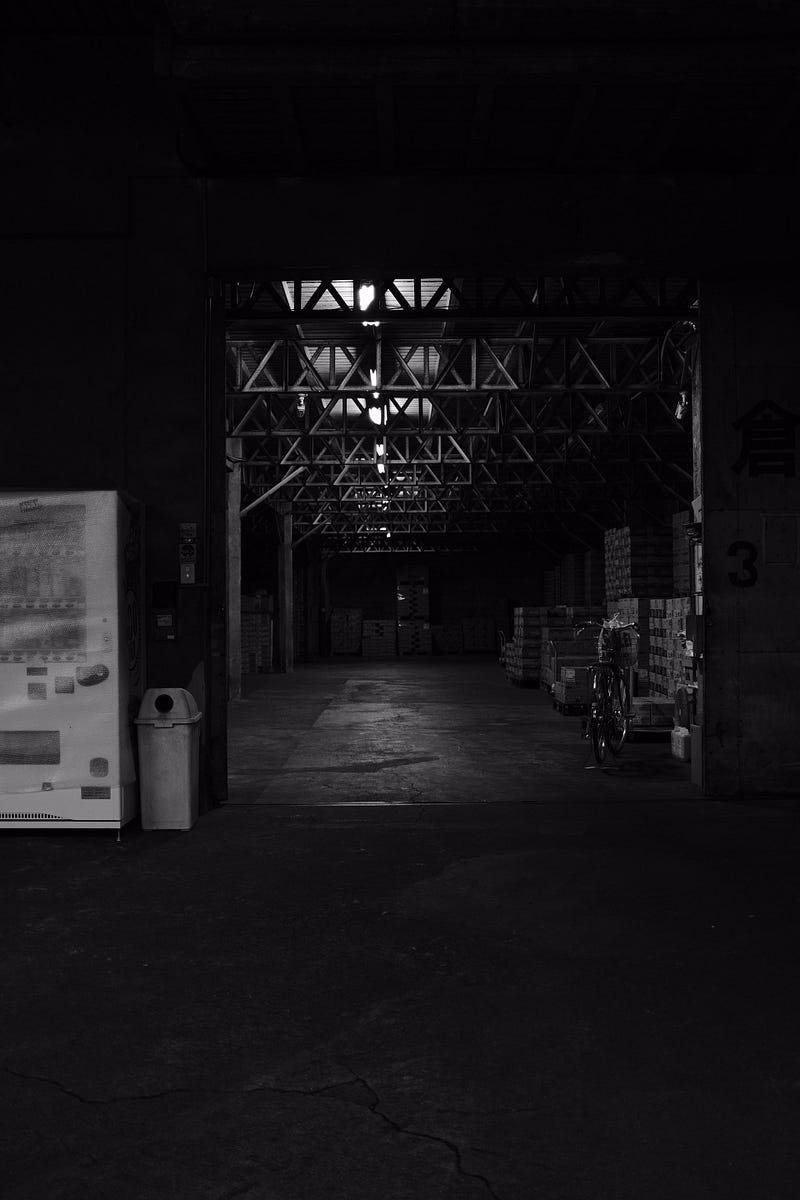
We proceed through the entrance, and into the dark area beyond. The glow from the rest of the warehouse provides a little light, so we can make out rows of shelves, most of which contain piles of new, flattened boxes, piles of pallets, and miscellaneous containers of laboratory equipment.
Not wanting to linger in the doorway, lest our silhouettes are seen, we duck to our right, following the wall, until we reach the corner. It’s much colder in this part of the warehouse, and I suppress a shiver. As we pass each aisle between shelves, I peer into the gloom, but the red-haired woman is nowhere to be seen. She could be further in, out of sight.
‘This is ridiculous,’ Jennifer whispers under her breath.
Despite creeping through the warehouse, it is impossible to entirely muffle the echo of our footsteps. I peek up at the shelves and into the steel rafters, wondering from which beam Sarah Lucas decided to hang himself. Returning my gaze to what lies ahead, we eventually reach the far-right hand corner. Still no sign of the red-haired woman. We follow the wall to the far left-hand corner, taking care to look back along each aisle. Searching is far easier from this side of the room, as the light from the rest of the warehouse will illuminate any human figure lingering between shelves. But we see no one. I’m confused.
‘Is there another way out of here?’ I whisper to Jennifer.
‘No. Are you sure she didn’t slip past us as we searched the other side of the room?’
‘It’s possible I suppose. But I reckon we’d have heard her footsteps.’
‘She probably heard ours. Perhaps she’s hiding on one of the shelves, or underneath…’
Jennifer stops speaking as faint footsteps echo from the other part of the warehouse. They get louder, and a few seconds later Hayden White walks into view, alongside Martha Long from HR. They enter the dark room but don’t turn on the light. After striding some distance along one of the aisles, Hayden and Martha halt and begin a whispered conversation. What are they doing? Are they here to meet the red-haired woman?
I indicate to Jennifer that we should sneak nearer to listen. Jennifer shakes her head and mouths: What are you doing?
I creep forward, placing one foot in front of the other with immense caution until I stand hidden behind a pile of pallets, near enough to catch what they are saying. On instinct, I take out my phone and record the conversation, immensely thankful that they didn’t switch on the lights.
‘…not moving as much money as I’d like,’ Hayden says.
‘We still need to be cautious,’ Martha replies. ‘The police were all over this place after Sarah Lucas was killed. Have you any idea how hard it was to make it look like suicide?’
My stomach twists in knots. My immediate instinct is to grab Jennifer and make a run for it. Hayden and Martha have just admitted a murder conspiracy, and I have the audio of their conversation. My heart pounds, and my mind can’t accept what I’ve just heard. This is the kind of thing that only happens in thrillers. Perhaps I misunderstood what they were saying? Perhaps their words were out of context?
‘It was Sarah’s own fault for getting nosy,’ Hayden says. ‘She was the one who decided to hack my computer. But the inquest is over, and the police were satisfied. I want business ramped up again.’
‘Tyrone is getting suspicious,’ Martha says. ‘Why do you think he keeps lurking around here?’
‘To be pervy around the female staff, and if the rumours I hear are correct, to try and get some alone time with pliant, easily intimidated models during photoshoots.’
‘That may be true, but he’s also no fool. He knows something extracurricular is going on in Forest. If he begins to suspect we’re using the company to launder money…’
‘For God’s sake Martha, what are you driving at?’
‘We need to take care of Tyrone.’
‘Are you insane? We can’t stage another suicide.’
‘I’m not suggesting we do. There are people on the outside we could hire.’
‘Leaving ourselves open to blackmail, or worse? No thanks.’
‘Don’t you have the stomach for this?’
‘I just don’t want anyone else involved.’
‘Hayden, listen to me. Tyrone keeps asking difficult questions. He’s connecting the dots. Sooner or later, he will put it together, and it will lead back to us. What will you do then?’
‘I don’t know… Perhaps I’ll bring him in on it. I’ve got enough dirt on his sexual misdeeds to help him see sense.’
‘I thought you said you didn’t want anyone else involved? Besides, Tyrone Paste is loaded. He doesn’t need the money the way we do. No, we need to take him out of the equation.’
Martha and Hayden’s voices are now loud enough to carry to where Jennifer stands. Judging by the expression on her face, she is as horrified and scared as I am.
‘Now you listen to me,’ Hayden says. ‘We’re not killing Tyrone Paste. Bloody hell Martha! I run this company for his father. Sarah Lucas was one thing, but this is totally different. If Tyrone becomes a problem, I’ll handle it.’
‘I think you’re making a mistake…’
‘No! Enough. And no more conversations like this on Forest premises. If you want to talk, we arrange to meet me on the outside.’
Hayden strolls out of the warehouse. Martha lingers for a few seconds and follows. Once they re-enter the main part of the warehouse and disappear from sight, Jennifer steals up to me, wide-eyed and incredulous.
‘Did you hear what I just heard?’ she whispers.
‘Yes,’ I whisper back. ‘And so did the woman we followed in here. I reckon she was suspicious of Hayden and Martha and snuck in to overhear their conversation. Time to throw some light on the matter.’
I stride through the aisles to the light switch at the entrance. I flick the switch and turn around. The dark area of the warehouse is illuminated as strip lights flicker on, revealing a still shaking Jennifer. I glance left and right, checking behind boxes, pallets, and shelves. But there is no sign of the red-haired woman. Perhaps she did sneak out whilst we snuck in after her.
‘No sign,’ I say.
‘Never mind the board member. Please tell me we’re going straight to the police.’
I shrug. ‘You’re right.’

We leave the building as quickly and silently as possible, emerging beneath dark skies and spluttering rain. Only once we’re in my VW Golf, out of the industrial estate, and on our way to the police station do we dare to speak.
‘I can’t believe it,’ Jennifer gasps. ‘We were just in real, actual mortal peril.’
‘Hayden White and Martha Long using Forest as a money-laundering operation,’ I mutter. ‘And they killed Sarah Lucas when she found out.’
‘We should contact that board member we followed. Which one was it? There are a few women on the board.’
‘I don’t know her name. She’s got long red hair, green eyes, and was wearing a brown pencil skirt, with a white blouse…’
I stop speaking as I note Jennifer’s expression of gaping incredulity.
‘What on earth’s the matter?’
‘Pull over.’
‘What for?’
‘Just do as I say!’
Astonished at her vehemence, I indicate left and pull up by the kerb. Other cars shoot drive past in the rain, heading into the centre of Abingdon.
Jennifer whips out her phone, presses a few buttons, then rotates the screen in my direction. It shows a selfie photo of Jennifer next to Sally the receptionist, and the red-haired woman.
‘Is that the woman we followed?’
‘Yes.’
Jennifer puts down her phone. Tears well up in her eyes.
‘What is it?’
‘That’s not a board member,’ she says. ‘That’s Sarah Lucas.’

Six months later, I’m on a Zoom call with Jennifer. Her novel has been accepted by a publisher, which I’m thrilled to hear.
‘It’s all thanks to your help,’ Jennifer says. ‘Never would have got the deal otherwise. Of course, the release date has had to be pushed back, thanks to the pandemic.’
‘I still think it’s bloody terrifying,’ I say.
‘The pandemic?’
‘No, your novel. Amazed I managed to read it as many times as did, working on all those edits. I had nightmares, thanks to you.’
‘It wasn’t as scary as what happened in Forest. I still can’t believe it. You saw a ghost.’
‘I still refuse to accept that. There has to be a rational explanation.’
‘Oh, come on! You saw her three times! She appeared in the right place, at the right time, so we’d overhear that conversation, and her killers could be brought to justice.’
‘Perhaps I’d seen a photo of her elsewhere, and the fumes from one of those herbal remedies had an adverse effect on my mind, causing me to hallucinate. Side effects of knobweed perhaps…’
Jennifer laughs. ‘You’re still a hopeless case.’
‘Not as hopeless as Hayden White and Martha Long. They were right about Tyrone being suspicious. Turns out they were rather inept at covering their tracks. One police officer I spoke to said he’d seen better organised money-laundering from his own children.’
‘Yeah, I know, right? I thought they’d turn out to be criminal masterminds, and we’d end up in some witness protection programme or something. Shame that slimy git Tyrone Paste ended up taking over at Forest. He’s a total creep. But he’s a good muse for a horrible character in my next novel.’
‘Are you managing to stay clear of him in Forest?’
Jennifer nods. ‘More or less. He’s not in that much lately. Perhaps he’s found fresh pastures for his sexual harassment power-trip hobbies. I still can’t believe he had the nerve to let you go after your trial period.’
I shrug. ‘At least he replaced me with you, rather than some other washed-up publishing has-been.’
‘Hey! Stop saying such horrible things about my friend Dennis! And stop pretending that you had nothing to do with my promotion. I know you recommended it.’
‘It was Tyrone’s decision.’
‘And you had nothing to do with it? Bollocks.’
‘Yeah, well perhaps you won’t be at Forest long. You deserve much better than a boss like Tyrone Paste. With any luck, you’ll get enough sales to become a full-time author. Don’t expect me to buy any copies though. Your books are too scary for me.’
Jennifer laughs.
‘How’s Shaun?’
‘Oh, he finally popped the question! So we’ll be getting married once we can figure out when. How about your family? How are the children coping?’
‘Oh, fine… Home-schooling is a nuisance though. Grace is on furlough, so has her hands full with that, whilst I try to find a new job.’
‘And how’s that going?’
I force a smile. ‘Oh, great! Fine. Lots of interesting possibilities.’
We chat for a little longer, about meeting up for a drink after lockdown ends, as well as reminiscing about our strange experiences in Forest. After the call, Jennifer returns to the world of herbal remedies, and I return to Linked In. So much interminable nonsense in those job descriptions. What way to leap? Sell my soul to a corporation or join a cult? Will my CV make it past the Algorithmic Overlords?
Trying to find a new job at this time of life is rough at the best of times. During a pandemic, it’s stressful beyond belief. I know it isn’t my fault, but I keep feeling as though I’ve let the family down. I’ve lost two jobs in less than a year; one by being made redundant, and the other because I was foolish enough to stop a board member abusing his power, only for him to end up in charge of my employment fate when the CEO was unmasked by a ghost as a money-laundering murderer.
You really couldn’t make it up.
Grace enters the room. She’s brought me a cup of tea.
‘How’s it going?’
I shrug. ‘Honestly? It’s a bloody nightmare.’
Grace puts a hand on my shoulder and smiles. ‘I still think something you love will come up.’
My wife, ever the optimist.
I love her.
Copyright 2021 Simon Dillon. The moral rights of the author have been asserted. For more information about short stories and novels by Simon Dillon, click here. For more information about Simon Dillon on Medium, including additional short stories, click here.