
Treatment of Bitcoin Under U.S. Property Law
Establishing the legal basis of cryptocurrency ownership as ownership of intangible property

Court precedent establishes domain names as intangible property

In this white paper, the authors analyze the treatment of bitcoin under applicable U.S. property law. The authors conclude that property interests should exist in bitcoin under such law.
This paper makes many arguments for why cryptocurrency should be treated as property. I will only be highlighting a single argument from their paper which I feel provides the strongest basis for their claim. The argument I find most persuasive from this paper is that cryptocurrency represents ownership of the blockchain in the same way that domain names represent ownership of the protocols which underpin the Internet. To be clear, the described court case didn’t use language which describes the Internet as a protocol suite and domain names as ownership of a part of this protocol, but it’s not a stretch to make such a claim on the basis of established case law. The court case does however establish legal precedent which affirms that ownership of domain names is ownership of a form of digital property. For this reason it provides a great opportunity by which we can establish ownership of cryptocurrency as ownership of digital property.
Kremen v. Cohen and the dispute over sex.com
In 1992, the U.S. Court of Appeals for the Ninth Circuit distilled three criteria that remain the prevailing standard for when California law will recognize a property right: “First, there must be an interest capable of precise definition; second, it must be capable of exclusive possession or control; and third, the putative owner must have established a legitimate claim to exclusivity.”
This standard was used as the basis to establish ownership of a domain name as being classified as ownership of digital property.
In a widely cited 2003 case, Kremen v. Cohen, the Ninth Circuit concluded that Internet domain names are a form of intangible property under California law. In reaching this outcome, the court applied the prevailing three-part test as follows: first, like a “corporate stock or a plot of land, a domain name is a well-defined interest”; second, “ownership is exclusive in that the domain registrant alone makes” the decision as to what is on the associated webpage; and third, there is a legitimate claim to exclusivity given the act of registering a domain name and the investment involved in developing and maintaining a webpage.
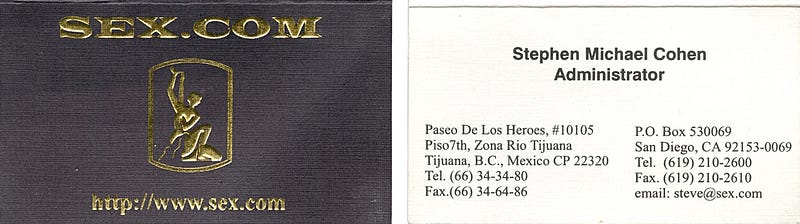
To summarize the details of this case Steven Cohen stole the domain name sex.com from Gary Kremen by writing a letter to network solutions making the false claim that Mr. Kremen gave the domain name to Mr. Cohen. If you want to find out more about the details of this case I recommend you listen to season 6 episode 2 of the Gimlet Media Startup podcast where Gary Kremen relates the story himself. Or you can also watch this youtube video from today I found out. This is from the sex.com entry in wikipedia:
Cohen was ordered to pay $25 million into court; in April 2001, the California District Court awarded Kremen an additional $40 million for lost earnings, for a total judgment of $65 million.
This is $65 million dollars for the single most infamous domain name on the Internet. Additionally Kremen settled his lawsuit against Network Solutions for an undisclosed amount said to be in the millions of dollars, enough for Kremen to retire by his own account.
Ownership of a domain name is ownership in the Internet itself

Continuing with the whitepaper they make this observation:
Given the requirement to have the correct private key to transfer ownership of UTXOs, bitcoin ownership is much more analogous to the domain address at issue in Kremen, where the domain registrant could fully control the site associated with an address.
Third, users have a “legitimate claim to exclusivity” in their UTXO ownership interests. In Kremen, the court cited two factors underlying a “legitimate” claim to exclusivity for purposes of property rights. We address these as follows:
One factor discussed in Kremen is that a domain name owner’s address is publicly registered, “like staking a claim to a plot of land at the title office,” thus informing others “that the domain name is the registrant’s and no one else’s.” Similarly, in a proposed bitcoin transaction, the transaction is broadcast to the entire bitcoin network to determine the validity of the underlying UTXO ownership interest so as to ensure that there is no fraudulent transfer of interest. Once the transaction is validated, the transferred ownership interest is irrevocably recorded in the form of the new, output UTXOs that correspond to specific public addresses on the blockchain (which is available for anyone to see).
The court documents asserted that a domain name was property analogous to a brand or a trademark which is registered in a public database. Ownership of a domain name goes beyond ownership of these types of intangible property for a very special reason. A brand or a trademark requires one to pay for the registration of one’s intellectual property. But, ownership of a trademark doesn’t entitle users to own a share of the underlying protocol used to register trademarks. By contrast, ownership of a domain name is to own a share of of the protocol which underlies the Internet itself. In order to register a domain name one must use the DNS system to resolve a domain name. The very system of domain names allows one to navigate the Internet to claim ownership to the digital property of a domain name. Furthermore, the Internet isn’t owned by any one government, nation state, or corporation. The system of trademarks, patents and copyright is entirely enforced by governments and nation states. The Internet transcends these boundaries. Since ownership of a domain name does not depend on a government or nation state the reality of it being a unique type of digital property is even more defined than for other types.
If a person attempts to register a domain name that has already been registered, he will not be permitted to register it. This denial indicates that the domain is owned by another, even if it is not actively associated with a website. This aspect of a domain name alone is more akin to tangible property than intangible property. If one wishes to register a trademark or a copyright a long process ensues whereby human judgements are required to determine if your application infringes upon another person’s trademark or copyright. This means that a trademark or copyright is not property in an absolute sense. Even worse after registering a trademark, if someone isn’t using a trademark it’s actual ownership can be forfeit. So the analogy of a domain name to a trademark is relatively poor as a domain name is a far more tangible digital good than a trademark is.
Here is a ridiculous analogy, what if owning a gas station provided you with ownership of part of the highway connected to the gas station? This analogy reinforces how physical objects have a lower degree of interconnectedness than internet protocols. In the world of internet protocols owning a part of that protocol entitles you to some partial ownership of the Internet itself. Owning a gas station never implies ownership of any property in the vicinity of the gas station i.e. the road that leads to it.
I highly recommend you listen to the Gimlet Media Startup podcast episode because it reinforces the point that Mr. Kremen did nothing to make the property sex.com more valuable over time. He did not build the brand sex.com but simply used it to redirect traffic to other sites on the Internet. As more people used the Internet there were more porn sites competing to pay for the privilege to have traffic redirected to their site. Mr. Kremen did nothing to make sex.com valuable as a brand, he simply watched as the Internet became more and more valuable. Unlike a brand where value is completely dependent on the work you do to build your brand, the value of this specific domain name was instead dependent on how many people valued the Internet and used it.
The internet is composed of multiple protocols the sum total of which is a symbol for the most valuable protocol suite the human race has ever created to communicate and publish content. Domain names therefore are ownership of the most valuable protocol the human race has ever created, and this will continue to be true so long as people continue to use the Internet.
Applying court precedent to cryptocurrency

Understanding that the protocols which make up the Internet allow access to the information built upon it, is key to understanding the Internet. The ability to access this valuable information is entirely reliant upon the Internet’s protocols.
The protocols which govern cryptocurrency likewise allow access to the value of the unique payment features built upon it. Understanding the value of these features is key to understanding the value of cryptocurrency. Cryptocurrency protocols enable the following unique features which no other payment system on earth can provide:
- Payments that are censorship resistant and irreversible and not subject to payment friction imposed by governments or other authorities.
- Escrows which remove third party custodians from holding funds that do not belong to them.
A platform such as Ethereum might one day become a powerful protocol suite for decentralized payments and escrows. Ownership of one ETH represents ownership of a share in this protocol. The protocol will enable new decentralized applications such as peer to peer insurance, prediction markets, stablecoins, decentralized identity and reputation systems and many more. if the protocol can continually provide value to people through its utility then it can become a network of value similarly to how the Internet is a network of information.
Domain names are baked into the protocol of the Internet, and this is what makes their value increase as adoption of the Internet increases. Similarly, for the Ethereum protocol to process transactions there is a requirement that fees be paid in ETH. As this adoption increases the value of ETH would also increase. So long as the supply of ETH is not elastic this might cause an increase in the price of ETH, similarly to how the price of domain names have increased with the Internet’s adoption.
Given that ownership of both cryptocurrency and domain names is of a very similar nature; it seems reasonable for the courts to apply the same precedent which has already been granted to domain names in determining the ownership rights of cryptocurrency.
Property rights were essential for promoting the Internet’s growth and similarly essential for promoting the growth of cryptocurrency

The paper concludes this section by saying:
Kremen also emphasized the public policy interest in recognizing that domain name registrants “invest substantial time and money” to develop websites, and that protecting property interests in domain names therefore “promote the growth of the Internet overall.” Similar policy interests underpin the legitimacy of bitcoin owners’ property interest in their UTXOs. A great deal of risk, innovation, and investment has gone into the creation of the bitcoin/blockchain ecosystem since its inception, and it has already yielded numerous business use cases and promises more in the future. Moreover, bitcoin owners themselves have developed and sought robust protections for their bitcoins — including “cold storage” and back-up mechanisms, multi-signature arrangements, paper wallets, and insurance — and have gravitated toward vendors who provide such protections. Protecting the investment-backed expectations of bitcoin owners is essential to promoting the further growth of this system, just as protecting domain name ownership interests was critical to promoting Internet development.
For the above reasons, we believe that an intangible property right should exist in bitcoin under California law.
For a more involved discussion on how to leverage the key features of cryptocurrency this blog post dives into what types of use cases have the most potential to leverage the protocol.


