avatarKate Campbell

Free AI web copilot to create summaries, insights and extended knowledge, download it at here

2453

Abstract

s regarded as one of the first major confrontations in what was to become the modern Troubles.</p><p id="a5f8">Three days of rising tensions in 1969 between the nationalist residents of the Bogside in Derry and the RUC (Royal Ulster Constabulary) over an Apprentice Boys parade brought British troops onto the streets of Northern Ireland for the first time. More than 1,000 people were injured in the fighting.</p><figure id="5c3f"><img src="https://cdn-images-1.readmedium.com/v2/resize:fit:800/1*eIEL3ctw-JF5x76Q-PCS3w.jpeg"><figcaption>Peace Talks, 1992, oil on canvas, Ulster Museum, Belfast. Artist: Jack Pakenham,</figcaption></figure><p id="5953">Kelly explained the area of Ravenhill, where I’d rented a vacation apartment, and the nearby shopping area on Ormeau Road, form a mixed community where both Catholics and Protestants peacefully live together. I noticed that within a few blocks of where we were staying there were at least three large Presbyterian churches and an equal number of Catholic churches, as well.</p><figure id="17be"><img src="https://cdn-images-1.readmedium.com/v2/resize:fit:800/1*k02nhffPxrm3YdcJ0H85qw.jpeg"><figcaption>Cooke Centenary Presbyterian Church, Ormeau Road</figcaption></figure><p id="c29a">Their presence was spiritually reassuring, except for the Martyrs Memorial Free Presbyterian Church up the block from where we stayed. It’s a breakaway church that was founded by minister and politician Ian Paisley, who died in 2014. He’s credited with stirring up the Troubles and prolonging the sectarian/labor conflicts in Northern Ireland, which is a disturbing legacy for a churchman.</p><p id="a67b">Paisley’s version of Presbyterianism is far more conservative than the Presbyterian Church USA that I belong to. My church is a great deal more inclusive, tolerant and progressive. But, I went to Northern Ireland, in part, to true up my Presbyterian upbringing with the sectarian violence of the past — and present — and to better understand the history of the conflict, and perhaps take my own share of any blame. I still mourn the death of Bobby Sands and the others who died during the hunger strike in the Maze prison.</p><p id="21e3">The issues in Northern Ireland aren’t well understood in the community where I live today. There are so many other things going on. But, I know something of the Troubles. I grew up in San Francisco’s Noe Valley, an Irish working class neighborhood and lived with a cert

Options

ain amount of sectarian prejudice. I know that in Northern Ireland these struggles are history, but also a way of life and the conflicts remain as real as this moment.</p><p id="6b73">I was able to talk about the situation in Northern Ireland during my trip, although there’s some reticence on the part of locals to engage with outsiders on the subject and, like most things, it’s complicated. My belief, however, is that artificially dividing communities and countries with “Peace Walls” and barriers force divided people to harbor festering animosity that eventually blows up. After visiting Northern Ireland, my view has not changed. It’s a dangerous game and is not sustainable.</p><figure id="9980"><img src="https://cdn-images-1.readmedium.com/v2/resize:fit:800/1*P7itTKnt8LZleKUC94KqJA.jpeg"><figcaption>More violence, August 13. Source: UK media image</figcaption></figure><p id="1bde">I was told by several women during my stay that they have two purses, one with British pounds sterling and one with euros. They choose the purse with the correct currency, depending where they’re going, meaning which borders they’re crossing. A hard border due to Brexit will only make matters worse, they say.</p><p id="76f6">I believe there should be one purse, one island, one Ireland. I was told that opinion would not be well received in certain places I’d be traveling and that it might be best to keep it too myself. Thanks to Kelly’s advice we stayed out of trouble and ended the day tucked away with musicians at Kelly’s Cellars, drinking Guinness, enjoying “Cead Mile Failte”. Gaelic is spoken everywhere and many of the signs in Ireland — North and South are in both Gaelic and English.</p><figure id="22e2"><img src="https://cdn-images-1.readmedium.com/v2/resize:fit:800/1*anbG9rSmxWhzvSI1DH89GA.jpeg"><figcaption>Mural outside Kelly’s Cellars offers “A Thousand Welcomes” in Gaelic.</figcaption></figure><p id="047c">Background on the current state of the Troubles: August 13, 2019 BBC report about Bogside protests. <a href="https://www.bbc.com/news/uk-northern-ireland-49326359">https://www.bbc.com/news/uk-northern-ireland-49326359</a>. August 24, 2019 Guardian report: <a href="https://www.theguardian.com/uk-news/2019/aug/24/fermanagh-irish-border-lanes-bad-old-days-returning-no-deal-brexit-bomb">https://www.theguardian.com/uk-news/2019/aug/24/fermanagh-irish-border-lanes-bad-old-days-returning-no-deal-brexit-bomb</a></p></article></body>

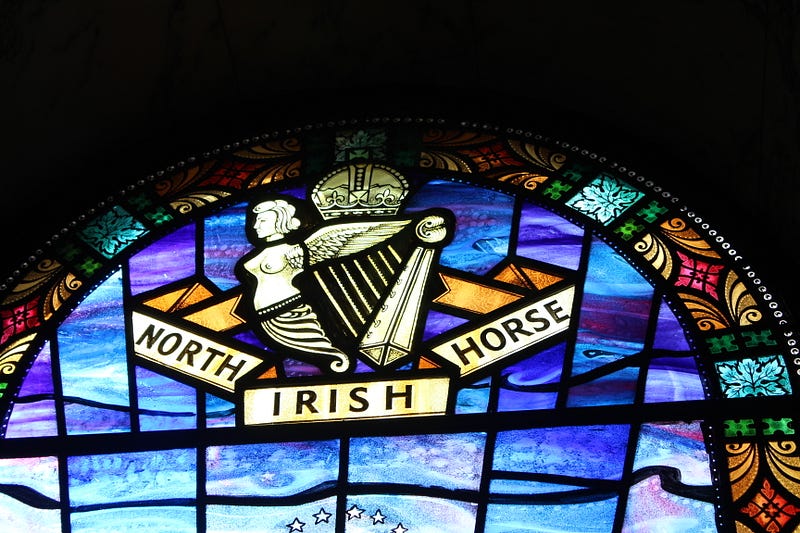
Conciliation window, Belfast City Hall

Travels in Northern Ireland — Unpacking the Troubles

Unpacking, not just my suitcase, but also experiences and impressions gathered during 2.5 weeks in the UK — Ireland, Northern Ireland and London. In part the adventure was about resetting my creative life, finding a new starting point, connecting with who I am on a deeper level, understanding what it means to be an American of Scots-Irish descent, what is true about my heritage, what is myth.

So I stood bickering in Ormeau Road in Belfast with my adult son Michael and his girlfriend Mariah about how to spend the day exploring the city, which bus to take, how far a British pound would go. Thankfully, our squabbling was interrupted by photographer Kelly Morris and her son Cormac, who live in the neighborhood.

Find out more about Kelly and background on her stunning photo that U.S. President Obama hung at the White House here: https://www.belfasttelegraph.co.uk/news/world-news/obama-hangs-kelly-morris-picture-on-the-white-house-wall-28596598.html
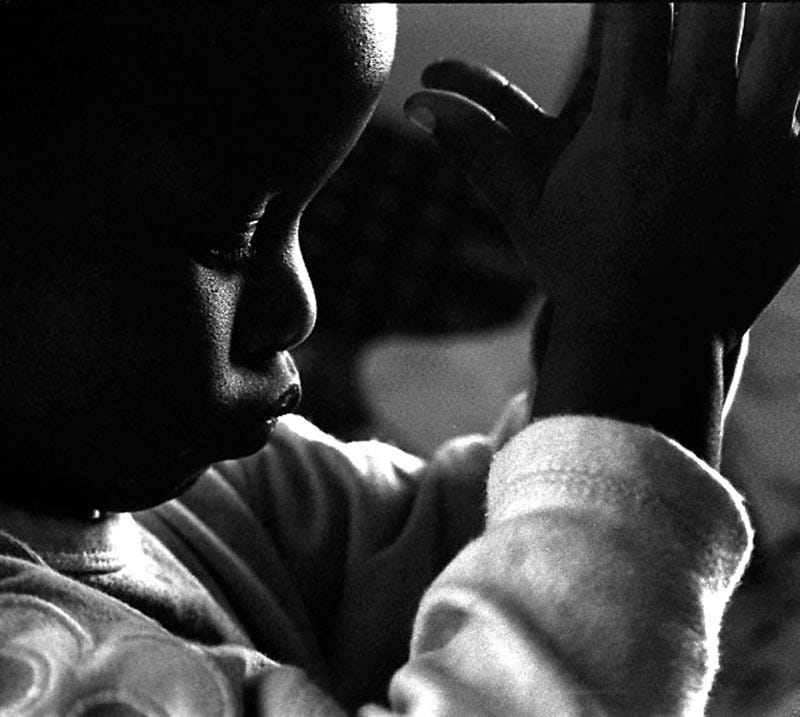
Kelly Morris’ photo sent to U.S. President Obama of a child in prayerful contemplation.

Kelly and Cormac introduced themselves and asked if they could help direct us. She called me “mama,” took us to her home nearby, which was filled with photography equipment and amazing photos she and her husband have taken. Kelly sat us down and planned our day. Her itinerary was brilliant! She is magical. One of our best days during the trip.
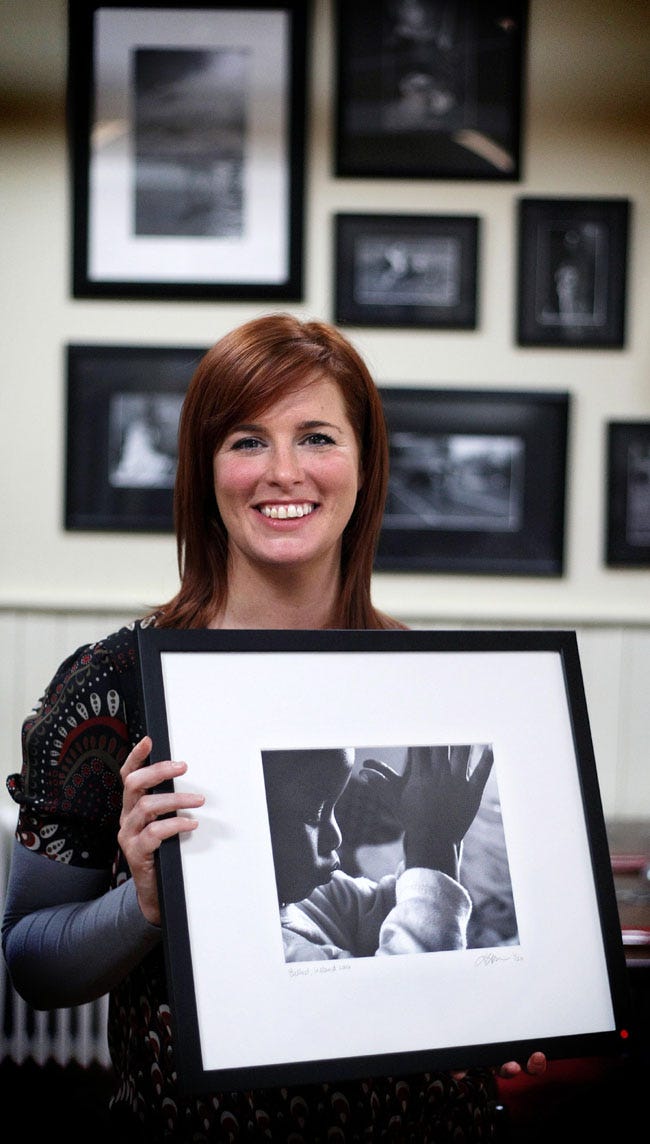
Photographer Kelly Morris

I told Kelly I wanted to go to the Peace Walls in Londonderry to see the murals, but was cautioned that it might not be safe. I arrived in Belfast, coincidentally on the 50th anniversary of the Battle of the Bogside, which occurred in August 1969. The event is regarded as one of the first major confrontations in what was to become the modern Troubles.

Three days of rising tensions in 1969 between the nationalist residents of the Bogside in Derry and the RUC (Royal Ulster Constabulary) over an Apprentice Boys parade brought British troops onto the streets of Northern Ireland for the first time. More than 1,000 people were injured in the fighting.
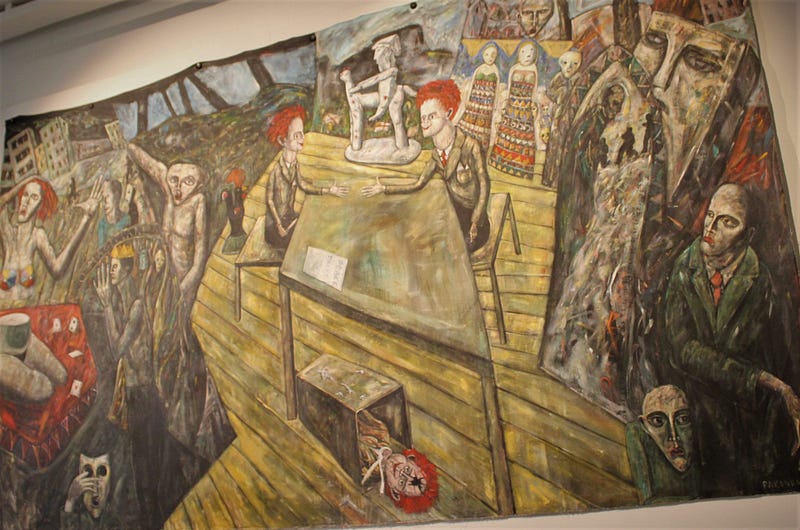
Peace Talks, 1992, oil on canvas, Ulster Museum, Belfast. Artist: Jack Pakenham,

Kelly explained the area of Ravenhill, where I’d rented a vacation apartment, and the nearby shopping area on Ormeau Road, form a mixed community where both Catholics and Protestants peacefully live together. I noticed that within a few blocks of where we were staying there were at least three large Presbyterian churches and an equal number of Catholic churches, as well.
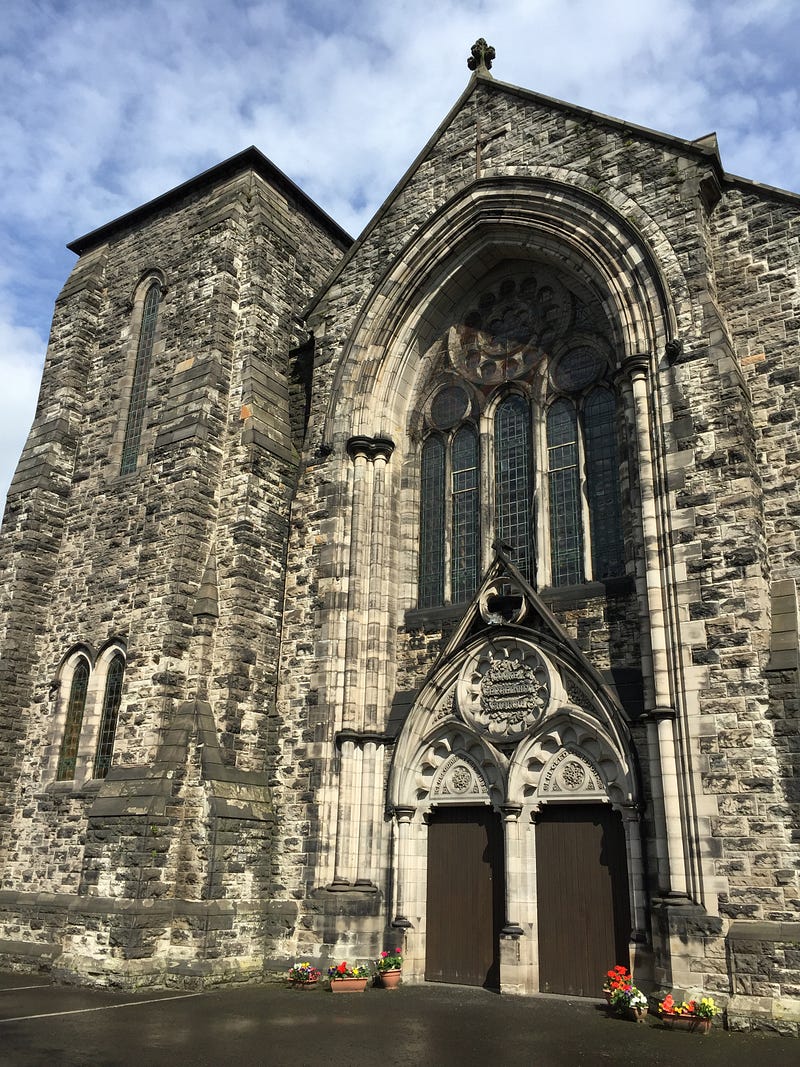
Cooke Centenary Presbyterian Church, Ormeau Road

Their presence was spiritually reassuring, except for the Martyrs Memorial Free Presbyterian Church up the block from where we stayed. It’s a breakaway church that was founded by minister and politician Ian Paisley, who died in 2014. He’s credited with stirring up the Troubles and prolonging the sectarian/labor conflicts in Northern Ireland, which is a disturbing legacy for a churchman.

Paisley’s version of Presbyterianism is far more conservative than the Presbyterian Church USA that I belong to. My church is a great deal more inclusive, tolerant and progressive. But, I went to Northern Ireland, in part, to true up my Presbyterian upbringing with the sectarian violence of the past — and present — and to better understand the history of the conflict, and perhaps take my own share of any blame. I still mourn the death of Bobby Sands and the others who died during the hunger strike in the Maze prison.

The issues in Northern Ireland aren’t well understood in the community where I live today. There are so many other things going on. But, I know something of the Troubles. I grew up in San Francisco’s Noe Valley, an Irish working class neighborhood and lived with a certain amount of sectarian prejudice. I know that in Northern Ireland these struggles are history, but also a way of life and the conflicts remain as real as this moment.

I was able to talk about the situation in Northern Ireland during my trip, although there’s some reticence on the part of locals to engage with outsiders on the subject and, like most things, it’s complicated. My belief, however, is that artificially dividing communities and countries with “Peace Walls” and barriers force divided people to harbor festering animosity that eventually blows up. After visiting Northern Ireland, my view has not changed. It’s a dangerous game and is not sustainable.
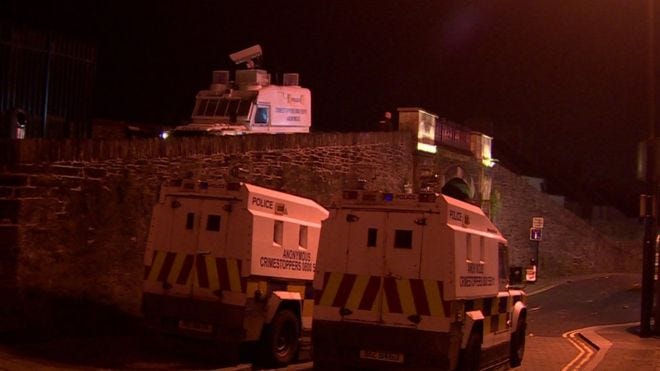
More violence, August 13. Source: UK media image

I was told by several women during my stay that they have two purses, one with British pounds sterling and one with euros. They choose the purse with the correct currency, depending where they’re going, meaning which borders they’re crossing. A hard border due to Brexit will only make matters worse, they say.

I believe there should be one purse, one island, one Ireland. I was told that opinion would not be well received in certain places I’d be traveling and that it might be best to keep it too myself. Thanks to Kelly’s advice we stayed out of trouble and ended the day tucked away with musicians at Kelly’s Cellars, drinking Guinness, enjoying “Cead Mile Failte”. Gaelic is spoken everywhere and many of the signs in Ireland — North and South are in both Gaelic and English.
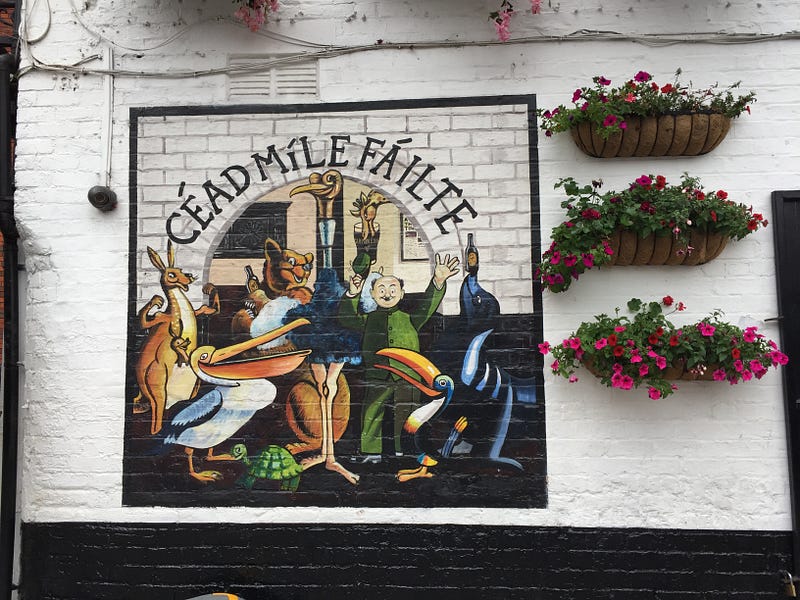
Mural outside Kelly’s Cellars offers “A Thousand Welcomes” in Gaelic.

Background on the current state of the Troubles: August 13, 2019 BBC report about Bogside protests. https://www.bbc.com/news/uk-northern-ireland-49326359. August 24, 2019 Guardian report: https://www.theguardian.com/uk-news/2019/aug/24/fermanagh-irish-border-lanes-bad-old-days-returning-no-deal-brexit-bomb

Northern Ireland
The Troubles
Scots Irish History
Church And State
Photojournalism
Recommended from ReadMedium