
Travels In Christian Syria — When Peace Made It Possible.
When we visited Syria as independent travelers in 2000, there was no restriction on our movement. But we were under surveillance even then. While we were having a drink in Aleppo at Baron’s Hotel (where D.H. Lawrence and Agatha Christie stayed), some members of the Syrian secret services approached us and were more than friendly. However, we were assigned a guide for our visit to the famous Aleppo Al-Madina Souk the next day. He never left us out of his sight even for one minute. This covered market extends for 13 kilometers!
Sadly, war-torn Syria today can only allow group tours and it is a harrowing experience to see so many ruins and hardship. After eight years of war, millions of people have sought refuge and safety abroad. The Christian population has fallen by at least 66% due to war and persecution.
I still have treasured happy memories of that trip because it was really interesting to discover its Christian and Muslim heritage which have managed to exist side-by-side down the centuries.
Christian traditions abound
Syria is a fascinating country full of Christian connections and traditions which go right back to the beginning of Christianity. This is also reflected in the fact that although the country is now mainly Muslim (86%), the rest is divided among a vast array of Christian traditions: Greek Orthodox, Greek Catholic, Syrian Orthodox, Armenian Orthodox, Maronite, Roman Catholic, and Protestant.
In Damascus itself, there is, of course, the ‘Street Called Straight ‘ and the Chapel of Ananias which marks the spot where St. Paul’s sight was restored. There is also Saint Paul’s Chapel where Paul was lowered from the city wall in a basket in order to escape the wrath of the Jews (Acts 9,v.25).
The Umayyadi Mosque
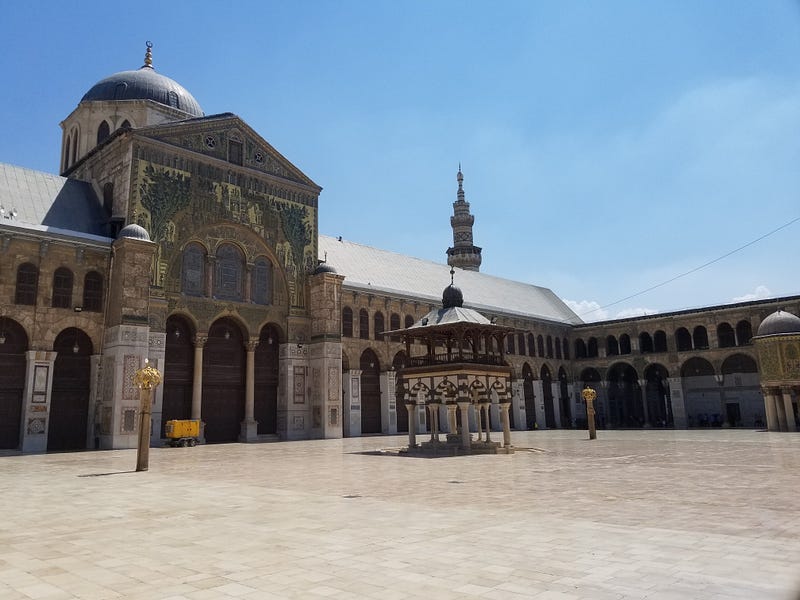
But much more interesting for me was the fact that the principal mosque of the city (the Umayyadi Mosque) has a strong Christian connection. In 300 BC the Romans built a temple of Jove on the present mosque site. This temple was enormous as it measured 380m. by 310m. By the fourth century AD, most of the population had been converted to Christianity and the temple of Jove was taken over by the Christians and dedicated to John the Baptist.
In 636 AD the Muslims had taken over the city but in a remarkable show of tolerance, they allowed the Christians to worship in the western part of the mosque while reserving the eastern part for themselves.
When one visits the mosque today — (if you are female you will be wearing a black cloak)- one is immediately struck by the vastness of the interior but also by an unusual chapel-cum-mausoleum complete with doors, windows, and domes. This is said to contain John the Baptist’s head. When I was there I noticed that worshippers stopped and touched the iron grille on the windows and say a prayer. This is not so surprising as John the Baptist is also revered as a prophet by Muslims and he is known as Yahya. It was interesting to be in a spot where Christianity and Islam meet.
Outside, the courtyard contains a number of smaller edifices, one of which is the octagonal Treasury Tower with a beautiful mosaic. This was where public funds were kept safe. If you look up in the southwest corner you can see a smaller minaret. This is known as the Jesus minaret and local tradition has it that this is the spot where Jesus will appear on Judgement Day.
Palmyra and the Qalamun Mountains
The next day we set off for Palmyra in a hired car (having first ensured we had a full tank of gasoline as filling stations are few and far between). Our plan was to make a small detour to visit a rather special village high in the Qalamun Mountains located about 50 km north of Damascus.
Syrian motorways often have no slip roads — the motorway simply narrows to two-way traffic thus allowing you to turn off quite easily!
The surface on this secondary road is good and as we climb, the rock faces become more spectacular. The houses in the village are painted in a variety of colors such as light blue, yellow or mauve. They cling to the rock faces and one can see caves and grottoes which reminded me of Matera in Italy.
Jesus spoke Aramaic
Why have we come to this village? Well, it is one of the three villages in these mountains where Aramaic, the language of Jesus Christ, is still spoken! This village is called Maalula, (left in ruins after 2014 fighting) while the other two villages are Jaba’deen and Bakh’a.
According to linguistic experts who are now developing an Aramaic dictionary, New West Aramaic (its official name) is remarkably intact and ancient. Scholars only rediscovered it 150 years ago.
Aramaic was widely spoken in the area between 1,000 BC and 1,000 AD. With the rise of Islam in the seventh century, it began to die off slowly and is now only spoken in these three villages.
While we listened to teenagers chatting away in Aramaic, I reflected on the fact that Jesus and his disciples were often ridiculed by the way they spoke Aramaic which was regarded as being rather sloppy. The Talmud recounts the ridiculing of a Galilean in the Jerusalem market place for trying to buy what he called ‘amar’. He was mocked: ‘You stupid Galilean, do you want something to ride on (hamar: a donkey) or something to drink (hamár: wine ) or something for clothing (àmar: wool) or something for a sacrifice (immar: lamb)?
The Galileans evidently dropped their aitches!
This brings to mind the story of how Peter was recognized by the way he spoke: ‘You are one of them for sure! Why your accent gives you away!’ (Matthew 26.v.73).
Before we left Maalula we searched for the one and only filling station without success although we did find a man who sold us five liters of gasoline from a plastic container. We really didn’t need the gasoline so desperately but it was a good excuse to hear some Aramaic!
What happy and sad memories of Syria now disfigured and crippled by a war that never ends.