
Travelling in the World of Ghosts
How does it feel to travel when everybody else can’t
All events leave a trace in our memory and soul; the bigger the event, the larger the imprint. A year ago, it seemed nothing could leave a more significant trace in my memory than the pandemic. But, alas, this is no longer so obvious after the outbreak of war in Ukraine, as it destroyed the lives of many of my friends and relatives.
Still, I want to track my memories back to the beginning of the pandemic, when my life suddenly went in the opposite direction to that of the majority of the world’s population trapped in a global lockdown.
My job requires me to go on occasional work trips all over the world. I will not go into details; I will only say that, more often than not, these trips come as unexpected as it gets. I can just get a call from my boss while enjoying a lovely Friday evening, saying: “We have an order from a client in Narnia (or any other country over two oceans away from my home), and your flight is tomorrow. Are you ready to go?”
That was the question I heard in mid-April 2020. It was when the entire world shattered into a mosaic of countless cells, locked in a deafening self-isolation. Planes did not fly, and trains did not run. We all remember how it was. Working remotely as a construction worker is not an option, so I sat at home and gradually got fat from consuming food delivery and checking the slowly diminishing figures in my bank account.
However, some tasks should be done no matter what, and I was lucky to be one of those who could do such work. The assignment came at the right time, both financially and psychologically. And, damn it, it was the strangest trip of my life!
Of course, I could not fly out as quickly as I usually did before (a day or two after the notice). I had to get permits, certificates, admissions, and all sorts of other paperwork. Let me remind you: the world was just a few months into the pandemic; there were no vaccines or reliable information about the disease, and the situation was very confusing.
The plan was as follows: I’m flying from Estonia (where I live) to Germany and wait there for two days, because the flight to Bahrain, where I was going, was only once a week, and didn’t coincide with two flights a week from Tallinn to Frankfurt. Then I was supposed to fly to Bahrain, take a test, sit in quarantine for two weeks, take a retest, and finally go to the shipyard where I was to work.
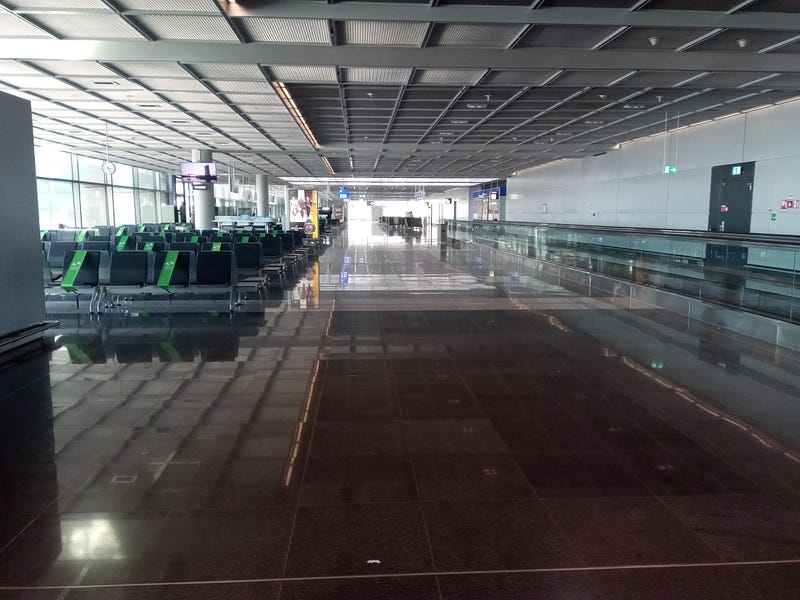
The picture of the completely deserted airports will haunt me forever. Anyone who travels regularly knows what a busy international hub looks like, buzzing with passengers. When our plane landed in Frankfurt, everyone on it (about thirty people, tops) stepped out into the dark and empty building and, to the resounding echo of their own footsteps, walked toward the exit without meeting a single person on the way and warily looking out into the dark gaps in the side corridors, where only the emergency lights were on.
I had the distinct feeling that I was in some kind of dystopian novel or movie. Remember the beginning of one of the Resident Evil series in which Mila Jovovich takes to the streets of an empty city? My consciousness refused to accept the total emptiness of the gigantic airport, where the chirping of sparrows drowned out the confused voices of lonely random people.
The interlude in Frankfurt lasted ten days instead of three because I couldn’t get on my plane. There were some problems with my papers, and if I had returned home, I would have had to sit there for two weeks (or even three, I don’t remember the exact rules that were in effect back then) in self-isolation before flying out again. So it was decided that I would wait for the next flight to Bahrain in a hotel near the airport. Under other circumstances, I would have loved to explore Frankfurt, but it was a dubious pleasure under lockdown conditions. In addition, the thunderstorms came, and it was raining for five days in a row. So I was delighted when I could finally fly to my destination.
By the way, from a traveller’s point of view, navigating the ghostly world of lockdown is a pure pleasure. There were no lines at the check-in and passport control, and the Boeing 777 was at the disposal of only fifteen passengers. Wonderful!
The next level of unreality awaited me on arrival. People in full biohazard suits spraying disinfectants on passengers’ luggage from spray guns with shoulder packs, then a giant tent with airtight doors in which they took tests from us. I almost expected everyone to have their clothes taken away and burned with flamethrowers, but instead, I was taken to a hotel.
I have absolutely no criminal history, so the prohibition to leave the room, the monitor on my arm and the daily triple checks by the authorities (mandatory selfies, where my face, my number, and the QR-code on the monitor’s wristband are clearly visible) were also, shall we say, fresh experience for me.
All in all, my journey to the ship where the job was waiting for me took almost a month. I completed the job in ten days…
The way home was relatively short, not counting the five transfers (I was bumping all across Europe like a pinball ball). Big deal, just three days! After two weeks of solitary confinement in Bahrain, self-isolation at home with my family felt like a pleasant vacation.
Looking back, that strange journey through the ghostly depopulated world seems almost unreal, as if I had spent that month in a dream. There were a few more trips later, but the shackles of the lockdown had loosened a bit by the time they were done, so I have no such vivid memories.
And yes, I still don’t know what the real Bahrain looks like. Unless you count the quick glances from the taxi and the view of the big construction site beneath the hotel windows.


