
Traveling into a National Emergency: The Gift of Losing My Stuff
As it was on 9/11, I’m learning valuable and amusing life lessons on the road: Who was that masked man?
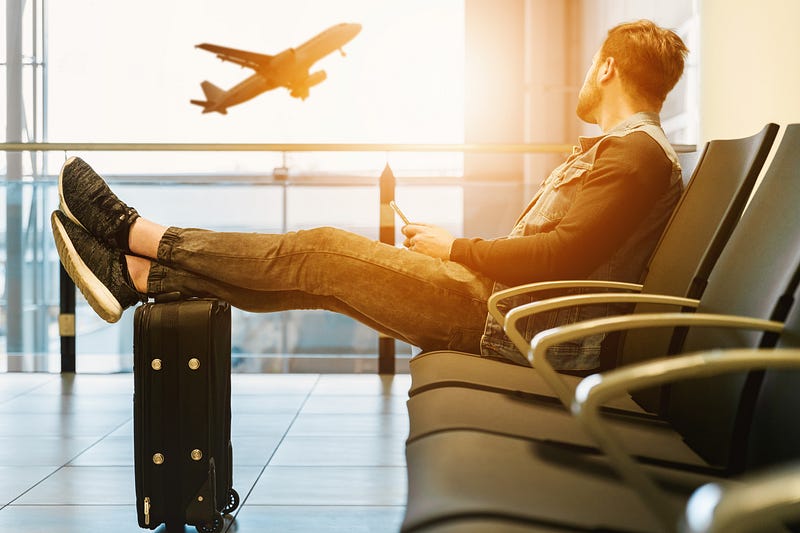
I stood in a hotel room, learning the news the morning of 9/11 — and here I am on the road again for the latest National (really global) Emergency.
On 9/11, travel was halted immediately…
On September 11, 2001, I was supposed to work a full day then fly American Airlines from Chicago to Detroit. My flight was cancelled when terrorists stopped the world that morning.
In 2001, we weren’t sure when the world could travel again. Air travel was halted and I remained in Chicago three extra nights, taking a packed Amtrak train home. Some people were so desperate to get home they bought used cars.
This time, we weren’t sure what would happen or when or how. So we went on with our plans as the spread of an unseen virus kept rippling through the world. My bride is wondering whether we should take our flight back as scheduled or rent a car. Everything is literally in the air.
Nothing is certain. Except the uncertainty.
“Who was that masked man?” they used to ask on “The Lone Ranger”
I ask myself the same question about the travelers in surgical masks and rubber gloves. When you think about disease every hour of every day, every cough or hiccup seems like danger.
I saw Joe Biden cough at the start of the March 15 (Ides of March) debate and wondered if he was ill. I hadn’t noticed him coughing once in 30 years (certainly he has before) but suddenly we are all hyper vigilant. Every ache seems like the start of death. But we keep going.
The first Bad sign was actually very good
In airline security Friday, I removed the chain around my neck with my papal cross and miraculous medal. They were missing after going through the scanners. A TSA guy advised me not to remove them next time.
“Maybe this is an omen, losing our protection?” I thought.
Agents searched in vain — I kept my cool: “Maybe someone who needs these medals more will find them.”
I was given a lost and found phone number and was told to listen on the PA but didn’t expect to hear anything. I gave up, accepted the loss, went on, letting go of any attachments to material things.
About 20 minutes later, the beaming TSA agent walked up to me, showing me he found the missing medals stuck in the machine somewhere. And the items that were once lost and now found meant more than they ever had before.
The gift of being lost, I thought, was the unexpected return: expecting nothing and getting much in return.
Bring your jacket — in case it rains
We boarded our plane from Detroit to Myrtle Beach (careful to squeeze all my belongings into a computer bag to avoid the $50 luggage fee) and all was good. Upon landing, I planned to Uber but couldn’t get the Uber app to work right — so we took a cab and the cabbie gave us a card with his phone number. So old-school.
So when I couldn’t find my jacket that night, my bride, who still had the cabbie’s business card, knew to call him. He wound up finding my jacket and kindly delivered it back to us the next morning. You’re getting the picture: I seem to be one of those absent-minded professor Mr. Magoo types.
We are all ADHD now — all distracted, looking away and missing the obvious
My alma mater, Michigan State University, shut down and the students crowded into the bars — much closer together than they would have in the classrooms.
Flashback to being 5-years-old, in kindergarten at Robert Frost Elementary School. We were sent home early because of a tornado warning (which sounded scary to a little boy).
My 28-year-old-parents chuckled and took me to the pool and all I remember was it turned out to be a bright, sunny and fun day. Young people are good at showing “no fear” in the face of storms.
Is this another 9/11 or another Y2K or something in between?
From 1995 to 2000, we heard about the impending Y2K shutdown that would destroy infrastructures because computerized systems weren’t designed to handle the change to a new millennium.
I turned on my computer on January 1, 2000, and saw my PC had changed the date to 1969. I changed the date to 2000 and that was about it. Disaster fixed.
America was far less ready for September 11, 2001. People seemed far less prepared for this year’s crisis (though my University of Michigan colleagues were preparing for widespread pandemics as far back as SARS warnings in 2003, all talking about “the next 1918 Spanish Flu”).
Both 9/11 and the Coronavirus Panic have many similarities…
After the 2001 attacks, someone asked if I thought the terrorists would poison the water because so many Arabs lived near Detroit. No, I didn’t think anyone would poison water they themselves might wind up drinking.
Two decades later: a Millennial friend said she was “totally on my own” for child care because she didn’t want her child exposed to her traveling relatives (and even their home). She had ruled out her father, the healthcare worker, (because, you know, he had been exposed to sink people). So no one could be trusted.
This weekend, my 77-year-old dad was told not to visit his 96-year-old friend. The 96-year-old’s daughter feared my dad knows too many people. Isolation is everywhere.
Americans have a bias toward action — we want to DO something
So being told “stay home, cancel activities” is actually much harder for many of us than it sounds. Our grandfathers went to war to fight for freedom — we are only being asked to stay home.
Our addiction to technology is tied to watching numbers grow
They call the need for “likes,” views and growing numbers in our stock accounts “gamification,” the need to feel we are winning the game of life.
We see those numbers climb and we feel we are moving forward, like watching the speedometers on our cars get us somewhere faster. Seeing no growth is like being stuck in a traffic jam, at a full stop. Suddenly, we feel trapped.
Now, as it was during 9/11 and 2008, markets and people are all over the map
The Dow is down nearly 3,000 points today, 27 percent below the all-time-record high reaches last month.
We are no longer sure who or what to trust. That tech stock that flew up is down. That stranger offering help could be infected with germs that could kill you or your grandmother. Work, business, school, your favorite church, gym, movie theater, restaurant and events could be or already are all shut down.
Then, as now, we fear most what we cannot see, what we can’t imagine.
“We have an invisible enemy,” President Trump said. “We have a problem that a month ago nobody thought about.. My focus now is getting rid of this virus problem. Once we do that, everything is going to fall into place.”
But sometimes loss is a gift
You lose something you thought you needed, like a medal or a jacket or access to things you have taken for granted like the gym, the church and your favorite restaurant.
And you feel a great sense of loss but you adjust, even when it’s hard.
When that lost thing returns, you can see it in a new way again, treasure it and appreciate what you had previously taken for granted — which may explain why these sacrifices and losses (expected to continue through March) are occurring during Lent, a time of sacrifice, a time to turn your focus to things that remain steady.
The young people who show no fear crowding into the bars also know how to have a sense of “community” when they are alone staring into a phone, ordering food deliveries. They can help us get through this, we are told.
Our 30-something kids were just 11 and 14 when 9/11 hit and fresh out of high school after the financial crisis started the last recession. Now in their early 30s, they were formed by sacrifice and should be ready to help this time.
“The Millennials are the key,” said Deborah L. Birx, M.D., the White House coronavirus coordinator.
“I want to speak particularly to our largest generations now, our millennials. I am the mom of two wonderful millennial young women who are bright and hard working, and I will tell you what I told to them: they are the core group that will stop this virus.”
“They are the group that communicates successfully independent of picking up a phone. They intuitively know how to contact each other without being in a large social gatherings. They’re the ones who are out and about.”


