Traveling Back to Lhasa
I visited India and Nepal for the first time on a Buddhist pilgrimage led by Shantum Seth in 2007. The following is from my 2008 trip to India, Nepal, and Tibet and is about Tibet.
I just gave a little kid a pen — it seems to have worked, since he took it and walked away. Great, even toddlers know the English word “Hello.”
Today we are driving back to Lhasa.
Yesterday was International Women’s Day, which I never heard of before. I need to research that. People were celebrating by drinking and dancing. That explains the fireworks. I didn’t know about it until this morning: Gyantzing asked me if I slept well and explained why there was so much noise that could have kept me awake but didn’t.
I wish I’d known about this yesterday. Too bad I wasn’t out celebrating with women, but then again, I’m not into drinking and dancing. I’m into overthrowing patriarchy. I’m into getting the revolutionary ball rolling, which is what Women’s Day should be about.
It’s ironic that it was supposed to be Women’s Day when for me it felt like Misogyny Day. Without patriarchy, every day would be Women’s Day — a day free of war, rape, incest, domestic violence, and prejudice. Every day would be a day free of oppression and injustice. Bye-bye Dominator Society, hello Partnership Society, to use the scholar Riane Eisler’s terminology.
It seems to me like International Women’s Day is scarcely more than condescension, mere words. It doesn’t seem to be conjuring a lot of feminist consciousness around here, that’s for sure, judging by my experience on the streets of Shigatse yesterday. It should be about sociological transformation to an egalitarian and just society, not about drinking and dancing.
Writing while in the car (and therefore large and messy handwriting):
I see shaggy goats with curly horns.
Brahmaputra/Yellow River — we’re passing it again.
Shigatse Region:
On the left of the highway, we see some small buildings and an area where a new, smaller airport will be built.
Straight ahead stands a wide, roundish, rocky brown mountain. It’s a holy mountain for sky burials; wealthy families pay for funerals there. I see two stupas, smoke, and prayer flags on top of the mountain. It’s significant that only wealthy families get sky burials there; I didn’t think to ask what happens to poor people when they die. Perhaps I didn’t ask because my mind was on the breathtaking scenery, but I’ve been in Tibet for nearly a week and have continually seen breathtaking scenery.
We stopped for gas, and I walked around. I approached a bridge, and across it we saw what looked like a monastery with three pointy roofs. Gyantzing explained that it’s a Bön monastery on the river. (I’m adding an “e” after the “o” in “Boen” because of my computer’s inability to type an umlaut; it has the same effect on pronunciation as an umlaut in German.) The monastery has a backdrop of big brown mountains looming over it. While we looked at this building in the distance, Gyantzing told me some things about the Bön religion.
Interling is the name of the monastery and means “Center of the Swastika.”
Bön has statues like Buddhas, but with a swastika on the chest. I commented that I’ve seen Chinese Buddha statues with a swastika on the chest, and he explained that’s only Chinese, not Tibetan. I believe it was a Hindu sun symbol before Buddhists took it up — simply because you see a lot of swastikas in India, such as on Hindu temples, and Buddhism branched off Hinduism. The swastika is like the Irish goddess Bridget’s sun sign; in Ireland, I purchased one made of twigs.
It’s unfortunate that Nazis coopted the swastika. In Hinduism, Buddhism, and Bön, it’s straight; the Nazis twisted it not only symbolically but also visually, putting it at an angle. As a Westerner who’s part ethnically Jewish, I’m uncomfortable with swastikas.
Shirup (or maybe that’s Sherab, since that was the name of an early and influential Bönpo abbot) is the name of the Bön Buddha. Bön is more naturalist since it’s an indigenous shamanistic religion. Tibetan Buddhism gets its more Pagan aspects from Bön — both religions seem to have influenced each other (although Hindu tantric practice influenced Vajrayana Buddhism in Tibet). Various elements of Tibetan Buddhism, such as images of the sky and moon, prayer flags, juniper burning — all come from Bön originally.
Gyantzing mentioned that his uncle was a monk at this monastery in 1959. The Chinese put an abrupt end to his monastic career.
During the gas station break, I saw two cute donkeys in the street. I stared at the donkeys, and locals who stopped here stared at me. By the gas station there might be a place to stop for tea and snacks; quite a few vehicles are parked here.
From the car, I saw ponies with colorful saddle blankets.
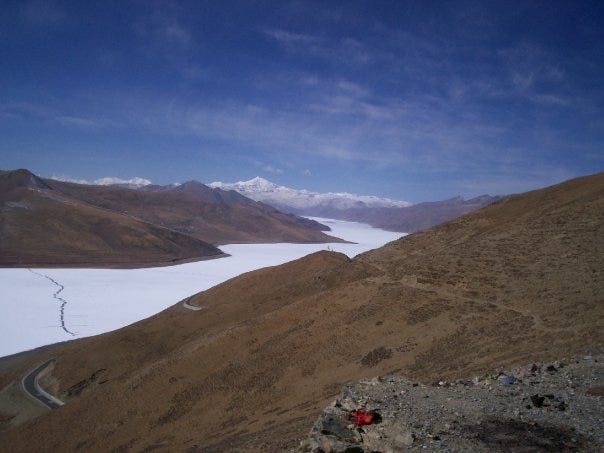
A bit ago, I saw a vast stretch of sand, what you might call a cold desert, on a flat surface backed by large, brown, and rocky mountains, and I also saw sand on mountainsides. We’re riding through an area of mostly brown mountains with some streaks of greenish gray in smooth descending falls, surrounded by sharp and roundish surfaces. Down by the river are some dark, shiny, slick, large rocks. This landscape includes green flowing water.
Still in a rural area, we stopped at a café that emits loud music — a song I frequently hear in Tibet. I wasn’t hungry for lunch, having had a large and relatively late breakfast, so I wandered around outdoors after telling Gyantzing I wasn’t ready for lunch.
I enjoyed stretching my legs after sitting in the car. I admired the mountains, some of which were snow-capped. Behind the café, the land sloped downward dramatically — the bank of a river. The sky was an amazingly bright blue, and the sun shone intensely. Breathtaking mountains surrounded me. The yard included two scruffy cows and three dogs.
I saw nine crows fly off; I wonder if that’s an auspicious symbol, since seven appeared when the first Dalai Lama was born, and five appeared when the Fourteenth Dalai Lama was born.
A group of five children walked up and chatted with me; they knew some English words. I thought they’d beg, but they just wanted to chat. Maybe if I had had a functioning camera, they would have wanted their pictures taken. They would have begged for money, and I would have given it to them, but since my camera was broken, I didn’t take it out.
The kids said, “Hello!”
I said, “Tashe delek!” and, “Hi!” It was a new day, and I was more patient. Besides, they were free of malice, unlike certain men and boys on the streets of Shigatse.
The kids said some Tibetan and got a blank look from me. One of the girls pointed at my forehead, and I thought she was pointing at my third eye. They asked me my name, and I said, “Susan.” They repeated it after me, and I smiled. I said, “What are your names?” But I guess they didn’t get the question, or I didn’t understand their names; they tended to talk all at once.
One of the girls pointed at my forehead and said, “You are beautiful!”
Embarrassed and taken by surprise, I laughed. “Thanks!”
Soon they said, “Bye!” cheerfully, and I did the same, and they moved on, playing kick the can in the street.
Perhaps they were walking to a school far away from their home. A couple of them were dirty enough to be beggars. They were a variety of ages — like between two and seven I think, not that I’m a good judge of age. I wish I’d had my bunch of pens in my purse to give one each to the kids; unfortunately, the pens were in my suitcase. Not a useful place to leave them.
In hindsight, I should have studied the Tibetan language before coming here. I would have if I’d been staying for more than a week.
With some urging, namely a grandma stepping out onto the café threshold and waving me in, I went indoors, sat down at a long table with the guys, and snacked on rolls and butter tea. Inside, the café was like a family house — maybe it was combo home and café. Tibetan butter tea doesn’t taste bad if you dip bread in it — it tastes like bread and butter.
Gyantzing chatted with Grandma. The family was busy in a courtyard, just outside a big glass window. I sat facing it and watched as three people covered an old wooden table with a big shiny plastic red and blue tablecloth that advertised Coca Cola. There was a grandfather, a dad, and a young woman, presumably the oldest daughter, working on the table. Children were hung around. They stapled the shiny tablecloth onto the table, and I thought it would look so much prettier to paint the table in bright colors. I have a hand-painted and colorful coffee table painted with African-inspired designs — a cast-off from an ex-roommate.
Back in the jeep, we passed a glistening turquoise river. I’ve noticed many police checkpoints on this route, which have resulted in numerous short stops.
My travel memoir Every Day is Magical: A Buddhist Pilgrimage in India and Nepal is available on Amazon here: