
Travel Buffs Splash Out on Jumbo Jet Flights to Nowhere
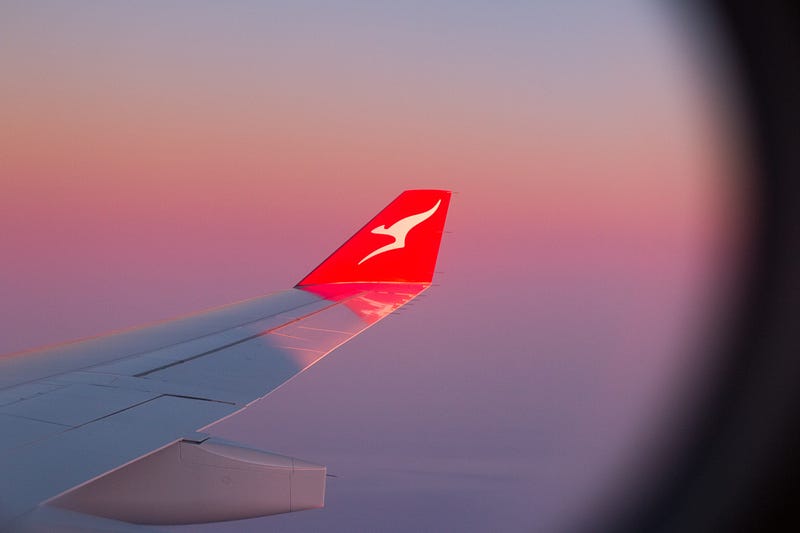
A seven-hour flight to nowhere by Australian Airlines Qantas sold out in 10 minutes.
“It’s probably the fastest selling flight in Qantas history,” the airline’s CEO, Alan Joyce, said in a statement. People clearly miss travel and the experience of flying.”
The seven-hour scenic flight will perform a giant loop taking in Queensland and the Gold Coast, New South Wales, Uluru, and the country’s remote outback heartlands.
But why? Let’s look at the benefits and disadvantages.
Benefits
1. Satisfaction for people who enjoy taking to the skies and being carried by thousands of tonnes of metal through space…….even if they are not going to land anywhere except where they started from.
2. Qantas wins favour with the people in number one, even if it doesn’t break even on these Pandemic Joy-flights.
3. It breaks the stifling atmosphere of lock-down and isolation by hopping onto a metal machine that was built to transport people and cargo from A to B and not made expressly for scenic rides.
4. It leverages the stance of the Airlines whom are being given free space in the monopolised Australian media, to demand that all Australian States open their borders, to allow interstate flights to resume.
5. It gives those on this scenic Jet flight a life-time opportunity to luxuriate in a 787 Boeing while cruising through the skies above Sydney Harbour, the Great Barrier Reef (what’s left of it) and Uluru.
So we come to other reasons for this 7 hour expensive jaunt through the skies, crossing the country faster than a horse or a sports car, but not as fast as Super-man.
The journey will take place on a Qantas Boeing 787 Dreamliner aircraft, usually reserved for intercontinental journeys across continents.
If you can pay for it, you can probably have it. Also, customers’ yearnings to fly must be filled, even if it means going on a joy-ride on a jumbo jet that is going nowhere.
There were 134 tickets on sale — spanning business class, premium economy, and economy and costing from AUD$787 to $3,787 (US$566 to $2,734). Qantas is considering putting on more of these alluring “flights to nowhere.”
These flights aren’t entirely necessary. However, for people employed by airlines such as Qantas, they’re extremely necessary. [ Cam Walker, Friends of the Earth Australia ]
Other countries have also had jumbo jet joy-rides, so this is nothing new. Qantas has had Antarctica jumbo jet joy-flights too. But the above is contradictory. How can something be both necessary and unnecessary? Cam is saying the obvious. To a select few, these jumbo-jet joy-flights are necessary.
Despite the disadvantages of unnecessary carbon emissions.
Yes, there may be only a small amount, and jumbo jet fliers may say “just off-set the emissions.”
But like every dollar counts, so does every bit of carbon dioxide, even if this time around, only a small amount of it is being emitted once-off, based upon the principle “give the people who can pay , what they want”.
But this principle can lead to more jumbo-jet joy-flights in this age where fossil fuel emissions are too high, and governments are ignoring the scientific facts of accelerated warming of the Planet due to carbon emissions.
On a 4,000 KM round trip, from Sydney to Alice Springs and back to Sydney, a 787 Jumbo Jet, at a rough estimate, will emit approx. 300 tonnes of carbon dioxide emissions.
The 10 October 2020 flight will go over Queensland and the Northern Territory, flying over Uluru, and back to New South Wales. Uluru or Ayers Rock is 350 km south from Alice Springs.
Nature Climate Changes states:
Government policies during the COVID-19 pandemic have drastically altered patterns of energy demand around the world. Many international borders were closed and populations were confined to their homes, which reduced transport and changed consumption patterns.
The impact on 2020 annual emissions depends on the duration of the confinement, with a low estimate of –4% (–2 to –7%) if pre-pandemic conditions return by mid-June, and a high estimate of –7% (–3 to –13%) if some restrictions remain worldwide until the end of 2020.
Nature Climate Change states that:
Our study reveals how responsive the surface transportation sector’s emissions can be to policy changes and economic shifts. Surface transport accounts for nearly half the decrease in emissions during confinement, and active travel (walking and cycling, including e-bikes) has attributes of social distancing that are likely to be desirable for some time.
A seven-hour flight creates a per-passenger footprint of about 0.64 metric tonnes of CO2e, or “carbon-dioxide equivalent”. You would have to drive your car nearly 4000 kilometres to match those sorts of emissions. And while Qantas is purchasing carbon offsets for its scenic flight — there are those who say offsets don’t negate the environmental impact that flights like this will have on the environment. [ Source: traveller.com ]
The effects of reduced emissions from reduced air-travel will only be temporary, unless humanity changes its habits globally.
The Australian Broadcasting Corporation’s (ABC’s) three-part series “Fight for Planet A: Our Climate Challenge” shows how all householders can reduce carbon emissions through energy saving and through making informed choices about what they do or how they live.
Of course, addressing companies that let out carbon emissions, and changing surface transportation and developing and using renewable energy technology are also essential.
None of the parties involved can be let off the hook. We all need to be accountable for what our actions are doing to our one home, Planet Earth.
Workers in the fossil fuel industries and others can be helped to make a fair transition to renewable or other industries. Beyond Zero Emissions has a plan to create a million jobs in this way, the Million Jobs Plan.
If we review our amount of flying around the world for frequent overseas or interstate holidays every year (and while we’re at, review our wishes to go on ocean liner cruises), and review how we do business, and address other sources of emissions, we can work toward making a cumulative difference.
We can take considered measures.
Like, not host or take a jumbo jet flight to nowhere. Some may say that there are “bigger fish to fry” to use a colloquialism, and say that flights to nowhere may be good for some people’s mental health.
But it’s time to put every angle on our choices between “this” and “that”, for example, between allowing an enjoyable jumbo jet joy-flight for a few and squashing the rights of passengers to enjoy this and impinging upon the rights of the airline to fly and look after its employees and its business.
This endeavour can be regarded from a different angle, that of choosing between collectively working toward net zero emissions (by adapting to air travel being grounded, by not flying) or engaging in what is seen as a worthwhile activity or a tonic to some, but while adding a cog to the wheel of spiralling carbon emissions output.
The balance of Life on Earth is precarious at the moment. Every choice and action that each one of us makes is a cog in an interconnected system. Less carbon emissions somewhere means just that. Qantas knows this. We all should know that there are nowhere near safe levels of carbon emissions in our atmosphere currently.
Globally, we are continuously putting out a lot more carbon emissions than we are storing. Our offsets are currently far from enough. Together we can focus on the achievable target of globally reducing our carbon emissions every year for the next decade, to reach net zero.
We need to choose the right this and that. Reduce our carbon emissions every way we can and create non greenhouse emitting and non carbon-emitting options for employment, industry and enjoyment.
And being ethically resilient and adapting to sudden changes is necessary, not optional.
A seven-hour flight to nowhere by Qantas may show resilience and adaptation by the airline, in the face of possibly a lack of adaptation by its passengers to air-travel being grounded, but the question remains: is it a necessary resilient and adaptable action?
.