

Trauma and Your Nervous System: How to Rewrite Your Reactions
Learning to regulate an activated nervous system

I always thought I was a passionate person who felt everything deeply. If I got angry, it took a long time to return to a state of calm. If I was sad, it felt devastating. My emotional highs and lows were evidence of a strongly feeling person — or were they just evidence of trauma?
It would take a long time before I understood that I didn’t have strong, passionate feelings just because I’m a Highly Sensitive Person (HSP). I had strong feelings because I had experienced trauma. I was sensitive because I was hypervigilant to what was happening around me due to that trauma. What I called passion was simply the evidence of a dysregulated nervous system.
My therapist refers to it as activation. When we talk about an experience in our lives, activation begins when we leave calm behind and become agitated. I’m recounting an event, and my heart begins to race. My breathing becomes shallow. My tone of voice is filled with emotional urgency. I become visibly upset.
When we transition from an observer telling a story to a person feeling the story, our nervous system is activated. I used to call this passion. I felt things strongly — what was so wrong with that?
What was wrong with it is that I couldn’t tell the difference between triggers of trauma and feeling a strong conviction about an idea. I didn’t realize that I could feel strongly about injustice but stay calm while advocating for it. I didn’t know that I could talk about a childhood experience without experiencing the emotions that were attached to the memory.
Until my journey with Eye Movement Desensitization and Reprocessing (EMDR) therapy, I didn’t understand what it was like to have a memory without experiencing the visceral emotions from it. It’s taken months of work to identify when I’m feeling activated and even longer to learn to settle and soothe my nervous system when that happens. It’s not easy. I often discover new triggers I didn’t realize were there until my nervous system is in full response mode. I use it as an opportunity to identify another area in need of healing. There were more of those than I ever realized.
Curiously enough, it’s helped me to stop taking things personally. It’s grown my compassion big enough to see that how people receive me is often a reflection of their own healing journey and not personal to anything about me in particular. I’m learning to hold space for my experience but to also acknowledge it in others.
Trauma Healing Outside Therapy
My journey with EMDR has helped increase my awareness of the body-mind connection. I’ve learned to identify the feeling I’m experiencing but then to take it a step further and ask myself what thought is attached to feeling that way. I turn my attention to where I’m experiencing this in my body. Most of the time, what I find is that the thought attached to the feeling isn’t reflective of what’s happening in the present. It’s an echo of a difficult moment in the past.
For instance, I’m explaining to my therapist about an incident with a former partner that left me with massive anxiety. The second I started talking about what happened, I began to cry.
- What was I feeling? The strongest emotion was shame.
- What was the thought attached to the feeling? I felt powerless.
- Where was it happening in my body? It was heavy on my chest, making it difficult to breathe.
As we worked through this incident, I began to see that I wasn’t powerless. In fact, the moment I’m referencing was likely the first clear one when I knew that the relationship was toxic, and I had to get out. It was startling, unsettling, and deeply upsetting, but in the end, I used my personal power to get through it. It wouldn’t take much longer for me to leave the relationship, but it took years beyond it before I dealt with the reaction to the events leading up to leaving.
In therapy, I have an expert guide who can take me from one end of the experience safely to the other, but I’ve also learned how to better process my emotions in real-time outside of therapy. When I become activated, I try to identify the specific feeling, trace it to a thought, and see where I’m feeling that dysregulation in my body.
I’m not miraculously cured and calm all the time. I still get triggered. I still have moments when the past surprises me with an overblown reaction to something in the present. The moment I’m tempted to overreact, I ask myself the right questions to find out why. What’s behind it? What’s beneath the strong feelings that feel disproportionate to what’s happening?
I’m still a passionate person. I feel things deeply. I just don’t mistake activation for passion. I take it as an invitation to go deeper and to see more. I’m learning to regulate my nervous system outside of therapy.
The 6 Responses to Trauma
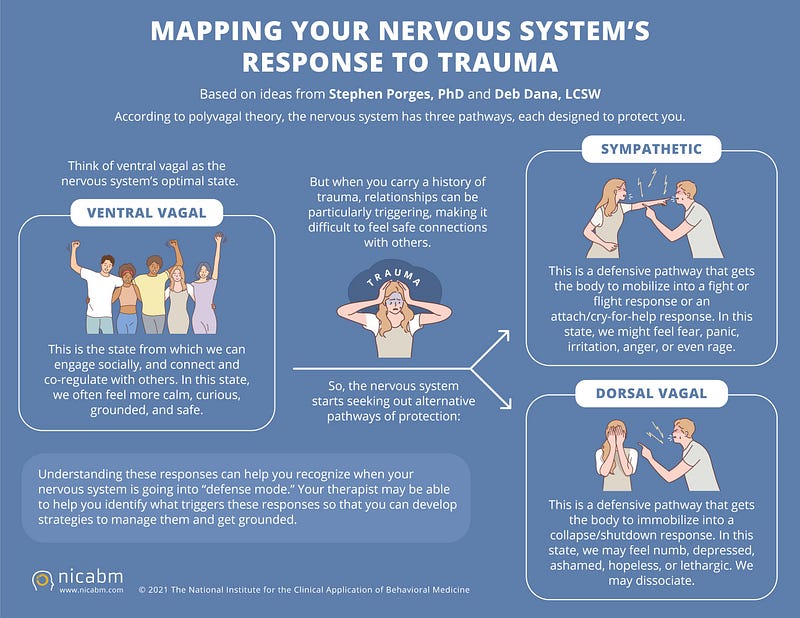
There are 6 possible responses to trauma. When we’re triggered, we’re likely to default to one of these reactions.
- Fight- Fight occurs when we shift into confrontation mode. This can present as anger, defiance, demands, or other outbursts.
- Flight- Flight occurs when we attempt to avoid the threat. This could manifest as anxiety, overthinking and over worrying, fidgeting, workaholic tendencies, or denial.
- Freeze- Freezing is most often characterized by dissociating behaviors. When we freeze, we might experience brain fog, numbing, and even losing time.
- Fawn- Fawning is a lesser-known but common response to trauma. Those who fawn attempt to circumvent the experience with people-pleasing, flattery, fear, self-sacrifice, and agreement to avoid making waves.
- Flood- Flooding happens when the reaction to a trauma trigger is to be overwhelmed with emotions. This is when the nervous system is intensely dysregulated.
- Fatigue- Fatigue is another possible reaction to triggers of trauma. It’s possible to feel overwhelming fatigue and exhaustion at the mere presentation of a potential threat, which can also be considered another way to dissociate and numb oneself.
Keep in mind that each of these responses is a way the body has adapted to survive. There’s no right and wrong when it comes to how we handle trauma. However, noticing our tendencies can help us become more aware of them, which can lead us to coping skills to help regulate the nervous system response we’re most likely to experience.
How to Regulate the Nervous System
Recognizing activation is simply a first step. It’s important to also learn how to manage triggers and to regulate an agitated nervous system. According to exercise physiologist Chelsea Long:
The parasympathetic nervous system is part of the body’s autonomic nervous system. Its partner is the sympathetic nervous system, which control’s the body’s fight or flight response.
The parasympathetic nervous system controls the body’s ability to relax. It’s sometimes called the “rest and digest” state. It helps maintain daily functions like your resting heart rate, which is your heart rate while your body is at rest; your metabolism; and your resting bronchial constriction, which affects your breathing rate. It essentially keeps you in a relaxed state.
Dysregulation of the nervous system is often experienced as feeling overwhelmed and disempowered. While it can certainly impact our mental health, it can also be detrimental to our physical health. Our immune response can be reduced by an excess amount of stress in our bodies.
It’s important to first become aware of the experience of dysregulation. Identifying the experience is important, but we must also learn strategies to regulate an upset nervous system.
- Exercise
- Deep breathing
- Grounding practices
- Meditation
- Yoga
- Spending time with a support system
- Spending time with pets
- Engaging in a fulfilling hobby
- Spending time in nature
In the middle of overwhelm and feeling powerless, it might not seem like the time to go for a jog or drop into downward dog. Sometimes, the simplest step is to become aware of our breathing. Deepening our inhales and slowly lengthening our exhales can help return the body to a calmer state.
What We Resist Persists
It can also help to feel our emotions rather than trying to avoid them. Interestingly enough, as I was working through my trauma, I realized that my first instinct is to block emotions that come up. When I want to cry, I suppress that response.
I didn’t realize how hard my body was working to block those outlets to my emotions until that moment. When I blocked them, the feelings had nowhere to go. They would just stay inside until I exploded later in an emotional episode.
Becoming aware of the tendency to block emotional expression was a turning point for me. Now, when I need to cry, I suppress the desire to block it. I allow tears to fall. I feel my feelings as they’re happening to me so that I don’t have to feel them all later in therapy. I experience them and then let them pass. And they always pass.
Once I began feeling my emotions rather than resisting them, it became easier to return to a state of calm. It also helped clear the way for me to utilize other coping strategies. I felt more able to use my senses to ground me in the present. I found techniques like tapping, vagus nerve massage, and reiki healing that helped return me to a state of calm.
Regulation Isn’t the End Stage of Healing
Everyone is different, which is why there is no one-size-fits-all strategy to get us back to a calm state of mind. It often takes practice and trying several options to find what works. Regulating the nervous system isn’t the last step to healing. It’s just one of them. After learning to calm the nervous system, there are other steps we need to take to keep it regulated:
- Address the damage caused by a previously dysregulated nervous system.
- Build stronger coping mechanisms.
- Create more supportive relationships.
These steps help us to maintain a state of regulation. When we’re healing from trauma, we begin to learn all the ways in which our choices were influenced by dysregulation. We begin to make new choices — choices that respond to the present moment rather than reacting to one originating in the past. It can be surprising to see just how powerful the change is to our lives when we’re choosing from a place of serenity and power.
I’m learning how to be a peaceful person who still feels passionate about many things. Healing from trauma is never an easy process, but it’s extraordinarily rewarding. The choices I made when I had unhealed trauma often lead to more trauma. My romantic relationships were often unhealthy. My family relationships were strained.
As I began to heal, I no longer found it difficult to break destructive dating patterns. The unease I felt with my family dissipated. I felt a stronger sense of self as I broke down the barriers keeping me chained to the past.
When strong feelings surface, I don’t resist them, but I do get curious. I used to go from zero to 60 in seconds — instant activation. Now, I’m learning to go from 60 to zero by going deeper into my internal processes to find a state of calm.