
Transversality of Information in Heptabase (Part 1)
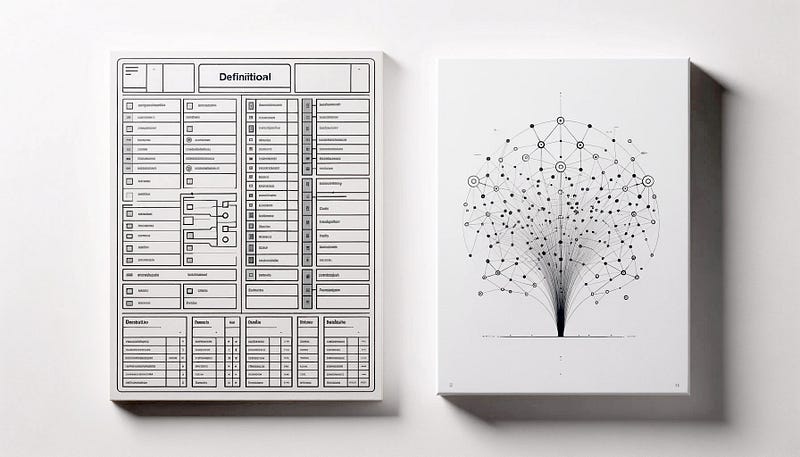
Two “Aspects” of Information
Information has two types, or aspects: “Definitional” and “Presentational”. Definitional information becomes effective when indexed, while presentational information becomes effectively utilized when arranged.
Definitional information often converges or encompasses concepts, or is classified to clarify its role. It’s not necessarily effective just by being arranged. On the other hand, presentational information may serve as an intermediate point when arranged, or may indicate the relevance or weight between things, often not identifiable as “definitional”.
Moreover, these two aspects can either give depth to a single piece of information if they are facets of the same, or influence each other if separate. For example, if “definitional information” is well-organized, it can become a catalyst for effectively arranging the other, “presentational information”. Alternatively, new “definitions” may arise when “presentational information” is better arranged.
Although most information has both aspects, more purely definitional information functions better when not arranged, while more purely presentational information should ideally not be indexed.
Each aspect should be handled in the form most suited to it, and should be utilized concurrently.
Two “Spaces” Provided in Heptabase
Heptabase offers a mapping attribute area called “Whiteboard” and a management attribute area called “Tag”. Information can be handled in both areas, or exist in just one.
In general information apps, the Tag function is often an additional feature. Whether the structure is directory-based or map-based, the tags are usually “added” to the information existing on the underlying infrastructure. In most such apps, information that “exists nowhere but only has tags” does not exist.
However, in Heptabase, if a Tag is attached, the information exists in the management area, even if it does not exist on the Whiteboard.
This means there are:
- Information existing in both the Whiteboard and Tag areas
- Information only arranged
- Information only managed
- Unaffiliated information
What I strongly felt disconcerting when I first used Heptabase was the “equivalence” of the Tag area to the Whiteboard area. The general notion had been that tags were classifications “belonging somewhere”, and in many cases, tags quickly became saturated and unusable.
However, a month after starting to use Heptabase, it made sense. Both the Whiteboard and Tag have deep structures, which are very carefully designed.
Information has its “appropriate place for utilization” according to its aspect, and each needed to be mutually utilized under the same operational system. That’s why the developer created such a structure, I understood. (To be continued)


