
Translation is More Than Communication
From interlinear translation to Google Translate

Translation is commonly understood as the practice of transferring verbal meaning from one language to another. Yet this conception doesn’t do justice to how translation actually works, and how it rearranges words as it moves across languages.
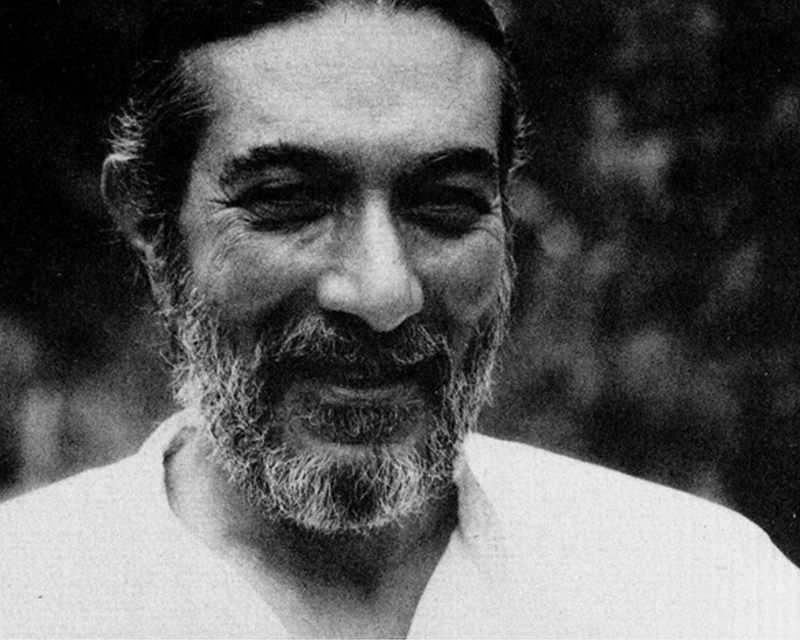
My co-author Kayvan Tahmasebian and I decided to engage with the complexities of translation by introducing Iranian poet Bijan Elahi’s translations of the German poet Friedrich Hölderlin into Persian.
We are interested in this issue for many other reasons beyond our specific interest in Elahi, including the writing of poetry, poetry translation, and the way in which language mediates consciousness. As Kayvan has written to me, predicting the potential applications of our theory of translation:
The results of our continued research on this topic can enrich the attempts to develop virtual translators like Google Translate. I’ve been taking notes about the possibilities of formulating this temporal structure in the framework of set theory and algebraic sequence.
What does a Persian translation of a German poet have to do with virtual translation and Google Translate, you might ask? It all goes back to the order of words (otherwise known as syntax) and with what happens to syntax in translation. It also relates to a certain kind of translation, called the interlinear crib, or marginal gloss. This type of translation is often associated with sacred texts, including both the Bible and the Quran. Here are a couple of examples:
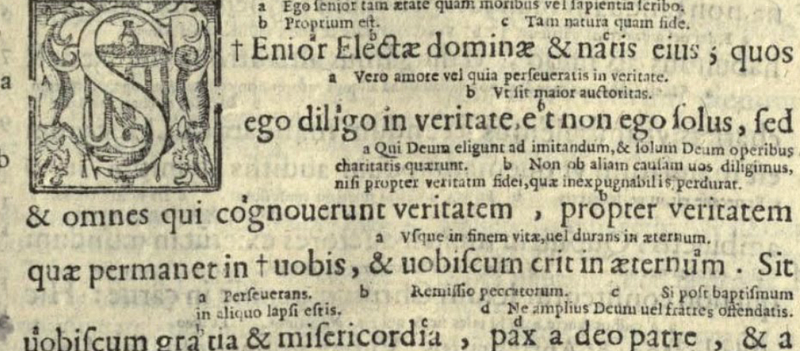
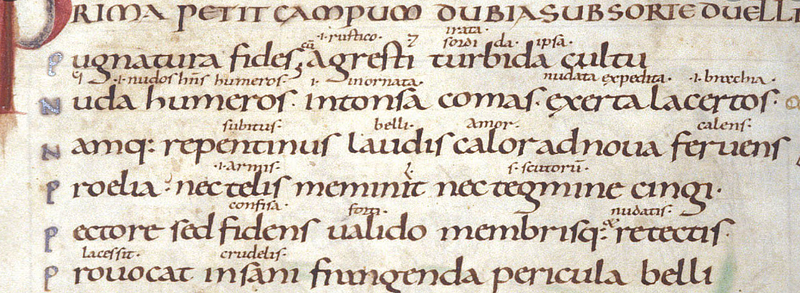
You can see above that there are two rows for every line. First, the main words of the text, which appear in a large font. Second, the commentary or gloss on the text, which appears as a smaller font, either below or above the main text. These translations are interlinear, meaning that their order exactly follows the order of the original, even when they do not make sense on their own.
Generally, interlinear translation is dismissed as irrelevant to everyday translation, as well as to literary translation. After all, the meaning of an interlinear translation is unclear when read by itself. Our goal is to contest this view, to challenge the widespread tendency to reject interlinearity, and to revive the literalist approach to translation, which enables us to see our own language in a different way, as well as to appreciate the strangeness and foreignness of the original.
Our theory of translation
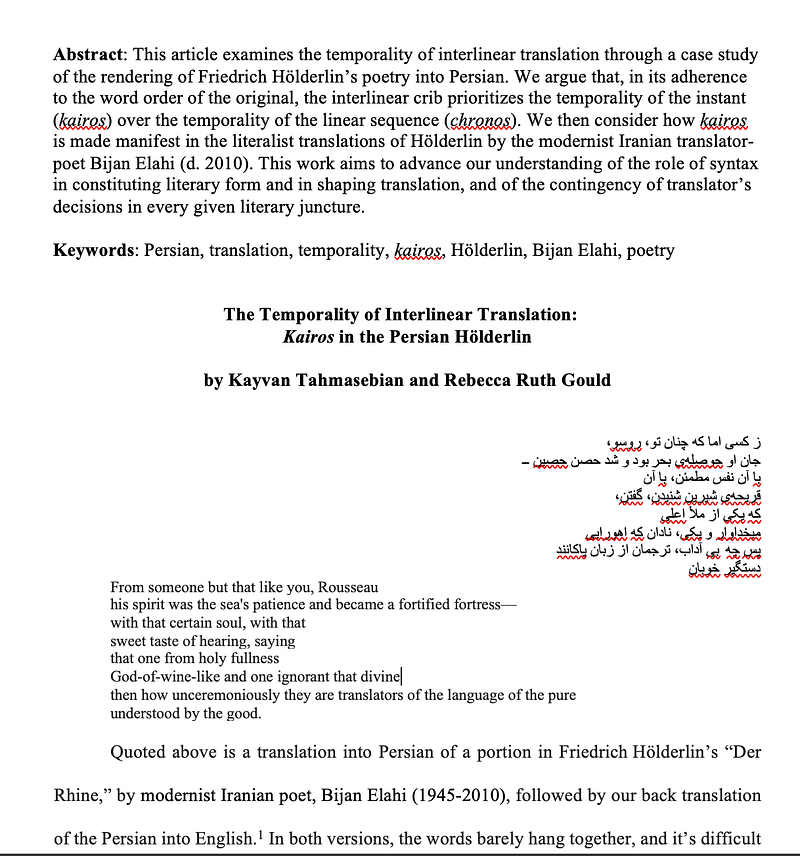
We have developed our ideas in an article soon to be published in Representations, one of the leading journals of critical and cultural theory.¹
Our article is the first to explore the Persian reception of Friedrich Hölderlin. More importantly, it is the first document in which we advance our approach to translation that keeps faith with what we call kairos, the time of the now. Kairos (καιρός) is the Greek god of chance, fortune, and certain kind of time.
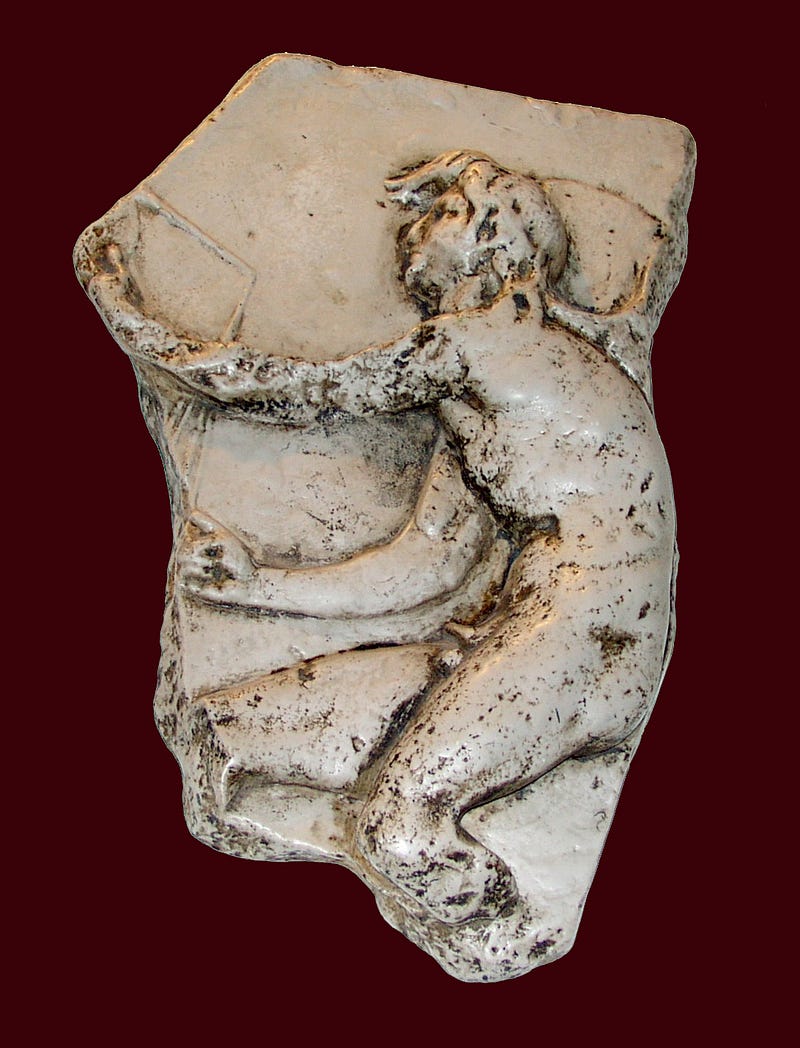

Remember the moment in Dead Poets Society, when Mr. Keating (Robin Williams) teaches his students about the meaning of carpe diem (Latin for seize the day)? That is kairos.
Here is how Kayvan explained kairos to me:
kairos is a matter of opportune moment, a slippery now, something that is irrevocably lost (now). The idea is that the sequential order of chronos flourishing to a closure must not distract us of the time of the now. What is its simplest expression in translation terms: an interlinear translation seizes the idea exactly at its time/place with no heed of sense. But a normalized translation (I mean when you reorder the words in literal translation, add or remove words, in order to make it syntactically and semantically intelligible to the receiver) betrays this irrevocability of the idea, in favour of meaning. It displaces ideas from their original moment in the hope that they are attainable at a sooner or later moment. Just like when you, for example, postpone what has to be done now. Later it is done but it’s not the same.
The problem with translation as it is currently practiced is that it leaves little space for kairos and instead focuses on another kind of time, which we call chronos. Chronos will be familiar to you as chronology. It adheres to the logic not of fate, but of reason.
How do you translate a language that doesn’t actually make sense, which is often the case with poetry?
We argue that kairos is needed here more than chronos. Kairos is best embodied in interlinear translation, not in a readable yet banal rendering that erases the strangeness of the original in order to force it to make sense. Imagine a dance that simply follows pre-established rules. Or a poem that is grammatical but uninteresting. These are the result of too much focus on chronos at the expense of kairos.
One of our major inspirations in this endeavor is the German writer and critic Walter Benjamin, who reflected widely on politics and culture. Among Benjamin’s most important works is “The Task of the Translator” (1923), a fervent theoretical defence of literalism in translation.
In contrast to Benjamin, recent scholarship has paid little attention to literal translation. In an age when even Google Translate can make more sense than a human-generated interlinear crib, the exigency and significance of word-for-word rendering continues to be overlooked.
If translations are to be defined and categorized according to their axes of fidelity, interlinear translations are those that remain faithful only to the caesura — and therefore to the rhythm — of the original, without which words lose their distinction and ultimately their meanings.
Hölderlin as Case Study
.jpg)
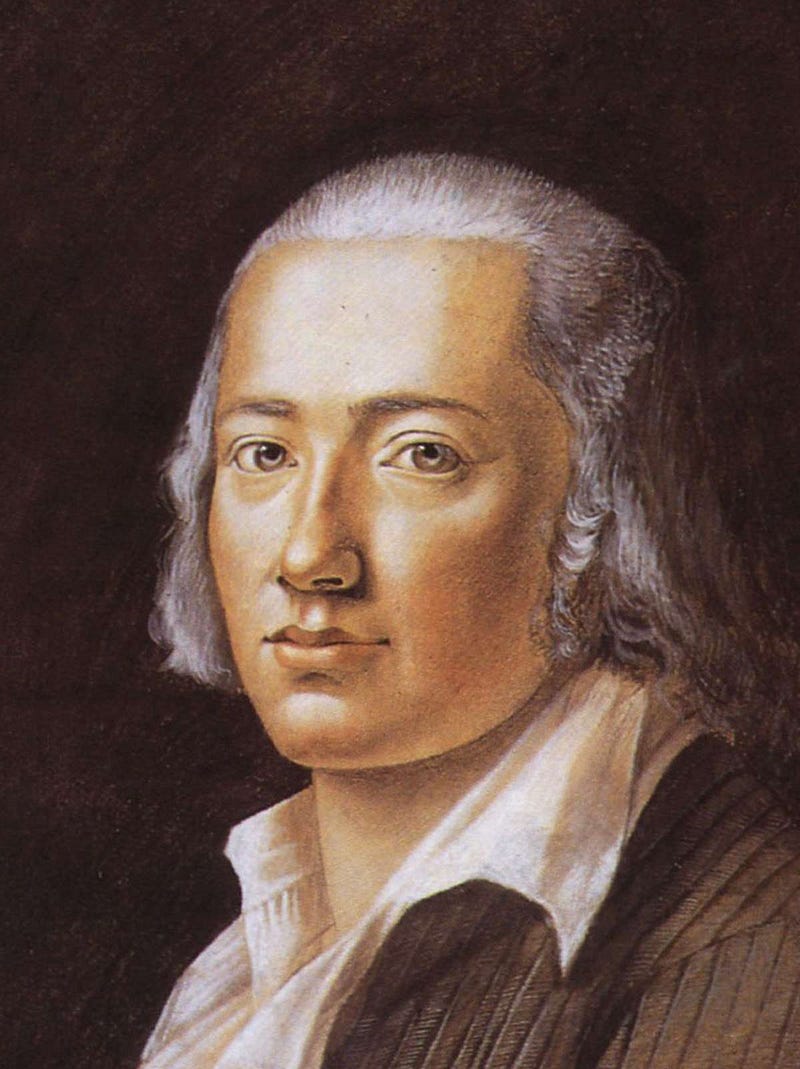
When he translated Hölderlin’s poems in Persian, Elahi believed that fidelity to the sequence of ideas in a text matters as much as the meanings the text may represent. This caused many readers of Elahi readers to attack him and to suggest that he didn’t understand translation. We however believe that Elahi understood poetry translation better than any of his contemporaries.
Hölderlin once compared translation to gymnastics. “It gets beautifully supple when forced to accommodate itself to foreign beauty and greatness and also often to foreign whims,” he wrote to his friend and fellow student Christian Ludwig Neuffer, a poet who was at that time translating Virgil.² Much like his Persian translator Elahi, Hölderlin’s approach to translation shifted according to the exigencies of the moment. He used translation to transform the language into which he was translating.
Given this precedent, it is unsurprising that the Persian poet who was drawn to Hölderlin more than any other is Bijan Elahi. As a pioneer of late Iranian modernism, Elahi did more than any other poet to transform Persian poetry through his translations from world literature in Spanish, French, Arabic, modern Greek, English, and German.
Poetry creation shares in common with translation the compulsion to interrupt everyday speech, and to disorient the medium of language in order to bring about a new revelation. Hölderlin’s Persian translators brought about this reorientation through translation.
While the most commonly trodden path to Hölderlin in modern Iran leads through Heidegger, whose influence on Iranian modernism and on state-based Shiʿa Islam was tremendous, our focus is on Hölderlin’s trajectory within Persian poetics, and his role in probing, and then extending, the limits of language.
What we offer is less commentary on Hölderlin’s poems and their translations than a poetics of engagement, through translation, with language at its limits.
Conclusion
It is impossible to explain or justify all aspects of our approach to interlinear translation here. Luckily, our article does that in detail.
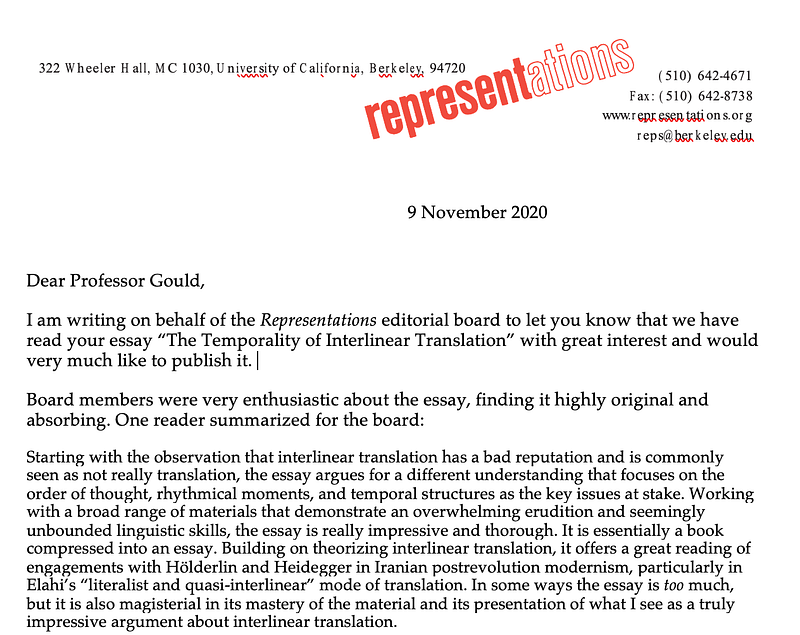
I will end with comments from Representations’ editorial board about our work:
Finally, a preview of the first page from our article, to be published this summer:
References
[1] Kayvan Tahmasebian and Rebecca Ruth Gould, “The Temporality of Interlinear Translation: Kairos in the Persian Hölderlin,” Representations (scheduled for summer 2021).
[2] Friedrich Hölderlin, Samtliche Werke, edited by Friedrich Beißner and Adolf Beck, 8 vols. (Stuttgart: Cotta/Kohlhammer, 1943–85), VI, 109–10, 125.
To read more about the work of our collective GlobalLIT to decolonize literary theory and to globalize world literature, sign up for our newsletter here: