
Transition Design: Fast and Slow thinking
Discussion notes from 10 Feb 2016 (Saumya Kharbanda and Dixon Lo)
Schedule for the day: 9:00–9:20 Discussion on David Orr and Stewart Brand readings 9:20–9:40 Warm-up futuring exercise. 9:40–10:40 “Thing from the future” game (made by the Situation Lab) 10:40–11:20 Reflection and Expansion of Thing from the Future game
Discussion on David Orr and Stewart Brand readings
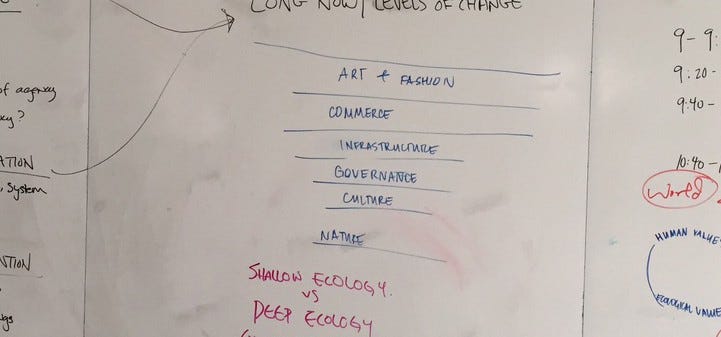
Discussion revolved around the need for different layers of civilisation operating at different time horizons. It was noted that David Orr is a little pessimistic about fast knowledge, while Brand cites all levels as useful for creating Healthy Civilisation. We also discussed fast and slow knowledge in comparison to shallow and deep ecology. Shallow ecology stops short of fundamental change and promotes somewhat quicker fixes (e.g. recycling). Deep ecology includes redesign of entire system along with values in the system.
As an exercise, we tried as a class to think of examples of design driven by both fast and slow knowledge. We attempted to then understand the problems that “fast” solutions were created to solve, and then questioned how similar needs could be fulfilled with design driven by slow knowledge. The discussion generated around this exercise brought to light some interesting points. As one class member pointed out, the way we think about problems in the first place (hence the way we define needs) may be based on fast knowledge, so asking how these needs are solved alternatively by slow knowledge may not be a valid question.
Warm-up futuring exercise
Ahmed ran an empathy exercise to understand/predict changes in context over time.
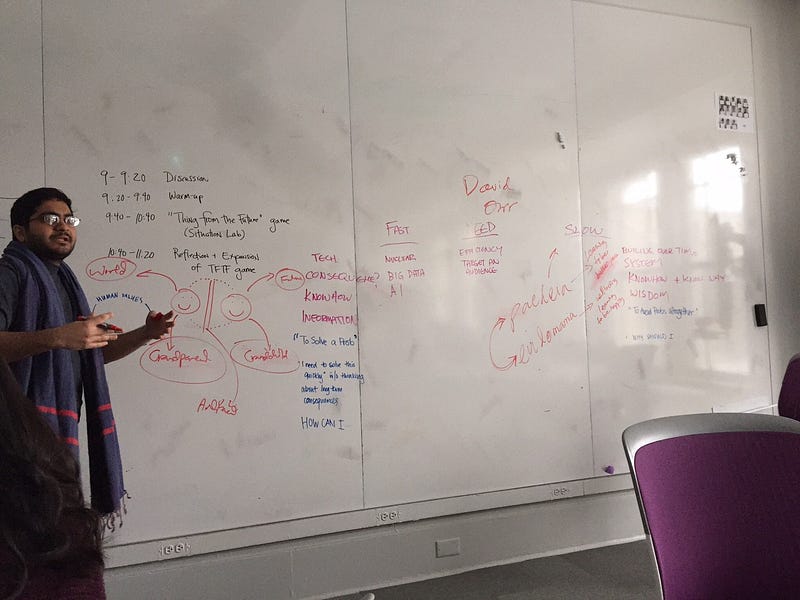
“Get in groups of 2, one of you imagine you are your grandparent, the other imagine that you are your grandchild. Talk about what the world you live in is like.”
“Thing from the future” game
Since Stewart Candy came to talk to us the class before, Kakee ran his exercise today to help us learn about future prediction.
Exercise consists of ATOM (Arc, Terrain, Object, Mood) Example logo above for a fictional cyber religion was drawn from Arc=Collapse, Terrain=Religion, Object=Logo, Mood=fervor
Groups tried to incorporate their learnings from the previous exercise as well as the wicked problem maps discussed earlier in the semester into their design solutions.
Reflection and Expansion of Thing from the Future game
What were the challenges? Thinking about near futures were the most challenging, because the group was forced to think of a logical progression into that future, whereas far futures had more freedom for imagination.
Reflections included improvements that could be made to the game. One suggestion was to include the percentage of population these cards affect; thinking about a religion that the entire world believes in is different from a cult only 10 people believe in.
Another comment was that “collapse” may be too easy a condition for Arc as it gives the scenario creator free reign in defining the world without needing to connect it to the current context.