Transhumanists Are Afraid of the Future
Instead of avoiding the cycles of life, we can embrace them for all they offer

The highest ideal in an unrestrained digital environment is to transcend one’s humanity altogether. It’s a straightforward logic: If humanity is a purely mechanistic affair, explicable entirely in the language of data processing, then what’s the difference whether human beings or computers are doing that processing?
Transhumanists hope to transcend—or at least improve upon—biological existence. Some want to use technology to live forever, others to perform better, and others to exit the body and find a better home for consciousness. Following through on mechanomorphism, transhumanism holds that people can be upgraded just like machines. By blurring the line between what we think of as biological and technological, transhumanists hope to ease our eventual, inevitable transition to life on a silicon chip.
As proponents will argue, our journey into a transhumanist state of existence has already started, with dentures, hearing aids, and artificial hearts — all synthetic extensions that change what it means to be human. Would we call contact lenses antihuman? Of course not. So why scoff at brain implants that enable us to speak new languages? Or why reject an offer to clone one’s consciousness and upload it to a server?
It’s a compelling thought: exchanging one’s humanity for immortality. Piece by piece, or maybe all at once, we become what transhumanists argue is the next stage of evolution: some hybrid of person and machine, or maybe an entirely digital species. Along the way, though, we take on an increasingly mechanistic understanding of our personhood.
Ironically, transhumanism is less about embracing the future than fixing the human experience as it is today. Medical and life extension interventions seek only to preserve the person who is alive right now. Cryonics seeks to freeze the human form in its current state in order to be reanimated in the future. Uploading one’s mind simply transfers the human brain, or a perfect clone of it, as is, into a more durable substrate.
In some ways, transhumanism is a reactionary response to the sorts of changes inherent in nature, a defiant assertion of the individual against its own impermanence. The cycles of life are understood not as opportunities to learn or let go, but as inconveniences to ignore or overcome. We do not have to live with the consequences of our own actions. There’s an app for that.
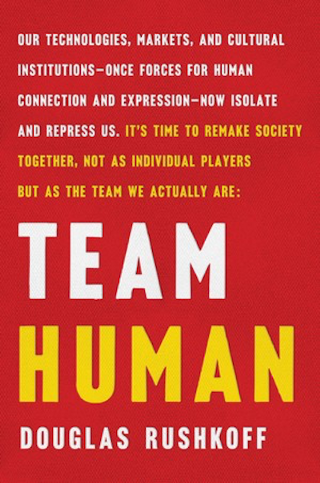
This is section 43 of the new book Team Human by Douglas Rushkoff, which is being serialized weekly on Medium. Read the previous section here and the following section here.