
Transhumanism, Gender Identity, and E.G.O. in Library of Ruina
Warning: this article contains major spoilers for Lobotomy Corporation (kept vague as possible for the purposes of the piece), and minor spoilers relating to the initial premise of Library of Ruina. It also mentions concepts related to psychological horror, cannibalism, death, and body horror. Please read with care!
Indie studio Project Moon’s breakout success began with Lobotomy Corporation, a 2016 construction and management simulation game with a premise steeped in psychological horror that may ring familiar to fans of the SCP Foundation. As the new Manager of the eponymous corporation, players must oversee the actions of employees as they converse with extremely dangerous monsters known as Abnormalities to generate “renewable” energy. At the story’s end, the corporation ultimately releases the energy stored within its underground building into the surrounding city — the Light, as it is called in the game — and in so doing grants random citizens incredible power to either manifest their desires, or be consumed by them entirely. It is this moment that sets the stage for Lobotomy Corporation’s sequel, Library of Ruina.
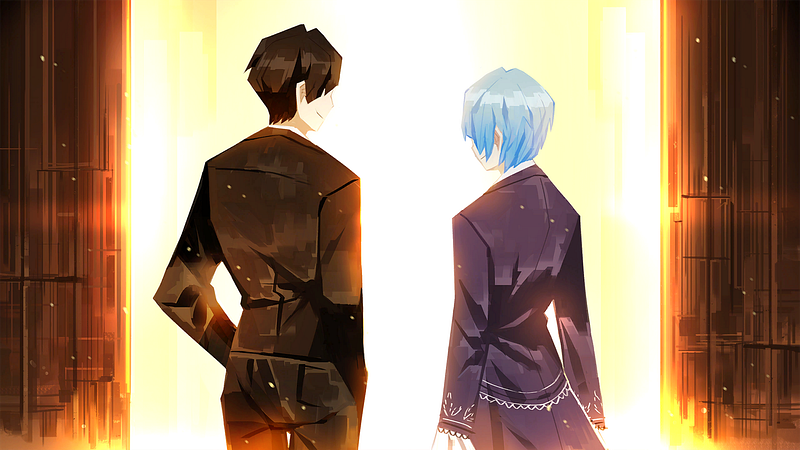
In Lobotomy Corporation, we only hear secondhand about the harsh conditions of the City above ground. It begs the question: what kind of world could the Manager and his companions live in that necessitates daily bloodbaths and OSHA violations? What omnipotent governing force drove the researchers who founded the company into hiding?
Library of Ruina answers these questions in profound and breathtaking social commentary of its own. From the start, we are familiarized with the grisly urban decay of the City as seen through the eyes of its protagonist, Roland, a freelancer who takes on less desirable jobs for a living (called a Fixer). Alongside Roland, countless Fixers sell their skills, their bodies, and even their souls to various Organizations and Syndicates in order to live another day — the City is an accelerationist’s wet dream, a hyper-capitalist nightmare machine fueled by cash at the cost of human life, sanity, and severed limbs. Every aspect of its citizen’s lives are dictated by a mysterious, omniscient organization known as the Head, whose task is to maintain the status quo to largely unknown ends. The City is a consequence of both laissez-faire markets and extreme surveillance, a deadly cocktail of neglect and micro-managing obsession. Despite positing itself as a place where disease and illness have been eradicated by technology, the City is a far cry from utopia.
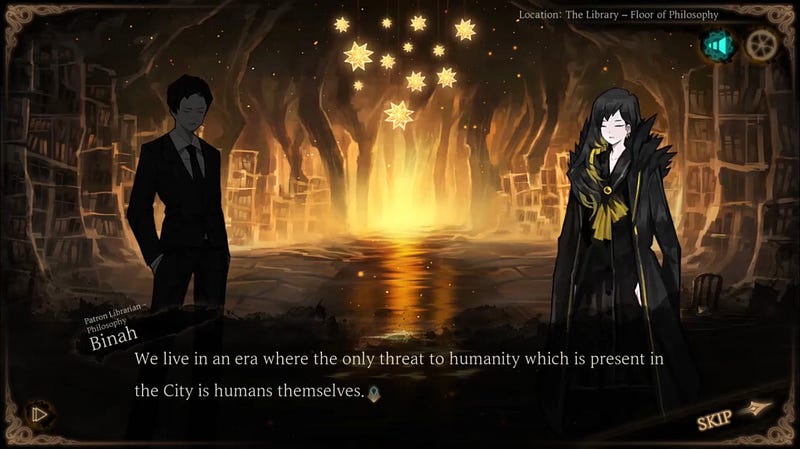
And yet, for all its prejudice and cruelty (most often expressed in the form of classism), the City offers a world that presents little in the way of diegetic gender or sexuality norms — after all, in a place where cannibals roam the streets and fulfilling prophecies written on scraps of cloth could be life-or-death, most people have more dire concerns. Perhaps this fact in itself has drawn so many transhumanist thinkers and transgender fans to the game.
In Library of Ruina, the aftermath of Lobotomy Corporation’s destruction is referred to as the White Nights and Dark Days. When the Light rained down onto the City, it did so over a period of four days; in that time, the Light touched various individuals at random, and began a slow transformation process within them. Some of those who received the Light would gain incredible power in the form of a suit, weapon, or other physical augmentation called E.G.O. (Extermination of Geometrical Organ). While formerly used in Lobotomy Corporation to subdue unruly monsters (and is ordinarily extracted from monsters themselves during conversation with them), the Light-induced variety of E.G.O. takes on a form suitable for the wielder. Think of it as a physical extension of the self that contains both tangible strength and symbolic value. For example, a thick suit of armor forged of pulsing blood and muscle might belong to someone who has sworn to protect others with brute force, even at the cost of their own safety. There is usually an emotional link between an individual and their E.G.O.
On the other side of the coin are Distortions. Distortions are uncontrollable manifestations of the self, or the darkest ideas and vices within us. The advent of the Light is not inherently positive — some people, often those overcome by negative emotion, lose control of themselves, and thus how their Light manifests in reality. Players will encounter characters who are ravaged by grief that permanently alter their appearance and functioning until they are no longer human, fully crossing the boundary into Distortions. In contrast with E.G.O., Distortions represent and result in a total loss of control — the full surrender and decay of the former self.
The line is not so rigid, however: Project Moon developer notes in the recently published digital artbook confirm that, as is implied in the game, there is a vast spectrum between ordinary humans, Distortions, and E.G.O.I.S.T.s. That spectrum is typically quantified via the level of control and self-awareness one has during (and after) their transformation. Any and all transformations of this nature, be it from human to Distortion or humans manifesting their own E.G.O. components, are referred to under the umbrella term for these events: the Distortion.
The phenomenon of the Distortion is in itself a transhumanist concept — when people receive the Light, it enables them to transcend the limitations of the flesh in favor of expressing the soul (for better or worse). Likewise, the living conditions of the city present transhumanist stakes: augment or replace your body in order to survive, or face certain death. It is not only consequential, but encouraged for residents of the City to undergo drastic procedures and transformations to get by. Gender and bodily experiences have no reason to be rigidly categorized in a universe where survival via augmentation is paramount.
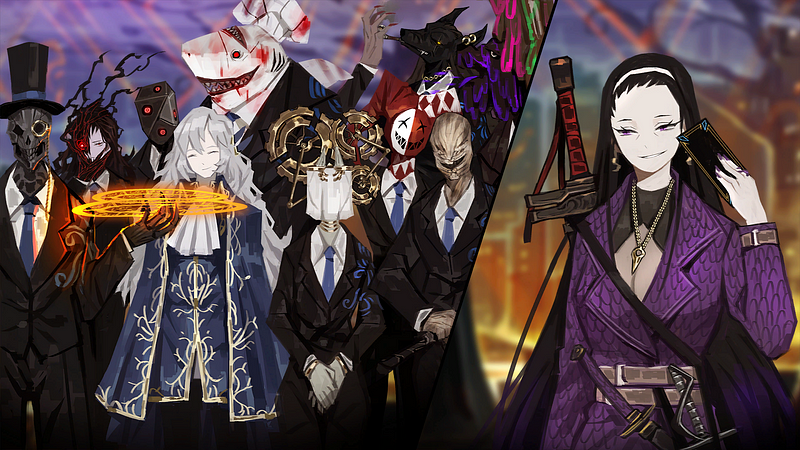
Library of Ruina represents this idea in various ways that resonate with fans all across the gender spectrum. Certain characters have names and designs that may be unusual if filtered through a gender absolutist lens; those we may read as male have feminine names, and those read as female may have masculine ones (and of course, gender-neutral names are abundant throughout the story). Hulking robots with dainty high-pitched voices and feminine mannerisms are high-ranking Syndicate officials, while visibly androgynous cannibal chefs write up cookbooks. A circus troupe of wild animals, clowns, and skeletons marches through the streets to the heartbeat of a delirious drum, all surrounded by writhing masses of flesh that defy explanation and norms of expression altogether.
The Distortion embraces the spaces in-between. It posits that human beings are not just human beings — that we are a complicated, multi-faceted thing called the self, which can be manifested as human, animal, machine, and anything else under the sun (or beyond it). It is our messy wants and ideas and desires, and can only exist in the beautiful, maenadic chaos of a city where the gutters run with blood. It is, perhaps, a small window into the “cyborg world” of Donna Haraway’s imagining in A Cyborg Manifesto: “a place… about lived social and bodily realities in which people are not afraid of their joint kinship with animals and machines, not afraid of permanently partial identities and contradictory standpoints.”
During my own player experience, a character named Hokma resonated with me the most by far. As a result of enduring extreme trauma and wielding incredible responsibility, he experiences a stark change in appearance across both Lobotomy Corporation and Library of Ruina — where others among the main cast consistently look to be in their thirties, Hokma aged more rapidly, and is thusly dubbed the “resident geriatric” of the library by our plucky protagonist Roland. Each member of the main cast (the Sephirot plural, and Sephirah for each individual) has a body made of Light itself; each of their appearances is thus a symbolic projection of how they might view themselves, another transhumanist component of the game’s narrative.
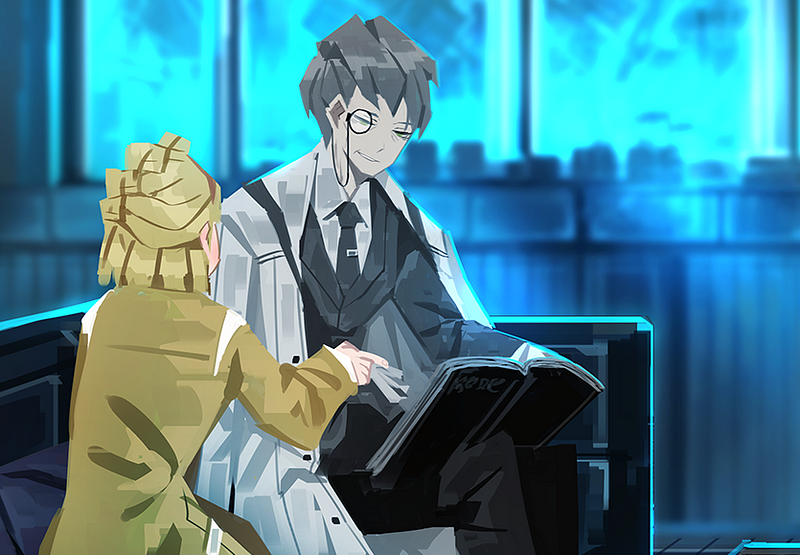
Hokma’s pain stems primarily from his relationship to the Manager in Lobotomy Corporation, and all that he endured for the sake of realizing their goals. His perceived age is both a mirror of his self-image and his wisdom obtained through agony; the pain is an intrinsic part of his identity, as is the will to accept what has transpired and move forward. Having grown up in a tumultuous household with two younger siblings, his story struck close to home — while our circumstances may change us, they also teach us. It would have been easy for me to slip through the cracks of society and disappear with the many disenfranchised children who grew up in troubled homes. In passing I’ve met some of them, and even been able to impart advice that later helped them cope with their own unsupportive or violent parents. I am grateful for that knowledge, the help of friends, and what little tenacity I’ve scrounged up in myself. In spite of it all, I’ve managed to recover enough to channel these negative experiences into writing, that my words might help someone else. Likewise, where Hokma could have fallen victim to total despair, he endures. Where he lost so much time to an environment of constant suffering, he finds new purpose in using his knowledge to enrich the lives of those around him — while his pain manifested itself in wrinkles and scars, his kindness and patience were made real by the strength of his beliefs. That absinthe twinkle in his eyes is still there, even in his twilight days.
Perhaps the most obvious representation of the Distortion’s effects, the protagonist Roland himself is depicted in multiple forms throughout key battles in the library. When he becomes emotionally unstable, his control over E.G.O. lapses, giving way to different selves in the form of Distortions. Each one is uniquely beyond our perception of “human”, some more so than others — a dagger-toothed homage to Red Riding Hood, a gangly scarecrow shedding bloody straw, a winged beast with as many eyes as books on the library’s shelves, a pink and purple Lisa Frank magical girl serpent with hearts along the tail, a golden royal clad in a skirt and extravagant flowing cape, to name a few. All of these Distortions are unquestionably different facets of Roland himself. There is no binary attempt to explain them, nor how they fit into his psyche; each manifestation’s significance is left largely to interpretation.
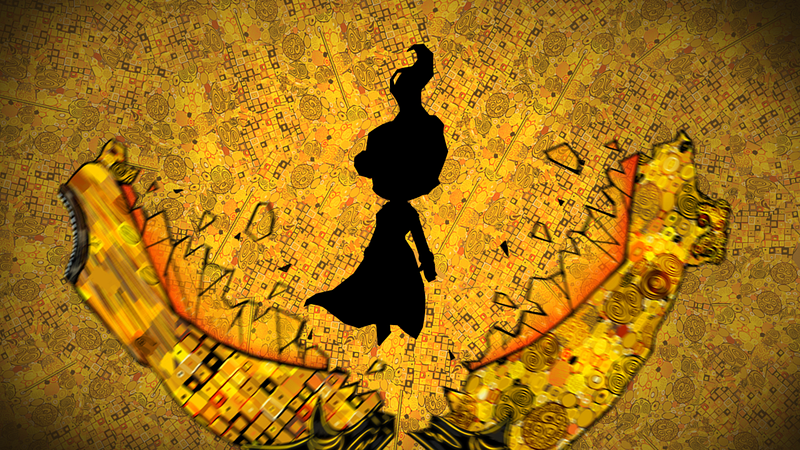
Whether or not players interpret Roland himself as transgender is another line of analysis entirely; the greater allure of this choice is the question that, if we lived in a world without arbitrary taxonomy of our bodies, does the birth form of the flesh really matter at all in defining one’s personhood? This brings us to the intersection of transhumanism and transgender identity: if we understand humans as beings of the soul rather than the corporeal, there are then no logical limits to self-expression.
Even in its striking inequality and ugliness, the world presented in Library of Ruina could almost be considered comforting for those deep in the throes of gender dysphoria—our lives are already fraught with tragedy and the daily threat of violence. The horrors of the City can only shock us so much. At the very least, it is a place of naked honesty about its true nature, where we can find truer reflections of ourselves than we do in our own communities. It centers the experiences of those disenfranchised by the Head and their peers, presenting their pain as a symptom of a broken world rather than an accessory or aside to invoke fleeting pity; by the same token, it presents the daringness to embrace one’s E.G.O. in the face of despair as a great triumph. It ascribes narrative value and worth to those who feel worthless in a place designed to make them obey — a catharsis we are rarely afforded in reality.
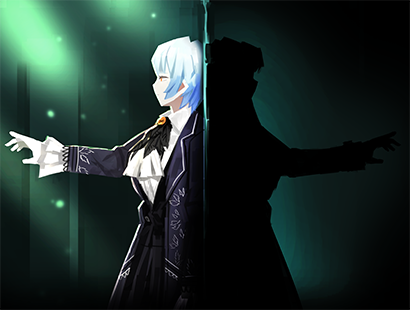
The ultimate goal of spreading the Light into the City is to carry out the will of a late researcher who was very close with the cast — to create a world where people have the freedom to be their most authentic selves by “curing the disease of the mind”, the cynical compulsion to follow the draconian status quo of the City without maintaining dreams or desires of their own. Sharing the power of the Light would, ideally, grant everyone the power to seize control of their own futures. In our own world, transgender people are always reaching for that “Light” — the ability to be our most authentic selves without scrutiny or violence leveled against us. Our “Light” takes on many forms: better education about gender, safe and equitable housing communities, ending employment discrimination, and conquering learned prejudice with newfound compassion. These are the small yet sincere powers we possess to manifest ourselves, to become E.G.O.I.S.T.s of our own making.
For more information about Project Moon, visit their website, or consider trying out Library of Ruina on Xbox Gamepass.



