

Transforming MLOps with Kubeflow & KServe: Churn Prediction
As a Kubernetes wrangler, you have probably heard the buzz about MLOps and its potential to revolutionize data-driven businesses.
While the potential ROI is significant (reducing churn by a mere 5% can boost profits by 25-95% [^1]) , building and maintaining effective MLOps pipelines can be daunting, especially if you're new to the machine learning world.
In this guide, I'll show you how to effectively use Kubeflow, KServe, and Flask to predict customer churn.
Traditional MLOps workflows often grapple with several pain points, such as:
- Managing the growing volume of data and models.
- Maintaining and scaling the underlying infrastructure.
- Seamlessly integrate and deploy models into production.
- Managing operational costs effectively.
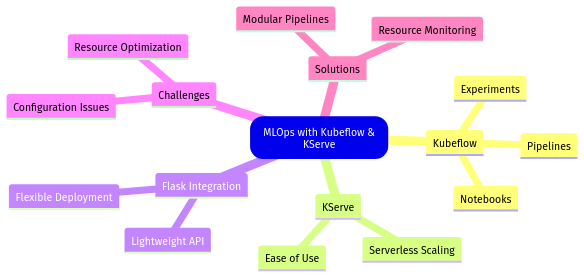
Enter Kubeflow, an end-to-end MLOps platform that streamlines machine learning workflows, and KServe, its serverless model deployment component.
Together, they offer a robust solution to these challenges.
Why MLOps Matters
Efficient MLOps practices can significantly impact businesses by:
- Accelerating the time from model development to deployment.
- Enhancing the ability to retrain and optimize models.
- Facilitating the handling of large-scale data and model training.
- Leading to more informed decision-making and competitive advantage.
Why Kubernetes is a popular choice for MLOps?
Kubernetes is a popular choice for MLOps because it:
- Efficiently manages resources and scales applications.
- Ensures optimal usage of computing resources.
- Allows for easy deployment across different environments.
Why Kubeflow?
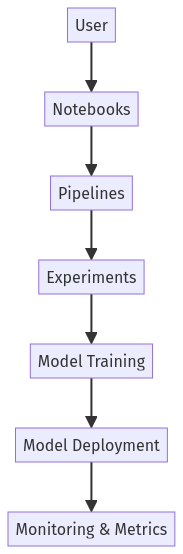
Kubeflow is a comprehensive platform that supports the entire machine learning lifecycle. It comprises several key components:
- Pipelines automates the workflow from data ingestion to model deployment, streamlining the process and ensuring consistency.
- Notebooks provides an interactive environment for data scientists to experiment, develop, and fine-tune models efficiently.
- Experiments tracks and manages different model versions and experiments, facilitating better model management and iteration.
These components work together to simplify and enhance the MLOps process, making it easier to manage, deploy, and scale machine learning models.
KServe & Serverless MLOps
KServe simplifies model deployment and scaling on Kubernetes with its serverless architecture, automatically adjusting resources based on demand.
Minimized operational overhead, automatic scaling, and cost-effectiveness makes KServe a powerful and straightforward choice for deploying, managing, and scaling machine learning models.
Case Study: Churn Prediction Project
In this project, my focus is on the MLOps pipeline, not the specific churn prediction algorithm.
I used Flask to create an API for the model, simplifying deployment and management with KServe.

What is Churn?
Churn prediction identifies customers likely to leave, allowing businesses to take proactive measures.
Using a telco dataset with customer data and churn status, I designed a Kubeflow pipeline to automate the entire process.
import kfp
from kfp import dsl

def preprocess_op():
    return dsl.ContainerOp(
        name='Preprocess Data',
        image='myrepo/preprocess:latest',
        command=['python', 'preprocess.py']
    )

def train_op():
    return dsl.ContainerOp(
        name='Train Model',
        image='myrepo/train:latest',
        command=['python', 'train.py']
    )

@dsl.pipeline(
    name='Customer Churn Prediction Pipeline',
    description='An example pipeline for customer churn prediction.'
)
def churn_prediction_pipeline():
 preprocess_task = preprocess_op()
 train_task = train_op().after(preprocess_task)

if __name__ == '__main__':
 kfp.compiler.Compiler().compile(churn_prediction_pipeline, 'churn_prediction_pipeline.yaml')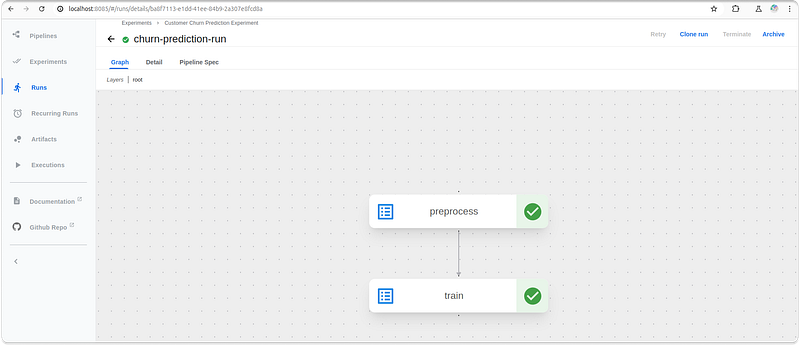
What does the Flask Web App do?
The Flask web app:
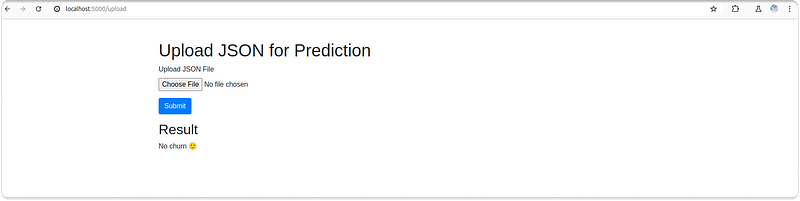
- takes a JSON file from the user,
- communicates with the model,
- analyzes file,
- finally returns the churn prediction result, chur or no churn.
from flask import Flask, request, jsonify
import requests

app = Flask(__name__)

@app.route('/predict', methods=['POST'])
def predict():
 data = request.json
 response = requests.post('http://kserve-model:8080/v1/models/customer-churn:predict', json=data)
 result = response.json()
    if result['predictions'][0] == 1:
        return jsonify({"prediction": "😢 Churn"})
    else:
        return jsonify({"prediction": "🙂 No churn"})

if __name__ == '__main__':
 app.run(debug=True)
Let’s simulate a customer profile that is more likely to churn.
      {
        "gender": 0,
        "SeniorCitizen": 1,
        "Partner": 0,
        "Dependents": 0,
        "tenure": 1,
        "PhoneService": 1,
        "MultipleLines": 0,
        "InternetService": 1,
        "OnlineSecurity": 0,
        "OnlineBackup": 0,
        "DeviceProtection": 0,
        "TechSupport": 0,
        "StreamingTV": 0,
        "StreamingMovies": 0,
        "Contract": 0,
        "PaperlessBilling": 1,
        "PaymentMethod": 2,
        "MonthlyCharges": 95.75,
        "TotalCharges": 95.75
      }
This customer exhibits a profile that is likely to churn.
Why?
We have observed that the customer is still in the early stages of their relationship with the company and may not be fully committed and has the flexibility to leave at any time, making them more likely to churn.
It’s crucial to remember that this is a prediction based on a single data snapshot.
For more accurate predictions, analyzing long-term behavior and other factors like customer service interactions, promotions, and competitor offerings is essential.
You can expand this study including other classifiers such as Logistic Regression, Random Forest, Gradient Boosting Machines, and Neural Networks.
Why KServe?
I want to focus on our model’s business logic and integration with other applications rather than worrying about the underlying infrastructure details.
Deploying the Flask-based model on KServe is straightforward:
apiVersion: "serving.kserve.io/v1beta1"
kind: "InferenceService"
metadata:
  name: customer-churn-model
  namespace: kubeflow
spec:
  predictor:
    serviceAccountName: sa-minio-kserve
    sklearn:
      storageUri: "s3://mlops-data/model.pkl"
Once I port forward the model endpoint, it is accessible for predictions.
We can interact with it programmatically (e.g., from our application’s backend) or through tools like curl or Postman.
curl -X POST \
  http://localhost:8080/v1/models/customer-churn-model:predict \
  -H 'Content-Type: application/json' \
  -d @input.json
Using flask based webapp:

Key Takeaways from Our Practical Implementation
- Manual management of ML workflows was time-consuming, prone to errors, and required significant developer effort. With Kubeflow Pipelines, we automated the entire process, reducing workflow management time and decreasing errors. This automation freed up developers to focus on model development and optimization.
- Deploying models manually resulted in inconsistent performance, frequent downtime, and scalability issues during high load periods. KServe provided automatic scaling and efficient resource utilization, resulting in improved model response time and reduced downtime during peak usage.
- Integrating the model with applications was cumbersome, with slow response times affecting user experience. The Flask API integration streamlined interactions, improving response times and simplifying the integration process, which reduced development time.
- Over-provisioning resources led to high operational costs, with many underutilized resources needing to be utilized. Implementing a serverless architecture with KServe reduced resource costs by 40%, as resources were automatically scaled based on demand, ensuring optimal utilization.
- The ML lifecycle stages were disjointed, causing delays and inconsistencies across data ingestion, preprocessing, training, and deployment. Kubeflow’s end-to-end automation reduced the time to deploy a new model version from weeks to days, improving consistency and reducing manual intervention.
Enjoyed this read?
If you found this guide helpful, check my blog archive for more challenging projects Kuberada 📚✨
Until next time!
[¹]: Harvard Business Review: The Value of Keeping the Right Customers


