
TRANSFORMATIONS for the WORLD and EACH OF US
There is a force for change from simple to revolutionary. Are you ready?
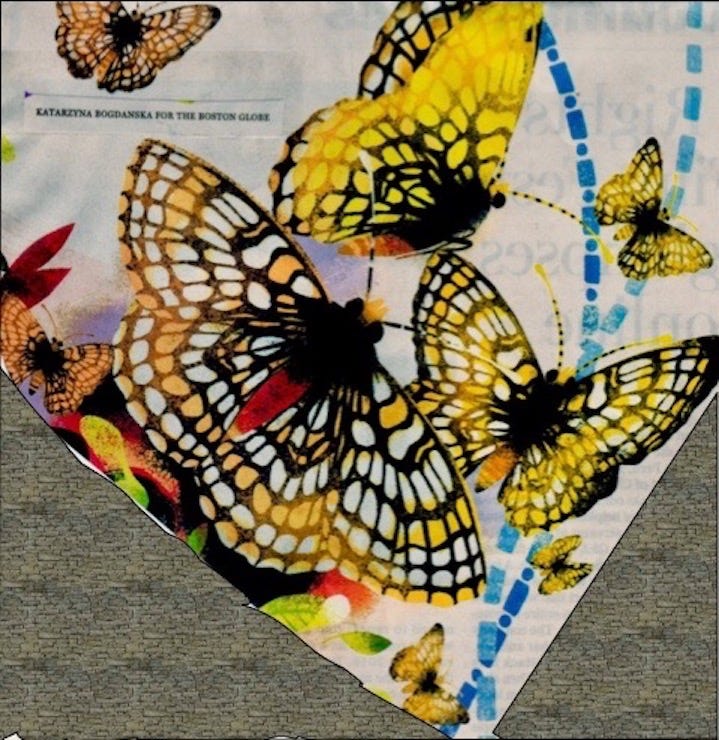
Butterflies represent a natural force for transformation. People fight change. Nature does not. The pandemic is forcing change on individuals, societies, economics, education, spirituality, technology, etc. Unfortunately, most of what I read is about how they feel about events — pushing us to feel their way. None, or very few talk about what to do about it or push what others, government, corporations, etc. should do. The few that make suggestions are very narrowly talking about how to “save” their specialized field, which often conflicts with other fields. None see the big picture of the whole world.
The Buddha said “rest your attention lightly, like a butterfly resting on a flower”
“Awareness is like the sun. When it shines on things, they are transformed.” Thich Nhat Hanh
Ayodeji Awosika (Medium) says, “What does ‘transform your life’ even mean?” “I’m not perfect, but I’m aware, and that’s the first step.”
In the Boston Globe, June 7, 2020, I was moved by Joshunda Sanders’ first sentence in which she does refer to the world. She says, “The main message of Sonia Shah’s latest book is that another world is possible.” I hope to read about some transformations. She is talking here about the migration — “On the Move”, but the words could apply to all events, and she uses “the butterfly as a universal symbol of transformation, resilience and perspective.”
Education:
Although I have taught on and off for 50 years in colleges and schools, now at 87, I can only communicate with those in education, and read and write articles. An article in the Boston Globe, March 24, 2020, on education was titled, Disruption by David Scharfenberg (D.S.). It is the best I’ve read on the state of higher education today. But most of his points are narrowly confined to education, and there is no field that should be as connected to the whole world as education.
A summary of problems, from D.S. — and I concur — started long before the pandemic, and is more critical now.
- “The value of an increasingly expensive college education. … A big swatch of college students weren’t working, and weren’t learning much either…. It is out of reach of too many people. A Boston University student complained, ‘was all the stuff (gym, televisions, buildings) really worth $70,000 a year?”
In my teaching I preferred students who did not go to college. Then I would not have to unteach the rules they had been taught. Professors, especially in research universities, are given great freedoms that are not given to students.
- “Elite universities … are non-profits and don’t pay taxes. They’re supposed to serve the public but don’t.
My personal experience with these research universities was in the 1990s, when winning a series of engineering design and technology grants in the apparel/textile industry from the National Science Foundation (NSF). It was horrendous what these elite, tenured professors thought about instead of anything to do with teaching. One of heads at NSF said that the first big thing to save higher education is “to get rid of tenure”. It was the graduate students who helped me the most. Professors didn’t know very much — only “publish or perish”
Future suggestions from D.S.
- “Advancements … hybrid approach — a mix of online and on campus learning … [example] Arizona State University”
- “Northeastern University’s co-op program that sends students into the working world”
- “Southern New Hampshire University, mega-university online serving adult learners in search of job-ready skills”
Mathew Ward (Education, Medium) says, “But teachers can’t make a student learn. It all happens on the student end at home.”
These three propositions are good, but too tiny steps toward what needs to be transformed in the future. My observation is that High School graduates, today, are ill prepared for college, and college graduates are ill prepared for the world. The example of SNHU of adult learners is excellent. What I believe needs transforming is that all higher education and training in schools and colleges should be lifelong for all adults after high school. Learning will be so much more appreciated and learn more once high school graduates have experienced some work life and all life experiences.
Some may argue that it would not be necessary for highly advanced scholars. I graduated high school with highest honors, and won scholarships in college on what I produced in my field of fashion design and art. However I had problems with the chair of fashion design because I knew more from life, work and business than she did. She tried to take away my scholarship, but, in my first experience with politics, I fought her and got it back.
After I sold my design and manufacturing business in 1980s, after 20 years, I was eager to go back to learning more about philosophy, literature, psychology, art appreciation, etc. I took adult classes at Harvard University in these subjects, and began an additional path in my life of reading and writing. It is so much more beautiful and enjoyable as an adult. I still continued in fashion design, teaching and mentoring in the field. I have had a happy life as I look back at 87, because I have done so much in many fields. I would love it that all people would become aware of the benefits of lifelong learning and consider this.
Thank you for listening. I would love to have your opinions, here or [email protected]