avatarTucker Lieberman

Free AI web copilot to create summaries, insights and extended knowledge, download it at here

6455

Abstract

ng.com/p/debunked-misleading-nyt-anti-trans"><b>debunking</b></a>.</p><p id="ac9f">I summarize Reed’s debunking:</p><ol><li>To the medical organizations that matter, “rapid onset gender dysphoria” and “transgender social contagion” are nothing but pseudoscience. A coalition statement says there’s a “<a href="https://archive.is/eK6hk#selection-887.12-887.85">lack of evidence” that would justify these terms, and the terms are likely to cause “harm.”</a></li><li>A professional whom Paul implies was unfairly maligned as a conversion therapist indeed did propose — get this — giving acupuncture to trans kids <a href="https://web.archive.org/web/20220719032740/https://webcache.googleusercontent.com/search?q=cache%3Aw3cBBAYpO94J%3Ahttps%3A%2F%2Fwww.sometherapist.com%2Fblog-musings-from-a-therapist%2Fyourkidwantstoliveastheoppositesex+&amp;cd=3&amp;hl=en&amp;ct=clnk&amp;gl=uk">just so the kids could “see how they like having needles put in them,”</a> hoping to dissuade them from seeking hormone injections.</li><li>“Many transgender people identify as gay or bisexual <i>after</i> transition,” Reed acknowledges. For this reason and others, trans people have “<a href="https://www.erininthemorning.com/p/fact-check-wsj-publishes-false-article">repeatedly</a> <a href="https://www.apa.org/topics/lgbtq/transgender-people-gender-identity-gender-expression">debunked</a>” the claim that “transgender people are ‘actually just gay’” and trying to become straight.</li><li>“Detransition rates are estimated to be between 1–4%.” Not the hugely higher numbers anti-transgender people frequently claim.</li></ol><h1 id="4f1f">Paul’s Framing is Recognizably Anti-Transgender</h1><p id="2630">Here’s my opinion.</p><p id="074d">Paul portrays trans people as inherently ideologically extreme. For example:</p><blockquote id="3928"><p>“…right-wing demagogues are not the only ones who have inflamed this debate. Transgender activists have pushed their own ideological extremism…And while Donald Trump denounces ‘left-wing gender insanity’ and many trans activists describe any opposition as transphobic, parents in America’s vast ideological middle can find little dispassionate discussion…”</p></blockquote><p id="5f98">By “transgender activists,” she means people who are trans. This is standard language in her movement. They have no working definition of <i>trans activist</i> other than a trans person with an opinion that differs from their own. Characterizing a different opinion as hard-left “activist,” especially when her stated goal is to move toward a “dispassionate” center, is a way of dismissing the opinion outright. It gives others permission not to bother to fairly categorize the opinion — i.e., the opinion may truly be <i>extremist</i> or <i>leftist</i>, but why bother figuring that out? It excuses others from assessing whether the opinion is grounded, reasonable, fair, and tenable — i.e., the so-called extremists and leftists may have a point and may be correct, but who cares? She’s prejudging that the “middle” is the opinion that’s correct, and the middle is everyone who isn’t trans.</p><p id="b7e1">When Paul says that a professional was “attacked by transgender activists,” she links to a <a href="https://archive.is/ww6ol">tweet</a> by someone who repeatedly self-identifies online not as an “activist” but as a “journalist,” a distinction to which Paul should be sensitive, having herself written for The Economist beginning in 1997 and for the New York Times since 2011. Nor did that person’s tweet recommend any “action” that would merit calling it “activist.” The tweet made observations about what someone else had said and added a single word of criticism: “transphobic.” Paul didn’t bother to analyze what observations were being made nor why that conclusion was reached.</p><p id="1c69">What Paul is actually — and intentionally — doing here is publicly shaming someone for using the word <i>transphobic</i>.</p><p id="76af">If you ever use the word <i>transphobic</i>, then, to Paul and the people who think like her, you’re an <i>activist</i>.</p><p id="65ae">Synonym: You’re ideologically extreme, and cis people are free to discard your knowledge and opinions about anything whatsoever. They’re even free to discard your perception about when you’re being attacked. Your assertion that they’re attacking you amounts to <i>you</i> attacking <i>them</i>.</p><p id="e1f3">Implication: Anyone (in Paul’s view) is allowed to systematically target, malign, control, restrict, fear, hate, and remain ignorant about trans people, as long as they call themselves the “ideological middle”; scrutiny falls on those who call out this aggressive intolerance, for it’s the call-out that’s forbidden.</p><h2 id="6e27">We can’t be dispassionate</h2><p id="ad90">Trans people, in one important sense, can’t be dispassionate about trans issues. We can’t in the sense that <i>we are trans</i>. We have a standpoint from which we perceive and know things, and we are affected by policies that target us. There’s a sense in which anyone can try to be detached and think “objectively” about their own identity and experiences, but inevitably there are limits because human knowledge always comes from our unique subjectivities. We can be dispassionate in some ways but ultimately can’t escape all our feelings and biases. This is the human condition. It isn’t unique to trans people.</p><p id="8939">Paul’s implied position here is that, because trans people are incapable of “dispassionate discussion” about our own transness, our opinions and insights aren’t merely subjective in the normal sense (i.e., that everyone is biased about themselves) but should be entirely written off.</p><p id="c5eb">When she speaks affirmingly of the “vast ideological middle,” she means cis people, i.e., non-trans people. They are the only ones who seek “genuine” facts about trans people, you see.</p><p id="86ba">Her <a href="https://archive.is/qr56o">link to that phrase (“vast ideological middle”)</a> doesn’t obviously define what ideology she might be talking about, nor support the idea that there’s a middle point of view, nor provide evidence that most people hold this view.</p><p id="3d7b">It’s a Pew Research Center opinion poll that asked USAmericans for their opinions on what trans people should be allowed to do, what rights we should have, and whether society should be more accepting of us. The poll found, for example, that knowing a

Options

trans person tends to be a big influence on those who accept us, while religion tends to be a big influence on those who don’t. No surprise, and who’s the ideological middle here, by the way?</p><h2 id="58bb">Why I say ‘transphobic’</h2><p id="0ff3">If we’re aware that some person or force opposes us just for being trans, we have reason to call that <i>transphobic</i>. For example, when (as Paul pointed out) Donald Trump “denounces ‘left-wing gender insanity,’” we have reason to say that his language is <i>transphobic</i>. The fact that we oppose <a href="https://tuckerlieberman.medium.com/donald-trump-nra-transgender-3fcd389e8d21">what Trump says about us</a> doesn’t immediately entail that we are, in fact, the ridiculously destructive “left-wing” he claims us to be. <a href="https://web.archive.org/web/20231208214950/https://www.seattletimes.com/opinion/weve-been-warned-about-the-trump-threat/">Paul opposes Trump</a> yet would consider herself a moderate. Why is a trans person who disagrees with Trump automatically left-wing?</p><p id="873a">More specifically, if Trump calls me an example of “left-wing gender insanity,” and I reply “no, I’m not,” how does my simple refusal of this characterization signal that I am, in fact, left-wing gender insanity? This logic works only if you assume that trans people are always mistaken (often delusional or lying) and that the opposite of anything a trans person says must be true. In other words, it makes sense only if you’re transphobic.</p><p id="ff16">Which is why the word <i>transphobic</i> makes sense. It has real meaning.</p><p id="f10a">Yes, <i>transphobic</i> may “describe any opposition” to what a trans person says <i>when said opposition is against being transgender itself</i>. People who are simply against any trans person living a transgender life—<i>against</i> us, including by trying to deny and control our genders, as if it were their prerogative to do so—are transphobic.</p><p id="0a6a">Sure, when we call someone <i>transphobic</i>, we’re making “accusations,” insofar as it is bad to be transphobic.</p><p id="5eff">Making accusations does not mean we’re extremists. An accusation can be evidence-based, accurate, and meaningful. It doesn’t necessarily hurt. Sometimes it helps. The accused person could choose to receive it as an invitation to change.</p><h1 id="c63a">The Political Schema is Incoherent</h1><p id="bb3e">Look here. Paul is saying that there are right-wing people who truly wish trans people ill or would otherwise harm trans people and that there are left-wing people who object to those intentions. But most people, she says, are in some vast middle that defines itself in terms of this dynamic while simultaneously denying and transcending it.</p><p id="4302">The middle pretends to detach itself from the reality that trans people <i>can</i> be harmed, controlled, and dominated and that some people <i>are</i> trying to do it—even though, were that not the case, it would have no reason to detect any middle to which it could belong.</p><figure id="e08c"><img src="https://cdn-images-1.readmedium.com/v2/resize:fit:800/1*KFmVrAKijlzHTVDiwRXDxw.jpeg"><figcaption>Illustration by Tucker Lieberman</figcaption></figure><p id="e9da">The self-declared “middle” here is mostly siding with the right-wing insofar as it downplays the injuries that the right-wing can do. It only pretends to have significantly different intentions and goals. In fact, it has very similar goals, and it merely speaks in a different tone of voice and uses different vocabulary. It shies from the word “insanity,” for example; that’s a Trumpian word. It uses words it finds more dignified. Nu, and trans people should be impressed by that?</p><p id="becf">Paul’s principle seems to be to avoid certain words that are transparently opinionated and forceful just because those are gauche. For example, avoid Trump’s lingo like “insanity” or trans people’s commentary like “transphobia.” It all sounds like indistinguishable mudslinging. As long as you, Pamela Paul, speak in a reasonable voice, you may consider yourself in the middle: well-educated in the sense of <i>well-mannered</i>, if not <i>knowledgeable</i>.</p><p id="8c94">Except that you can’t consider yourself in the middle. You acknowledged the bullying, and that means you have to take a side.</p><p id="1062">Maybe you didn’t mean to acknowledge the bullying, but when you highlighted the painful words, you shone a light on the real conflict, and you helped everyone to see who’s the bully and who’s the victim.</p><p id="f518">They can see it, unless they’re busy congratulating themselves on being in the middle, transcending it all, keeping their own noses clean, after you gave them permission to do that.</p><p id="55a0">Or unless they’re busy drawing big money from the New York Times by writing 5,000-word articles about how to sound elegant while delegitimizing trans people and helping to usher in an era in which we have <a href="https://tuckerlieberman.medium.com/ban-gender-transition-all-ages-fd994d4bf19e">less access to healthcare at all ages</a>. Oh wait, that’s you.</p><h1 id="60a3">A Novel Not Everyone Will Love</h1><p id="377f">Some trans authors might assume they are <i>personae non gratae</i> in the New York Times Book Review. I’m riding those feelings, so forgive me for this parting note.</p><p id="c89c">In honor of Groundhog Day, I’m giving away 100 free e-copies of <i>Most Famous Short Film of All Time</i>. <a href="https://www.goodreads.com/giveaway/show/382442-most-famous-short-film-of-all-time">U.S. readers can enter through Goodreads</a> until 11:59 p.m. Pacific on Friday, February 9.</p><p id="be87">I’d love it if more trans people would enter my ebook giveaway. This is a novel that Pamela Paul would hate.</p><figure id="c48d"><img src="https://cdn-images-1.readmedium.com/v2/resize:fit:800/1*zYwJFG2vW3iZ2VLUNBICSg.jpeg"><figcaption>Detail from the book cover by <a href="https://www.cellaflaca.space/">Cel La Flaca</a></figcaption></figure><p id="58ea">If this giveaway is not right for you, help me work with you. If <a href="https://booklife.com/project/most-famous-short-film-of-all-time-80120">you need this book</a>, can’t afford it, and you aren’t Pamela Paul, <a href="https://tuckerlieberman.com/contact/">drop me a line</a>, say gay, and we’ll make some magic happen.</p><p id="29ee">Pardon me, I have to go do my acupuncture now.</p></article></body>

Why This Trans Person Is Tired of Pamela Paul’s Columns

She could just stop talking about us. She could talk about anything else.

Presenter by Gerd Altmann, background by Peter Nguyen, both from Pixabay

Yesterday, the New York Times published a nearly 5,000-word opinion column by Pamela Paul.

She begins with a detransitioner’s story:

“In the fall of her senior year of high school, she started cross-sex hormones. She had a double mastectomy the summer before college, then went off as a transgender man named Grayson to Sarah Lawrence College, where she was paired with a male roommate on a men’s floor. At 5-foot-3, she felt she came across as a very effeminate gay man.”

Sounds like my story, except I’m two inches taller and 20 years older, hence my high school transition is 26 years in the rear view mirror.

My height isn’t the reason I didn’t get a phone call from Pamela Paul.

My age probably would have disqualified me, as it distracts from the dominant anti-trans narrative that gender-affirming hormones and surgery have been available for minors only within the last decade rather than, say, over the last century. Or that when minors transition today, it is somehow qualitatively different from when minors transitioned years ago, and thus trans adults’ retrospectives may be generally dismissed.

But the real reason Paul didn’t call me for her article is that I never detransitioned, nor am I otherwise unhappy with my gender-related choices. She’ll never have use for my gender narrative.

Nor (I’m going out on a limb here) will she (as former editor for the New York Times Book Review) ever be interested in me as an author, regardless of what subject I may write about. Even were I to write a book tailored to some interest of hers, she’d cease to appreciate it once I unmasked as an author who happens to be transgender.

I know this. I know it because the concern-trolling movement that purports to be worried about trans kids is tightly linked to a refusal to like, support, or want to know trans people at any age, in any capacity, in any context. They don’t want to know a trans person unless, of course, a trans person lends support to the anti-trans agenda by advocating (directly or indirectly) for restrictions on gender transition, for example, by providing anecdotes about how their life is inherently, unavoidably miserable.

If you perform that service for them, yes, they’ll give you fame.

Otherwise, no: The concern-trollers are not actually concerned about you.

She Has Done This Before

Four times I’ve written about Pamela Paul’s anti-transgender columns:

But This is Her Longest Essay Yet

Yesterday’s article in the New York Times is Pamela Paul’s “longest and most in depth attempt to tackle transgender issues,” Erin Reed notes.

Reed, to whose work I encourage you to subscribe, provides a partial debunking.

I summarize Reed’s debunking:

  1. To the medical organizations that matter, “rapid onset gender dysphoria” and “transgender social contagion” are nothing but pseudoscience. A coalition statement says there’s a “lack of evidence” that would justify these terms, and the terms are likely to cause “harm.”
  2. A professional whom Paul implies was unfairly maligned as a conversion therapist indeed did propose — get this — giving acupuncture to trans kids just so the kids could “see how they like having needles put in them,” hoping to dissuade them from seeking hormone injections.
  3. “Many transgender people identify as gay or bisexual after transition,” Reed acknowledges. For this reason and others, trans people have “repeatedly debunked” the claim that “transgender people are ‘actually just gay’” and trying to become straight.
  4. “Detransition rates are estimated to be between 1–4%.” Not the hugely higher numbers anti-transgender people frequently claim.

Paul’s Framing is Recognizably Anti-Transgender

Here’s my opinion.

Paul portrays trans people as inherently ideologically extreme. For example:

“…right-wing demagogues are not the only ones who have inflamed this debate. Transgender activists have pushed their own ideological extremism…And while Donald Trump denounces ‘left-wing gender insanity’ and many trans activists describe any opposition as transphobic, parents in America’s vast ideological middle can find little dispassionate discussion…”

By “transgender activists,” she means people who are trans. This is standard language in her movement. They have no working definition of trans activist other than a trans person with an opinion that differs from their own. Characterizing a different opinion as hard-left “activist,” especially when her stated goal is to move toward a “dispassionate” center, is a way of dismissing the opinion outright. It gives others permission not to bother to fairly categorize the opinion — i.e., the opinion may truly be extremist or leftist, but why bother figuring that out? It excuses others from assessing whether the opinion is grounded, reasonable, fair, and tenable — i.e., the so-called extremists and leftists may have a point and may be correct, but who cares? She’s prejudging that the “middle” is the opinion that’s correct, and the middle is everyone who isn’t trans.

When Paul says that a professional was “attacked by transgender activists,” she links to a tweet by someone who repeatedly self-identifies online not as an “activist” but as a “journalist,” a distinction to which Paul should be sensitive, having herself written for The Economist beginning in 1997 and for the New York Times since 2011. Nor did that person’s tweet recommend any “action” that would merit calling it “activist.” The tweet made observations about what someone else had said and added a single word of criticism: “transphobic.” Paul didn’t bother to analyze what observations were being made nor why that conclusion was reached.

What Paul is actually — and intentionally — doing here is publicly shaming someone for using the word transphobic.

If you ever use the word transphobic, then, to Paul and the people who think like her, you’re an activist.

Synonym: You’re ideologically extreme, and cis people are free to discard your knowledge and opinions about anything whatsoever. They’re even free to discard your perception about when you’re being attacked. Your assertion that they’re attacking you amounts to you attacking them.

Implication: Anyone (in Paul’s view) is allowed to systematically target, malign, control, restrict, fear, hate, and remain ignorant about trans people, as long as they call themselves the “ideological middle”; scrutiny falls on those who call out this aggressive intolerance, for it’s the call-out that’s forbidden.

We can’t be dispassionate

Trans people, in one important sense, can’t be dispassionate about trans issues. We can’t in the sense that we are trans. We have a standpoint from which we perceive and know things, and we are affected by policies that target us. There’s a sense in which anyone can try to be detached and think “objectively” about their own identity and experiences, but inevitably there are limits because human knowledge always comes from our unique subjectivities. We can be dispassionate in some ways but ultimately can’t escape all our feelings and biases. This is the human condition. It isn’t unique to trans people.

Paul’s implied position here is that, because trans people are incapable of “dispassionate discussion” about our own transness, our opinions and insights aren’t merely subjective in the normal sense (i.e., that everyone is biased about themselves) but should be entirely written off.

When she speaks affirmingly of the “vast ideological middle,” she means cis people, i.e., non-trans people. They are the only ones who seek “genuine” facts about trans people, you see.

Her link to that phrase (“vast ideological middle”) doesn’t obviously define what ideology she might be talking about, nor support the idea that there’s a middle point of view, nor provide evidence that most people hold this view.

It’s a Pew Research Center opinion poll that asked USAmericans for their opinions on what trans people should be allowed to do, what rights we should have, and whether society should be more accepting of us. The poll found, for example, that knowing a trans person tends to be a big influence on those who accept us, while religion tends to be a big influence on those who don’t. No surprise, and who’s the ideological middle here, by the way?

Why I say ‘transphobic’

If we’re aware that some person or force opposes us just for being trans, we have reason to call that transphobic. For example, when (as Paul pointed out) Donald Trump “denounces ‘left-wing gender insanity,’” we have reason to say that his language is transphobic. The fact that we oppose what Trump says about us doesn’t immediately entail that we are, in fact, the ridiculously destructive “left-wing” he claims us to be. Paul opposes Trump yet would consider herself a moderate. Why is a trans person who disagrees with Trump automatically left-wing?

More specifically, if Trump calls me an example of “left-wing gender insanity,” and I reply “no, I’m not,” how does my simple refusal of this characterization signal that I am, in fact, left-wing gender insanity? This logic works only if you assume that trans people are always mistaken (often delusional or lying) and that the opposite of anything a trans person says must be true. In other words, it makes sense only if you’re transphobic.

Which is why the word transphobic makes sense. It has real meaning.

Yes, transphobic may “describe any opposition” to what a trans person says when said opposition is against being transgender itself. People who are simply against any trans person living a transgender life—against us, including by trying to deny and control our genders, as if it were their prerogative to do so—are transphobic.

Sure, when we call someone transphobic, we’re making “accusations,” insofar as it is bad to be transphobic.

Making accusations does not mean we’re extremists. An accusation can be evidence-based, accurate, and meaningful. It doesn’t necessarily hurt. Sometimes it helps. The accused person could choose to receive it as an invitation to change.

The Political Schema is Incoherent

Look here. Paul is saying that there are right-wing people who truly wish trans people ill or would otherwise harm trans people and that there are left-wing people who object to those intentions. But most people, she says, are in some vast middle that defines itself in terms of this dynamic while simultaneously denying and transcending it.

The middle pretends to detach itself from the reality that trans people can be harmed, controlled, and dominated and that some people are trying to do it—even though, were that not the case, it would have no reason to detect any middle to which it could belong.
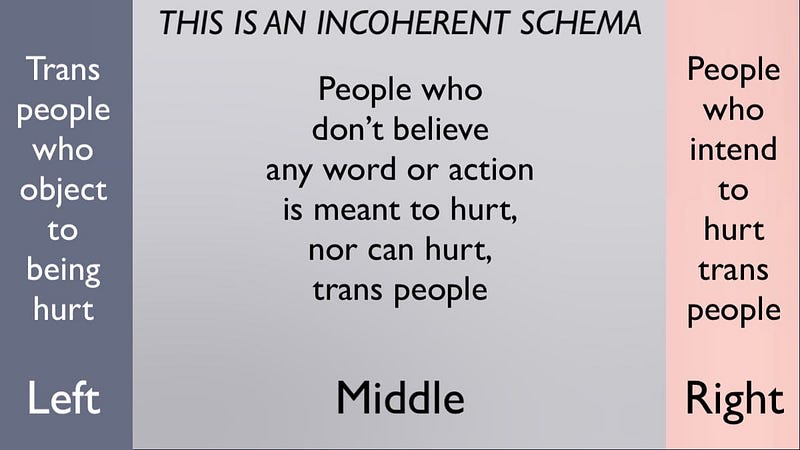
Illustration by Tucker Lieberman

The self-declared “middle” here is mostly siding with the right-wing insofar as it downplays the injuries that the right-wing can do. It only pretends to have significantly different intentions and goals. In fact, it has very similar goals, and it merely speaks in a different tone of voice and uses different vocabulary. It shies from the word “insanity,” for example; that’s a Trumpian word. It uses words it finds more dignified. Nu, and trans people should be impressed by that?

Paul’s principle seems to be to avoid certain words that are transparently opinionated and forceful just because those are gauche. For example, avoid Trump’s lingo like “insanity” or trans people’s commentary like “transphobia.” It all sounds like indistinguishable mudslinging. As long as you, Pamela Paul, speak in a reasonable voice, you may consider yourself in the middle: well-educated in the sense of well-mannered, if not knowledgeable.

Except that you can’t consider yourself in the middle. You acknowledged the bullying, and that means you have to take a side.

Maybe you didn’t mean to acknowledge the bullying, but when you highlighted the painful words, you shone a light on the real conflict, and you helped everyone to see who’s the bully and who’s the victim.

They can see it, unless they’re busy congratulating themselves on being in the middle, transcending it all, keeping their own noses clean, after you gave them permission to do that.

Or unless they’re busy drawing big money from the New York Times by writing 5,000-word articles about how to sound elegant while delegitimizing trans people and helping to usher in an era in which we have less access to healthcare at all ages. Oh wait, that’s you.

A Novel Not Everyone Will Love

Some trans authors might assume they are personae non gratae in the New York Times Book Review. I’m riding those feelings, so forgive me for this parting note.

In honor of Groundhog Day, I’m giving away 100 free e-copies of Most Famous Short Film of All Time. U.S. readers can enter through Goodreads until 11:59 p.m. Pacific on Friday, February 9.

I’d love it if more trans people would enter my ebook giveaway. This is a novel that Pamela Paul would hate.

Detail from the book cover by Cel La Flaca

If this giveaway is not right for you, help me work with you. If you need this book, can’t afford it, and you aren’t Pamela Paul, drop me a line, say gay, and we’ll make some magic happen.

Pardon me, I have to go do my acupuncture now.

Transgender
Transphobia
New York Times
Pamela Paul
LGBTQ
Recommended from ReadMedium