
(HOW) HAVE LGBTQ FILM & LITERATURE SHAPED YOU?
Trans Hermione and the Importance of Headcanons
Finding comfort in the art of the people who want you dead
I used to think I was in love with Hermione Granger when, really, I just wanted to be like her.
This is a trend I’ve noticed as I’ve recontextualized my childhood through the lens of my transness. Almost every single girl I ever thought I had a crush on meant something far different to me than I’d ever realized.
Were I not bi and very much attracted to women, this would be easier to sort through. I could simply proclaim them all as symptoms of good ol’ gender envy. Instead, I’ve had to learn to distinguish my past crushes on the basis of why I felt drawn to certain people.
Hermione, despite being much less real than many of my childhood crushes and/or sources of gender envy, meant a lot to me.
I would stare at the cheap poster of her that I had taped to my wall, wondering how I could ever be so graceful. I would carry around my LEGO Hermione minifigure like some kind of good luck charm, praying that her aura would somehow rub off on me.
I wanted her confidence. I wanted to read like her. I wanted her hair. I wanted her fashion sense. I wanted her smile. I wanted to punch Draco Malfoy.
Up there with Star Wars and Pixar, the Harry Potter franchise made my childhood what it was... before everything changed, of course.
I didn’t understand my transness in 2020, nor did I understand the concept in general. But I knew I didn’t like JK Rowling’s tone when she addressed a minority I was slowly becoming more associated with.
It’s a tale as old as time, so I’ll make this recap quick. The gist is that JK Rowling’s lack of education on the subject of transness led to some less than tasteful comments, and when folks tried to help her understand things, she doubled down with a now infamous essay about the dangers of the ‘trans contagion’ she dubbed evil.
Things have only gotten worse since. Countless tweets from Rowling have dismissed the trans experiences and perpetuate extremely harmful stereotypes and misconceptions. The has-been author has resorted to publishing under yet another alias — interestingly one of another gender — to spread sensationalized fiction that paints any signs of gender variance as the mark of a serial killer. (This trope is shockingly consistent in the media landscape for as far back as the mainstream has known about trans people.)
Trans people and allies who once devoted their lives to the Wizarding World found themselves in a terrible position. The thing they loved, the thing that brought them joy, and perhaps even what made them comfortable in their identity, had been ripped from under them.
While separating art from the artist can help people navigate these difficult conversations, it is rarely a plausible solution. Especially when the art in question was once seen as a pillar of light in a sea of pessimistic media. Harry Potter was a tale of hope and perseverance and the fact that good always triumphs over the evil individuals who seek to eradicate groups of people they see as less-than.
It’s terribly ironic for Rowling to have written a series of books that resonated so strongly with a generation that it played a huge role forming moral compasses — that would lead the grown-up versions of young Potterheads to places of compassion and allyship. This was a world that was safe for everyone, where the fascists always lost and the goodness of people triumphed….right?
Upon closer inspection, the Harry Potter narrative has several holes that hint at Rowling’s lack of political awareness.
For starters, the series features a remarkably small number of people of color, and even when the cast did become diverse, minority characters were given distasteful names and little to no development.
Although the deeds of Voldemort and his Death Eaters were strongly reminiscent of Hitler and the Nazi party, it seems Rowling took these concepts at face value. While the overall message of the franchise still lands, and while most fans walked away from the series with sound conclusions about morality and justice, the lack of cohesion between the series’ political implications and Rowling’s own beliefs is stark.
Rowling has always proclaimed herself proudly feminist, inserting characters like our beloved Hermione to nail home these themes and prove the validity of strong female characters. On a surface level, this approach worked. Hermione was the type of character Rowling set out to make her, and the series didn’t shy away from including other strong female characters too. (Luna Lovegood being a close second as my favorite Wizarding World character.)
Rowling would even become an advocate for the rights of gay people when she confirmed Dumbledore to be a gay man, hinting at a secret affair with the mysterious Grindelwald. It wasn’t life-shattering allyship, but it was a sign she was trying to be inclusive.
But as time passed, she soured. Whatever shifted in JK’s brain led to her spouting vicious rhetoric at the people who once looked up to her. The Wizarding World wasn’t safe anymore. Not for trans people and not for anyone calling themselves allies.
The problem is, once a work of fiction becomes so ingrained in someone’s identity, it’s hard to just rip that Band-Aid off. It wasn’t as easy as turning the other way. These were characters and worlds that meant something to people.
It hit me especially hard. I’d started to make trans friends and I’d started understanding the difficulties of their lives and the world that was (and is) constantly stacked against them. To see someone I’d once considered a role model set herself so adamantly against a minority group was the painful kind of ironic. It didn’t add up.
Was this really the woman responsible for Harry Potter?
Had she read her own books? Had she paid attention?
Would Hermione Granger stand for this?
Eventually, the Band-Aid came off. I abandoned ship, watching the Wizarding World sail into the sunset without me. It hurt at the time, and it probably always would, but it was over. Although my memories of the franchise were strong, the future of it didn’t look promising.
Everything changed in 2022 when the video game Hogwarts Legacy re-ignited the Wizarding World’s mainstream relevance.
Everyone was talking about Harry Potter again. Rowling was as loud-mouthed and vengeful as ever. Coincidentally, at the same moment, I got to re-watch Harry Potter and the Philosopher’s Stone in a college class. I ended up getting swept up in nostalgia so warm and cozy that it would send me reeling for days.
Against my better judgment, I started falling in love with the Wizarding World again. Worst of all, I really wanted to play Hogwarts Legacy.
What happened next, I’m not proud of. I bought Hogwarts Legacy… and I immediately felt a wave of regret that can only be described as self-deprecating.
I’ve tried to make up for this misstep. I’ve been a consistent trans advocate. And I’m only getting louder about my support for my trans friends and my love and appreciation of my own transness.
But despite Rowling’s lack of involvement in the creation of Hogwarts Legacy (and a trans character being added last minute), I knew some portion of the money was finding its way into the pockets of a bigot. And I am deeply, deeply sorry for contributing.
But I don’t entirely regret it. Had I not struggled with the purchase, had it not sent me down the path that it did, I might not have figured out the truth about myself so soon.
That’s right. In some ways, I’m giving Hogwarts Legacy credit for starting my trans journey. Because of the crisis it would lead me to, not because of the game itself.
With so much about the topic circling in my head, I decided to hear out trans creators on the debate, because I valued their opinions more than anyone else’s. This would lead me to well-renowned trans creator Natalie Wynn, known as Contrapoints, and her eye-opening exploration of JK Rowling’s cultural demise.
I instantly adored Natalie and her perspective, so I watched another Contrapoints video. And on and on until I’d watched them all.
I sought out other trans creators. I found the corners of the Internet they’d been pushed into. I found comfort.
And I remembered the way I’d felt about Hermione.
This rabbit hole did not make me trans. It wasn’t even the first time I’d thought about it (a story for another day). But it was the first time in a while that I’d given it a lot of thought.
It was tied so heavily to Hermione. God, I wanted to be Hermione.
This is when the magic (apologies for the bad pun) truly made sense to me. This is when my infatuation with Hermione Granger finally presented itself as painful, nuanced, raw envy.
She was the role I wanted to play in my friend group. She was the student I wanted to be. She was caring the way I hoped to be. She had the hair I wanted. The outfits. She owned it all like it wasn’t going to make some miniature trans girl incredibly jealous, but it did.
My hyperfixation died quick. As I said, I dropped the game, took some strides to reconcile my guilt, and moved on.
But this little stint had shifted something within me. I couldn’t stop researching the realities and complications of trans people.
It was around this point where I started feeling the Hermione feeling again, this time when I would encounter almost any girl in the world. It wasn’t me being attracted to them, per se.
For one, I know that feeling, and this was a whole lot more intense and confusing. And for two, I’m in a happy, monogamous relationship that I had no intention of leaving.
This wasn’t a case of constant crushing, nor was it lust. This was…. me wanting what they had. And what they had, I slowly began to realize, was womanhood.
I had that power too. I just didn’t know it yet.
My mind would be blown when, weeks later, I would stumble down a TikTok rabbit hole that would lead me directly to the namesake of this article. It felt like the climax to the first part of my trans journey because, of course, this ended — or rather, started — with Hermione.
I found a small but mighty community of trans folk and allies who head-canoned Hermione Granger as a trans woman, creating edits, art, and fanfiction about Hermione through a trans lens.
Now, obviously, JK Rowling would crawl out of her skin if she saw anyone viewing her precious Hermione that way. But there’s one thing JK forgot to consider….
These characters, these worlds, and these stories are ours just as much as they’re hers.
This is just the truth of it. Even as a creative myself, I acknowledge that the moment I put my art into the world, anyone has the right and privilege to interpret and enjoy it as they see fit.
And for a small selection of people, Hermione Granger is transgender.
It makes a good amount of sense. For all the tribulations Hermione faces, she rarely if ever loses sight of herself. She’s constantly in touch with who she is, what she wants, and the things she has the right to. She’s brave, she’s intelligent, and she’s powerful… all things that cisgender women can be and frequently are, yes. But the same can be said for trans people, and Hermione’s fight to be nobody but herself is a struggle many trans people identify with.
More than anything, viewing Hermione through this lens posits her as someone who, like me, sought to be who she now was. And Hermione was living proof that it’s possible — that after all this time, after all my hair-brained delusions, I could, just maybe, be like her.
Not in a cosplay sort of way. Not in a way that stripped me of my natural characteristics and mannerisms. But in the kind of way that had been desperately trying to fight its way out for a while. In a way that was true, nuanced, and beautiful.
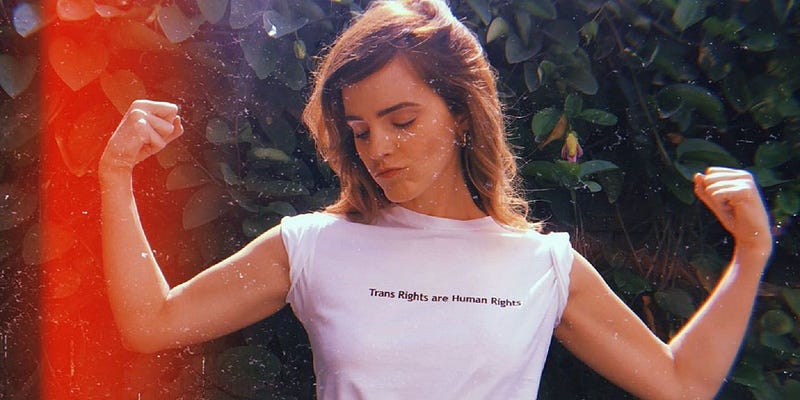
The cherry on top of this whole situation was none other than the wonderful Emma Watson.
Responsible for bringing the character of Hermione to life and being the face for which I constantly wanted, Emma Watson has been a loud and vocal feminist all her life. But, as JK showed us, feminism can easily be twisted to exclude trans women.
Emma was having none of that. Immediately after Rowling’s vile essay went live, Emma tweeted a short few sentences that have become among my top 100 reasons to live.
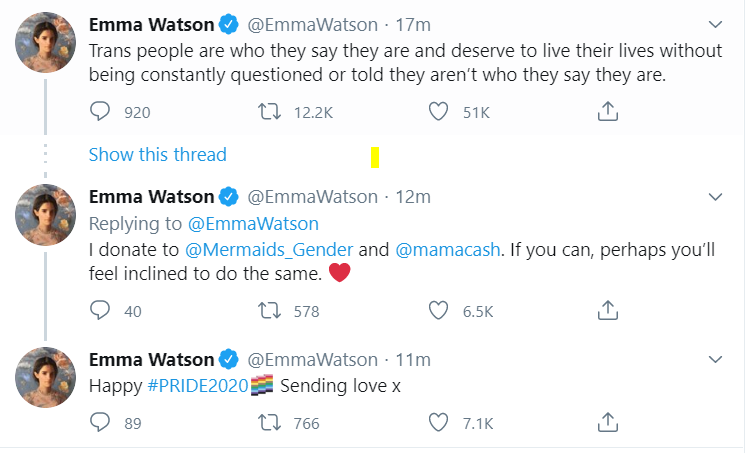
Knowing that Emma herself was a proud ally was the most fulfilling kind of validation I can imagine. It filled me with relief then, and it fills me with joy and affirmation now.
I just want to give her the biggest hug.
Losing a beloved franchise can feel like losing a friend. Whether this is because of wherever I am on the autism spectrum or because it’s a simple human truth, the whole Harry Potter thing has caused me a lot of hurt.
But when Emma Watson and a whole community of trans-Hermione Granger truthers are on your side, things feel less bleak.
I truly feel like I’ve finally been able to reconcile and reconnect with this story that made me feel seen as a kid, in ways that stretch far beyond gender. And, if I find ways to engage with these stories that don’t involve putting money in Rowling’s pockets (there are ways), I’m allowed to find joy in this world of magic. Truthfully, the people who adapted the source material and the fans who keep the heart of the franchise beating are responsible for fostering my joy.
Ultimately, I didn’t fall in love with Harry Potter because of JK Rowling. I fell in love with the LEGO video game, the rich set design, the John Williams score, and the kinship it brought about between me, my sister, and my mother.
And, of course, because of Hermione Granger, who I now understand was so important to me because…well, because she was Hermione, and nobody has ever done things quite the way she has.
It’s been an interesting, complicated, constantly tangled journey to get to this point of my life and my own trans journey, and I find it super interesting how involved Harry Potter has been in my journey. I think there’s an odd beauty in that.
As with all things in life, we get to where we’re supposed to be no matter what — or who — stands in our way.
I think I’m going to start carrying around my LEGO Hermione minifigure again. She’s been collecting dust for too long, and I’d reckon she has some pointers to give me. This womanhood thing is rough, but Hermione’s got it covered. She always does.

This story is a response to the Prism & Pen writing prompt, (How) Have LGBTQ Film & Literature Shaped You?
Here are other brilliant stories based on this prompt:


