
Training Our Body With Our Body
Why exercising can and should be simple
Our body is our most important asset. It doesn’t matter which goals we set, whether they are related to career, relationships, or self-development, the healthier and the more in shape we are, the easier it is to achieve them.
Exercising is one of the easiest and fastest ways to boost our health. We only need 15 minutes of daily physical activity to experience some benefits.
Yet many adults do not even manage to exercise weekly. There are countless excuses, like too much work, too tired, no time, or no motivation. But at the heart of it very often lies one big misconception: exercising comes with a lot of effort and can only be performed in a gym, in classes, or under supervision.
Many of us see exercise as a complex challenge that requires a lot of time and dedication. Instead of trying, we prefer to neglect it completely. In reality, a workout is scalable in both difficulty and duration.
When I started my fitness journey, I also used to associate training with gyms, joining a sports club, or needing a fitness coach.
However, the more I started exercising with my body only, the more I figured out how easy it is to scale any training so that it can be performed anywhere at any time.
Now, finding excuses to skip my workouts has become very difficult. I am proudly at a point where training is part of my daily routine.
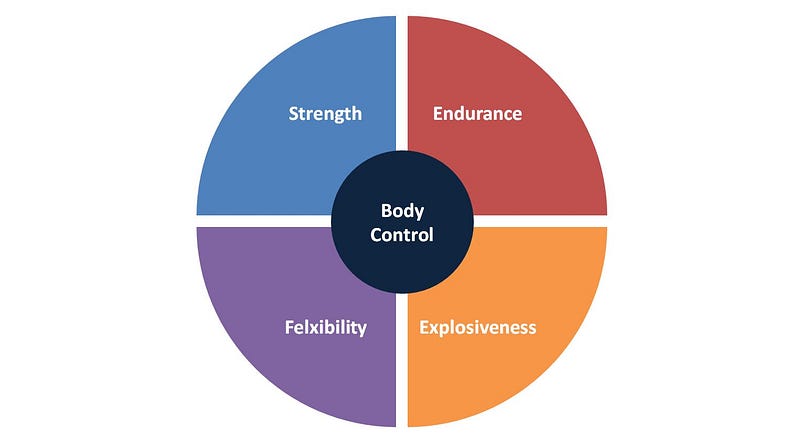
Here are some examples of how I use my body to train my strength, my endurance, my explosiveness, my flexibility, and my body control. I am not a fitness professional, but reading about my approach to exercising can hopefully help you find some motivation to start or to keep on training.
Strength
Strength is the most targeted fitness area for those going to the gym. Being able to lift heavier weights, and seeing the muscles grow are the main results we experience after some months of strength training.
Equivalent results can be achieved by using only our bodies instead of weights and machines. We can train our upper body by doing pull-ups, push-ups, and sit-ups, while we can strengthen our legs with some lunges and squats.
Similar to increasing resistance on machines for greater difficulty, we can scale a strength workout by increasing the difficulty of bodyweight exercises.
We can start with push-ups on the wall, then progress to the ground once we gain more strength, and then keep increasing the difficulty until we can do planche push-ups, where our feet are no longer touching the floor.
Pull-ups can be done first by jumping to the bar instead of lifting our weight. Once we develop more strength we can do them from the hanging position, and finally, for the more advanced, with one arm only. The same with squats, once they become too easy we can try to perform them on one leg.
Endurance
Important for our daily life is not only to have strong muscles but to be able to endure physical activity over long periods. Is it climbing up the stairs or hurrying up to catch a bus, we do not want to collapse every time we increase our heart rate.
Exercising is key for a healthy and well-functioning heart, in particular endurance training. To work on our endurance we can sign up to a gym and run on a treadmill, or cycle on a spinning bike.
However, on the days when we don’t have much time, we can simply wear our jogging shoes and go for a run. Otherwise, if we are not motivated to step outside, we can jump around, dance, or even walk up and down the stairs. And if we are not feeling ready for any of this, even a simple walk is much more effective than nothing.
Explosiveness
Developing explosiveness means being able to apply one or multiple times a large and concentrated amount of strength in a short timeframe. People with very high explosiveness can run very fast, jump high, and perform iconic bodyweight exercises like clapping push-ups or clapping pull-ups.
It is an ability that is partially genetically inherited, nevertheless, it can be improved. Regardless of how gifted we are in terms of explosiveness, training it offers significant benefits for our heart and all our other muscles.
Once again, we can work on it just by using our bodies. As long as we have enough space, all we need to do are multiple sprints, jumping squats, and some explosive pull-ups and push-ups.
Flexibility
Sprinting, doing cardio, and lifting weights are beneficial as long as they don’t lead to injury. Training sustainably throughout our lives by avoiding long-term damage to our bodies should be our number one fitness goal.
Training our flexibility is the most important aspect we should focus on, to reduce the risk of injury during a workout. We need to stretch regularly to make our muscles more resistant to stress and fatigue, and we need to improve our mobility to increase our range of movement, reducing the stress on our joints.
Both stretching and mobility can be trained anywhere. We can do active and passive stretches for our muscles and follow mobility flows to activate our joints.
Body Control
The more we train with our body, the more we become aware of the individual joints and muscles, increasing our control over them.
The ability to coordinate and move our body through different surroundings is what I call body control. Whether it is for balancing our weight on one leg, having quick reflexes, holding a specific position over a long period, or doing complex movement patterns, body control is crucial in our daily lives.
Improving our body control means improving our body-to-mind connection. This can be done anywhere. It can be trained by learning to do a handstand, balancing on one foot, holding a plank, or following a new dance choreography. All we need is a floor and enough space to move freely and safely.
If we have the time and opportunity, we should incorporate equipment in our training, use the advanced fitness machines in the gym, and ask for coaching and supervision. Doing so can only enrich our training and allow us to reach our desired results faster.
However, my point is that even without gyms, equipment, or coaches, we can still achieve great results for free using only our bodies.
Exercising can be simple, once we learn how to scale it down depending on available time, energy, and resources.
Exercising should be simple so that we can sustainably incorporate it into our daily routine.
Physical activity is only one part of the complex equation of physical health. It only helps to a limited extent if we continue neglecting sleep, eating unhealthy, and indulging in self-destructive habits like smoking or drinking alcohol.
However, we all need to begin somewhere, and spending 15 minutes daily to move our bodies is a great starting point for a healthier life.
We only get one body, so we should treat it as our most important asset.


