
The Making of a Learning Platform
Design principles of an educational product that experienced viral growth and has over 3 million users
All technology educators face a fundamental challenge: how do they motivate their audience to engage with the instructional content they create? Reading manuals or clicking through online help isn’t exactly fun for most people. Therefore, any innovation that makes the learning experience more enjoyable and effective can add enormous value, helping our customers, and therefore our company and career, to be more successful.
This was the challenge we faced in 2014 at Salesforce, which had grown rapidly, from a startup to the world’s fourth-largest software company, with over 20,000 employees. As the number of products and features multiplied, there was a corresponding increase in the amount of documentation. Our technical writers were doing an excellent job of providing clear, comprehensive, and accurate information, in the form of online help, user guides, workbooks, cheat sheets, release notes, and so on. However, the sheer volume of content, without a clear path to navigate it, was overwhelming. This made learning to use our products increasingly difficult, for both new and experienced customers.
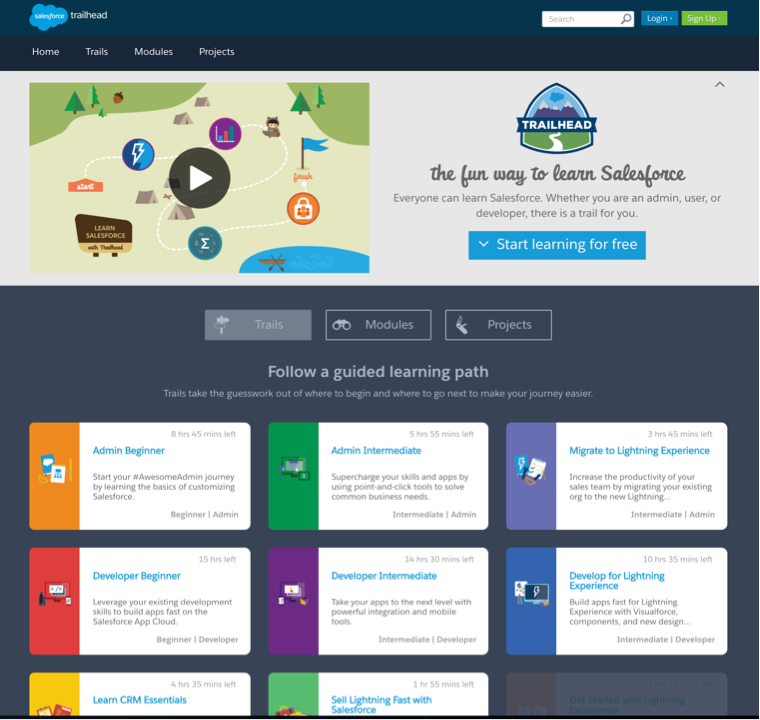
To address this problem, a small team began designing and building a new learning platform, called Trailhead. The goal of Trailhead is to empower customers to use Salesforce more effectively, by radically simplifying and redefining the learning experience. We were inspired by the surge in popularity of learning websites, such as Udacity, Coursera, edX, Khan Academy, and CodeAcademy and the advent of a new learning model, known as the MOOC (Massive Open Online Course). A MOOC, as defined by Wikipedia, is an online course aimed at unlimited participation and open access via the web. Many universities are now providing a wide range of courses as MOOCs, enabling anyone, anywhere to register and learn online. These sites provide a valuable alternative to traditional classroom learning, by making high-quality education accessible to a much larger audience.
What is Trailhead?
Trailhead adapts and extends the approach to online learning popularized by MOOCs to create a new model for product documentation. It provides a guided learning experience, introducing customers to specific product features through a set of free, interactive, web-based tutorials. Each unit contains a blend of text, graphics, and videos, and uses a playful, informal style to engage and retain the customer’s interest.
Trailhead has these key features.
- User-centric content — The content is organized by role, level, and goal, to meet specific learning objectives. This ensures customers have a predefined learning path to follow and don’t have to spend time discovering and organizing relevant content.
- Self-paced, online learning — Customers can learn what they need anytime and anywhere, and progress at their own pace.
- Modularity — The content is arranged in a hierarchy, with three levels: trails, modules, and units. Each module is designed to be simple, self-contained, and directly useful, and consists of short units, which can be read in 10–15 minutes each.
- Interactive challenges — At the end of each unit, customers can verify what they just learned, by answering multiple-choice questions or perform- ing specified tasks in the Salesforce application. On completing a challenge, they can click a button and get instant feedback on their work. Since our software is cloud-based, we can make API calls to check if the customer completed the task correctly, and provide relevant hints if they did not.
- Gamification and social rewards — We award points and badges on successful completion of units and modules, respectively. Badges are displayed on the customer’s public profile and are sharable on social networks, such as LinkedIn and Twitter. This provides customers peer recognition for their expertise and positive reinforcement to continue learning.
Trailhead’s innovative approach to learning has been remarkably successful. After its launch at the Dreamforce conference, in Oct 2014, Trailhead received an enthusiastic response, generating dozens of blog posts and thousands of tweets. It’s rare, if not unprecedented, for technical documentation to generate this level of excitement. Not only were our customers having a satisfying experience, we were helping make their jobs easier while increasing adoption and usage of our products. Trailhead has been so effective that Salesforce has adopted it for internal use, as the primary platform for onboarding and training all employees.
The interesting question, from a technical communication perspective, is: Why is Trailhead so popular, and can we draw any lessons from its success that are applicable in other learning contexts? This article explores some ideas relevant to that question.
One of our goals with Trailhead was to organize the large amount of content we had already created, and present it in a form that is so relevant, engaging, and useful that customers are motivated to learn. A key element of the solution was to design learning paths that would provide a guided sequence of topics, to address the most important customer use cases.
Consider this analogy: a typical university library has millions of books, covering all the courses offered by the university. Any student can readily access all this information, but can’t be expected to put together a program of courses that would lead to a degree entirely by self-instruction.
The knowledge required for all the degree programs is contained in the library stacks, but it’s not very useful to a student until it’s organized into a curriculum, consisting of a sequence of courses, each with its own syllabus and readings. Providing that organization, and then develop- ing activities to support the learning of that content, is the task of the university’s departments and professors. This analogy highlights the crucial importance of curriculum development — to facilitate learning, by selecting and organizing relevant information to fit a specific educational purpose.
We faced a similar challenge at Salesforce, but with a more limited repository of information. We had to organize not a university library, but the library of Salesforce product documentation. Trailhead was our approach to solving this challenge. However, learning paths though useful are not sufficient by themselves. A more holistic, integrated approach to learning is required.
Insights from Learning Theory
As technical communicators, it’s useful to think of ourselves as teachers, with our customers as students. This is a valuable metaphor, enabling us to leverage insights from the field of education to meet our fundamental goal, that is, to help customers learn to use our products more easily. Translated into educational terms, this is equivalent to answering the question: How can teachers help students learn more effectively? This issue has been the focus of research by educators for over forty years, leading to important insights, which are directly relevant to technical communication. Let’s take a brief detour into learning theory to explore some of these concepts.
Research into student learning received a major boost in the 1970s, with the publication of a classic study by Marton and Saljõ [1]. They gave a number of students some text to read and told them they would be asked questions on it afterward. The students responded in two distinct ways. One group read the text superficially and remembered isolated facts, without understanding the connections between them. Another group went below the surface and focused on understanding the meaning the author was trying to convey. Martin and Saljõ distinguished the two approaches by the terms surface learning and deep learning, respectively. The words “surface” and “deep” refer to particular approaches to learning, rather than the innate traits of the students.
In any group of students, there is a wide variation in the level of motivation and ability, which translates into variations in the outcome of the learning experience. The most talented and motivated students learn a great deal, even in adverse conditions. The challenge of teaching is to make even average students have extraordinary results. A great deal of educational research has focused on how to make teaching more effective, by guiding students to engage in deep learning rather than surface learning. Researchers have distinguished between two broad approaches to teaching: student-focused and teacher-focused [2]. In teacher-focused approaches, learning is a result of the teacher’s methods and activities, while in student-focused approaches, the emphasis is on what students do to achieve understanding.
The Australian educational psychologist, John Biggs, is one of the major innovators in the field of student-focused learning [3–5]. He classifies all theories of teaching into three levels, depending on their primary focus.
- Level 1 — Learning depends on the students’ level of motivation and intelligence. The focus is on what the student is. Hence, any failures in learning are the student’s fault. This can be called the “Blame the student” model.
- Level 2 — Learning is effective when the teacher moves beyond simply transmitting information to conveying concepts and principles. The focus is on what the teacher does. Hence, any failures in learning are the teacher’s fault. This can be called the “Blame the teacher” model.
- Level 3 — Learning is a result of students engaging in activities designed to directly support the desired learning outcomes. The focus is on what the student does. Learning outcomes are the shared responsibility of the teacher and student, with each having a specific role.
According to Biggs, most teachers start at Level 1 but move to higher levels as they grow in experience and ability. He considers the Level 3 approach the most effective and has developed a theory he calls constructive alignment, which provides explicit guidance on how to maximize the impact of teaching.
Biggs explains his theory in these words: “The ‘constructive’ aspect refers to the idea that students construct meaning through relevant learning activities. That is, meaning is not something imparted or transmitted from teacher to learner, but is something learners have to create for themselves. The ‘alignment’ aspect refers to what the teacher does, which is to set up a learning environment that supports the learning activities appropriate to achieving the desired learning outcomes.”
There is a great deal of support for Biggs’ theory from work by other researchers. Similar ideas were first advocated by Tyler in the 1940s [6], and developed in the 1980s by Shuell [7], who summarized his findings as follows. “If students are to learn desired outcomes in a reasonably effective manner, then the teacher’s fundamental task is to get students to engage in learning activities that are likely to result in their achieving those outcomes… It is helpful to remember that what the student does is actually more important in determining what is learned than what the teacher does.”
Learning objectives are concise and specific statements that describe what the student will be able to do as a result of a learning activity. At its most basic, Biggs’ theory requires alignment between the intended learning objectives, the learning activities the student engages in, and the assessment criteria used to test what the student has learned. The relationship between these three key components is summarized visually as the triangle of effective learning (Figure 2).
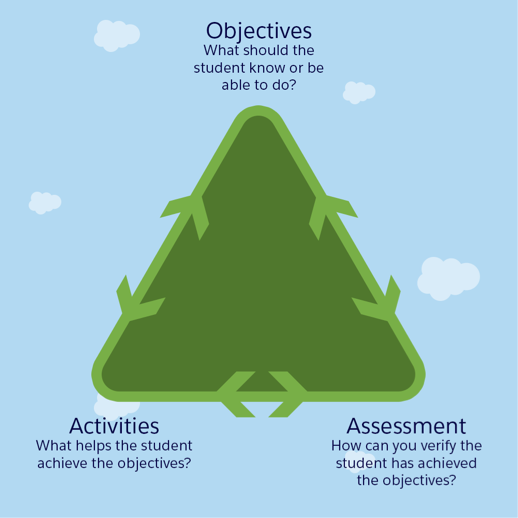
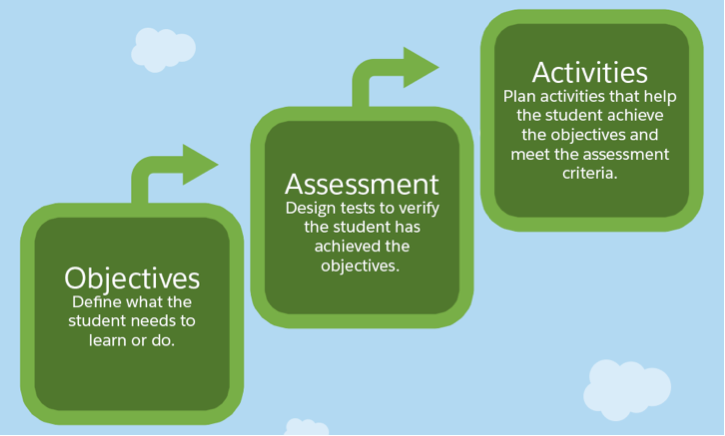
The key takeaway of this research is that teachers should focus on creating teaching and learning activities (TLAs) that are congruent with the learning objectives (LOs). Therefore, the proper order for creating any instructional content is as follows (Figure 3).
- Define the intended LOs, that is, what the student should know or be able to do.
- Design tests to assess if the student has met the LOs.
- Develop TLAs that help the students achieve the LOs and meet the assessment criteria.
The advent of the web provides a significant opportunity to implement this process effectively. That’s because the web, being an interactive medium, is ideal for active learning. A major advantage of web-based instruction is it expands the types of TLAs possible, enabling scalable, interactive learning without a human teacher. The key to success is to utilize the web’s interactivity to increase the students’ level of engagement, by transforming the learn- ing experience from passive to active. Trailhead’s design incorporates the above principles, which is a key reason for its effectiveness as a learning tool.
Switching gears from the field of learning theory, it’s useful to consider some ideas from the history of technology innovation, where similar concepts have surfaced in a different context. The distinction between teacher-focused and student-focused strategies in education closely parallels that between feature-centric and user-centric design in the creation of technology products. The classic example of this is the difference between the operating systems created by Apple and Microsoft. Prior to Apple’s introduction of the Macintosh in 1984, the dominant paradigm for interacting with computers was via the command line, as exemplified by Microsoft’s MS-DOS. This required the user to type in obscure commands to perform even simple tasks, such as, navigating between directories and files.
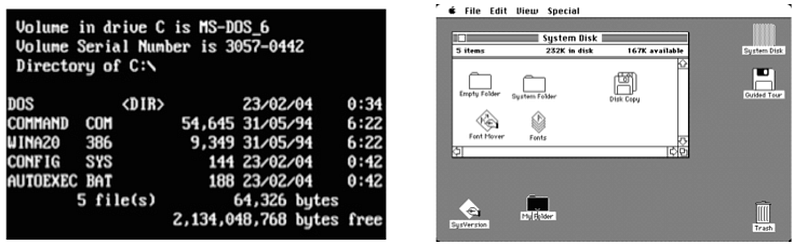
The Mac was a radical advance because its graphical interface provided a desktop with files and folders you could navigate visually by pointing and clicking, eliminating the need to learn and type arbitrary commands (Figure 4). This introduced a new paradigm of computing in which users no longer had to adapt their behavior to fit the computer. Instead, the computer was designed to fit how people naturally think. This simple but profound shift in perspective launched the personal computer revolution, making computers accessible and useful to a mass audience, instead of being confined to a specialized group of hobbyists and researchers.
Trailhead has the same relationship to traditional documentation that the Mac OS had to MS-DOS. Trailhead represents the concept of learning paths through the visual metaphor of trails, in the same way that the Mac OS uses the visual metaphor of a desktop. Trailhead content is also user-centric in that before writing a module on any feature area, writers spend a significant amount of time thinking about the use cases of greatest importance to customers, and then construct learning objectives, assessments, and content, specifically to address them.
Each module provides a predefined learning path to fit the customer’s goals, so there’s no need for customers to make decisions on what to learn and how. In effect, the documentation adapts to the customer instead of the customer having to adapt to the documentation. This ensures customers can focus their time and attention on high-value activities that directly contribute to learning instead of discovering and organizing relevant content.
Conclusion
Trailhead uses the interactivity of the web, to create an environment in which the customer is guided to engage in deep learning. It accomplishes this by aligning and integrating the learning objectives, assessment, and content, so they all work together to serve the goal of helping the customer learn. Trailhead encourages and facilitates active learning whereby customers learn by doing activities specially designed to meet objectives that ensure mastery. Finally, customers are tested to demonstrate they have acquired the intended knowledge and skills.
According to researcher John Cowan [8], “Teaching is the purposeful creation of situations from which learners should not be able to escape without learning or developing.” The key to Trailhead’s success is that it creates an environment in which customers can’t escape without learning, through a novel implementation of the principles of user-centric design and constructive alignment. The same principles can be applied to assess and enhance the usability of any instructional content, regardless of its audience and format.
Resources
- Trailhead: https://developer.salesforce.com/trailhead
- The Making of Trailhead (video recording of session at Dreamforce 2015 conference)
- Wikipedia entry on MOOCs
References
- Marton, F. and Saljõ, R. “On qualitative differences in learning. I-Outcome and Process.” British Journal of Educational Psychology, 1976: 46, 4–11.
- Prosser, M. and Trigwell, K. Teaching for Learning in Higher Education. (Buckingham: Open University Press), 1998.
- Biggs, John. “Individual differences in study process and the quality of learning outcomes.” Higher Education, 1979: 8, 381–394.
- Biggs, John. “What the Student Does: Teaching for Advanced Learning.” Higher Education Research and Development, 1999: 18, 57–75.
- Biggs, John. Teaching for Quality Learning at University. (Buckingham: Open University Press), 2003.
- Tyler. R. W., Basic Principles of Curriculum and Instruction (Chicago: University of Chicago Press), 1940.
- Shuell, T. J. “Cognitive conceptions of learning.” Review of Educational Research, 1986: 56, 411–436.
- Cowan, John. On Becoming an Innovative University Teacher, 2nd edition, (Buckingham: Open University Press), 2006.
Pavi Sandhu was at Salesforce when Trailhead was created, in 2014. As a member of the founding team, he designed Trailhead’s instructional model, wrote its first module, and created templates and guidelines that provided the framework for all content development. Pavi has over 20 years of experience as a writer, manager, and entrepreneur, at companies such as Wolfram Research, Oracle, Collabis, and Amazon, and a PhD in physics from Boston University. He is also the author of The MathML Handbook, a guide to displaying mathematics on the web.
Previously published in the 2016 STC Technical Communication Summit Proceedings.


