
Tragic Life Story of the Real ‘Beauty & The Beast’ Couple
The Fate of Real Couple That Inspired’ Beauty And The Beast’.
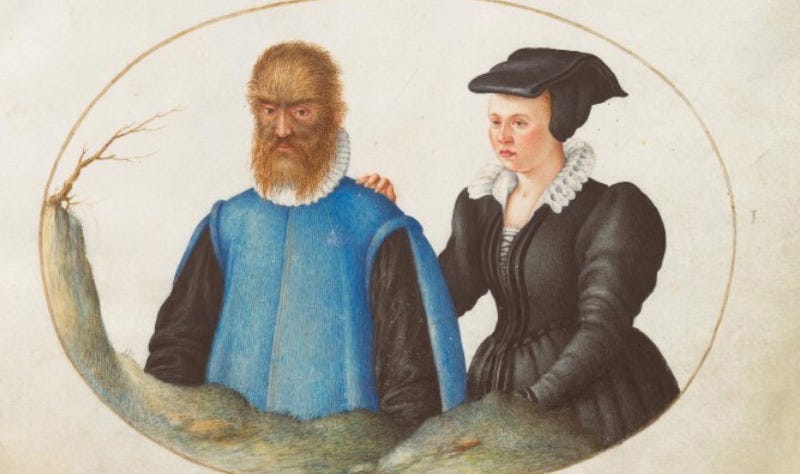
They lived happily ever after — this is not the ideal ending in real life. Love stories, mostly meet with tragic endings. European authorities treated real life’s beauty and the beast with utmost disgust.
You might have read several thousands of stories regarding P.T. Barnum, who was fond of finding the oddity in human beings. Similar to his fascination, 16th-Century European royal courts held an interest in finding the strangest human being — just a piece for their own amusement.
Their amusement was fed when Petrus Gonsalvus was brought to the French royal court and kept there for years. Born with a condition of a face covered in hair, Gonsalvus was treated like a freak.
The French royal court even arranged for Gonsalvus, the “beast”, to marry just for the sake of joking and tormenting his children. Let’s dive into not a fairy tale ending but a tragic story that will move many.
Not a fairy tale happy ending
Belle’s character painted in the movie shows her as an intelligent and strong-willed individual, who develops feelings for a person cursed to resemble a beast.
Ignoring his fearful exterior, Belle fell for those caring eyes which reflected devotion for her. The outcome of crooning with dishes, snowball fights, and whirling through candlelit ballrooms was meant to be a strong love attachment between the two.
The curse breaks when their love blooms, and they live happily ever after. But then what? Well, in real life, Gonsalvus had to live with the strange condition for his entire life. There was no way of breaking the curse.
The real beast was caged & shipped Off as a gift
Gonsalvus was born in 1537 with excessive hair. The Canary Islands, approved Gonsalvus existence as a “wild man, giving him the title of the beast.
Appearing more like animals than humans, wild men were supposed to live on the edges of civilization. Like any other “wild men”, people treat him as a vicious being, assuming that he was not fully human because of his condition.
At the age of ten, Gonsalvus was locked into an iron cage. It was when he began to be properly treated like an animal — given animal feed and raw meat.
Getting shipped off was the last thing that Gonsalvus might have thought. In 1547, he was gifted to King Henry 2, a french king, for his coronation.
Petrus being treated like a human pet at France’s Royal Court
France treated him like a joke. Upon his arrival, Gonsalvus was seen as a wild animal and locked up in a dungeon for inspection.
After prodding and poking, the doctors concluded Gonsalvus not being from the animals. A ten-year boy with proper senses and feelings had to endure even his name transformation — French changed his name from Pedro Gonzales to Petrus Gonsalvus.
King Henry did one humanitarian act and ensured Gonsalvus received an education, though, deep in his heart, he never expected Gonsaluvs to succeed. After all, King deemed him a savage incapable of excelling in any learning.
Gonsalvus became fluent in Latin, shocking the entire court. His learning success extended, and he mastered noble etiquette, becoming an important court guest. Gonsalvus disproved the stereotypes about “beasts”.
Gonsalvus proved himself
Gonsalvus’s treatment in the court improved as education followed respect. Mastering three languages allowed him to get dressed as a nobleman and eat cooked food.
He was finally free from the dungeon as the King took a liking to him, but despite that improved status, one thing never changed — people’s gaze. Court visitors viewed him as a freak meant to dazzle them. Gonsalvus covered a journey from being a wild man to a human pet.
Later, Artist Agostino Carracci painted a portrait where Petrus was depicted naked, having only a small fur. The portrait titled Hairy Harry, Mad Peter, and Tiny Amon reflected Gonsalvus’s inferior status.

Queen Catherine de’ Medici's evil idea of marrying a beautiful lady with Gonsalvus
King Henry soon departed from the world, leaving the throne for his wife, Catherine de Medici.
She became the queen of France and performed several devious actions — the acts which required a wicked mind and a spare plotting time. Once she contrived an act against her rivals, she invited them for a marriage celebration and slaughtered them all in the streets.
No wonder such a woman could have thought to arrange Gonsalvus’s marriage and that too for quenching her awful fascination. It was a well-crafted hilarious idea for her.
Catherine de’ Medici dove into that horrible mission and found a young maiden also named Catherine for Beast’s bride.
By keeping Gonsalvus’s rare condition a secret, the queen, who did not deserve the title, ordered Catherine, the daughter of one of the royal court servants, for marriage.
Back then, kings and queen’s held the power of dictating the marriages of court followers — a strange, unfair advantage which the queen of France exploited.
What would have Catherine gotten? Her curiosity suppressed. She needed an experimental result — the lady wanted to see what kind of children the beauty might have produced with the beast.
Several burning questions ran across Queen Catherine’s mind. She wondered whether the children would be covered in hair like their father or not? She was all set for a mission of manufacturing the royal pets from such an unconventional arranged marriage.
The ‘beauty’ met ‘beast’ on their wedding day
When young Catherine encountered the sight of a guy covered with hair on the aisle, she was met with a huge shock. She was unhappy with the union, initially. But interestingly, with time, she began to care for Petrus.
After a few years of their marriage, they had two children. Both of them did not inherit any of Gunsalvus’ conditions.
Queen Catherine’s experiment went down in the dumps. Her disappointment did not last long as the next two offspring of the couple were covered in hair, proving to the queen beauty could not always conquer the beasts.
With seven children in total, Catherine and Petrus gave the royal court crazy fascination. Four of the children, born with the Gonsalvus’s condition, were taken for a tour around Europe so nobles could gawk.
Being sent on a European tour meant Catherine, Petrus, and their children were exposed to constant marvel. Naturalists further studied the children for making interesting analyses. One of the children of Catherine and Petrus, the eight-year daughter, was examined by a well-renowned naturalist Ulisse Aldrovandi in the 1590s.
The “Wild Children” were gifted as pets to Royal families
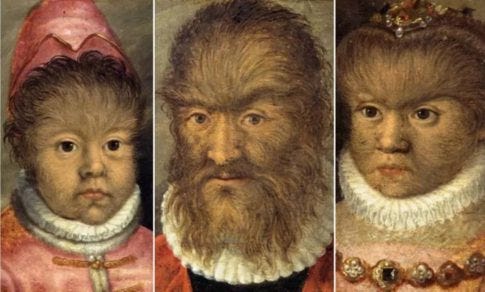
Settling in Parma, Italy, seemed a new beginning for the “wild children, “ but Gonsalvus’ family did not know a tragic turn awaited.
Aristocrats further treated Gonsalvus as property and exploited his conditions. Duke sent the four hairy children as gifts to noble friends, deeming them as pet animals.
The poor Gonsalvus’s family was neither captured nor freed but trapped in a vicious cycle of misery. How miserable is it to experience the pain of having one’s children snatched? The real-life story of beauty and the beast proves life is not about happy endings.
If we talk about Catherine, she died in 1623, as the town’s registrar had the record. But as far as Gonsalvus was concerned, no such data was found. Why? Perhaps because he was not even considered a human to have the last rites recorded. He was more of a curiosity than a man, something which the movie intentionally did not depict.
More from the author:
Reference: