
Top Fiction Books I’ve Read These Past Few Months
Recommendations in romance, sci-fi, and western.
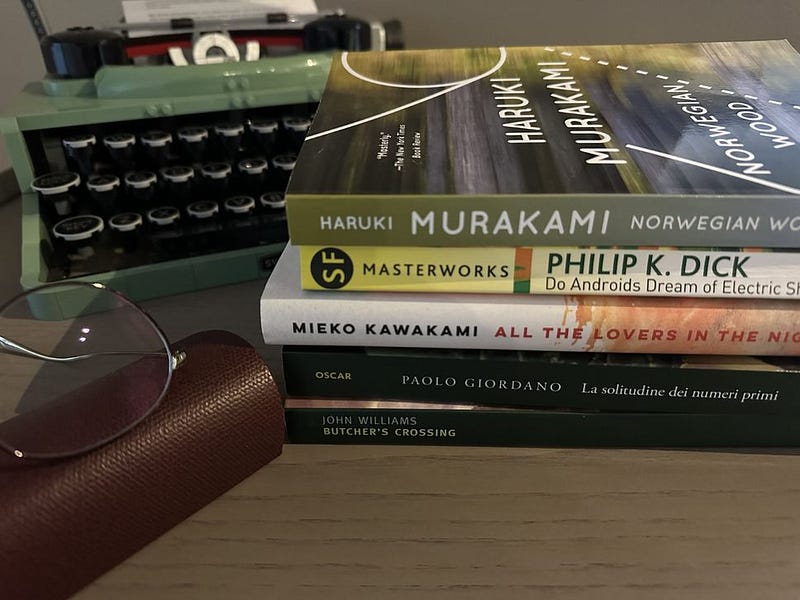
In this post, I write about five books that I enjoyed over the past months. I liked them so much that I plan to read them a few times.
Don’t you worry, I will keep it spoiler free.
Norwegian Wood by Haruki Murakami
The first time I read Norwegian Wood, I shook my head and said out loud “Wow, did I just meet my favorite author?” Then I read another of Murakami’s works and thought “Definitely not on my top.” Then another book and “Far from it,” was my thought.
With each successive book, I liked him less and less. So, I decided to capture and frame that love before it vanishes; I stopped reading his books.
Nevertheless, I just finished Norwegian Wood for a second time, and I still love it. I can feel the melancholy, loss, love, hope, and tribulations of becoming an adult. No matter what, this book holds a special place.
It is Murakami’s most-sold book.
The book is about a college student in Tokyo and life on the campus. The story kicks off after the death of a close friend. This event scars two characters, unites them, and ignites a passion.
The storytelling is great, the ambiance breathes, and the scenes feel alive. But every now and then, the spell is broken with minor things. A common complaint is how women are portrayed. They seem to be cut from the same cloth and are superficial.
Anyways, I solidly recommend it. Maybe after reading it, you will see it differently than I do.
“Despite your best efforts, people are going to be hurt when it’s time for them to be hurt.” ― Haruki Murakami, Norwegian Wood
Do Androids Dream of Electric Sheep? by Philip K. Dick
When it comes to science fiction, I sit on the fence. But I do occasionally come down to pick up a book.
If you are like me, Philip K. Dick is a must. A lot of his books have inspired movies. Do Androids Dream of Electric Sheep? Inspired the films and influenced the sub-genre cyberpunk.
The book is about an agent that hunts rogue androids and “retires” them — a euphemism for killing them. Or is it? Because when androids look and act like humans, how do you distinguish them?
Sounds like the movie Blade Runner? It is because that movie was inspired by that book.
Of all the books on this list, this one is the most engaging and fast-paced.
The book poses an interesting question relevant to our AI-incipient era: if it acts and feels like a human, why can’t an android be human? If our intelligence and feelings are matched by a non-organic being, what makes us human then?
“Empathy, he once had decided, must be limited to herbivores or anyhow omnivores who could depart from a meat diet. Because, ultimately, the empathic gift blurred the boundaries between hunter and victim, between the successful and the defeated.” ― Philip K. Dick, Do Androids Dream of Electric Sheep?
All The Lovers in the Night by Mieko Kawami
The book begins beautifully with a passage describing light. Then the story of Fuyuko begins. She is a copywriter who barely has contact with anyone except for her editor. Life flies by, and after reaching her mid-thirties she decides to turn her life around.
We may think that Hikikomori or social withdrawal is a Japanese phenomenon. But more and more we begin to see this in the Western world. As cities grow larger our circles grow smaller.
The story is plotless, but nevertheless, the chapters are short and engaging. This work is an exploration of loneliness, our inner worlds, and the ordeal of finding that special someone.
“The light at night is special because the overwhelming light of day has left us, and the remaining half draws on everything it has to keep the world around us bright.” ― Mieko Kawakami, All the Lovers in the Night
The Solitude of Prime Numbers by Paolo Giordano
Prime numbers can only be divided by themselves and one; they stand out by not being able to connect.
Paolo Giordano’s first book made him a literary sensation in Italy. The Solitude of Prime Numbers has sold over a million copies.
The book follows the lives of Mattia and Alice until early adulthood. During their teenage years, they weren’t the average students. They both were marked by events and came out with scathed spirits.
As Mattia grows up, he turns out to be gifted with numbers. Years go by, and after his studies at the university, he accepts a research position in a faraway place; nevertheless, the connection between the two lingered. Then, by chance, they reunite.
Quickly compared with All the Lovers in the Night, the loneliness in this book stems from the individual instead of imposed by the behemoth society.
“Choices are made in brief seconds and paid for in the time that remains.” — Paolo Giordano, The Solitude of Prime Numbers
Butcher’s Crossing by John Williams
I got this recommendation from ManCarryingThing. This book was a first for me: first time I followed a recommendation from a YouTuber, and first time I read a western.
When I think of western, I immediately think of gunslingers. But this book has none of that.
This work of art puts you into the West in the 1870s. It awakes that feeling of adventure. It makes me want to drop everything and go to the Wild West. Except, well, I already live there, or at least the modernized wild version of it. After finishing it, I reminded myself that I am a city dweller; I am not that outdoorsy.
The protagonist drops out of Harvard to be in “an original relationship to nature.” He winds up in Butcher’s Crossing. Here he befriends the hunters and goes on an expedition to hunt buffalo. After reaching a valley, they get caught up with their task at hand and lose sense of time. Winter arrives, and well, the story goes on.
The book is about men looking to make money and waste it. It is about a seemingly simple—but fickle and whimsical — America and its markets. Of all the books in this post, this one has the highest ratings on Goodreads.
“You spend nearly a year of your life and sweat, because you have faith in the dream of a fool. And what have you got?” ― John Williams, Butcher’s Crossing
Conclusion
I hope you like any of these five books. If you do, let me know so I write more small posts like this.
As an extra, I would add Dante’s Divine Comedy. But that epic poem requires a post by itself. In fact, I already wrote a post about it.