
Top differences between healthcare in Spain vs the US
The ultimate guide to Spanish healthcare!
This article will help you learn more about the Spanish healthcare system in-depth, and compare it to the US so that you can have a better idea of what it’s like.
I included my own experiences and some boring stats, but they are essential for you to see the whole picture.
I’ve spent the past two decades working in the US healthcare system, first as a nurse and then as a hospital administrator before moving into government and health insurance companies.
I’m an EU citizen who has lived in Spain for four years, and I’ve used the country’s national and private healthcare system.
Differences between healthcare in the US vs Spain
The US healthcare system is a complex mix of public, for-profit, and not-for-profit entities that provide a variety of medical goods and services throughout the country.
But don’t be mistaken even the not-for-profit entities make a profit and sometimes more than the one’s for-profit. On average, non-profits make 29% more money than for-profits.
The US spends much more on healthcare than any other country in the world, both in absolute terms and as a percentage of GDP.
In 2020, US healthcare spending was $3.3 trillion, or 19.7% of GDP. This is nearly double the OECD average of 9.6%.
GDP spending for healthcare in Spain is about 9.1%, and the government spends around $3,600 per person each year. There are over 1 million health care workers in Spain, which is a ratio of 3.4 health care workers for every 1000 people. There are also almost 50,000 doctors in Spain.
In contrast to Spain, the US federal government does not provide universal health coverage. In fact, 27 million people in the US (8% of the population) are uninsured, according to the latest data from the US Census Bureau.
The US has a higher number of doctors per capita than Spain, with 2.6 physicians per 1,000 people, compared to 2.3 in Spain. However, the ratio of nurses to population is similar in both countries, at around 8 per 1,000 people.
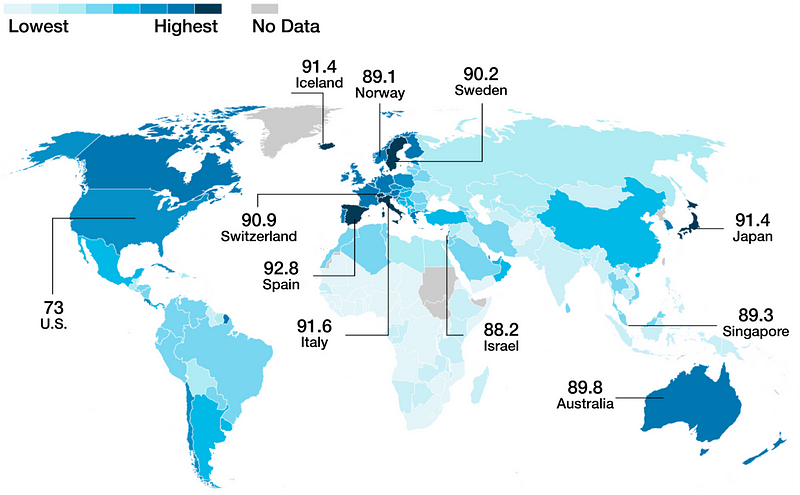
Healthcare outcomes in the US are generally worse than in Spain. For example, life expectancy at birth in the US is 73 years, compared to 92 years in Spain.
One of the key differences between the US and Spanish healthcare systems is that the latter is much more government-controlled and -funded than the former.
In the US, private health insurance companies play a major role in providing and funding healthcare, while in Spain, the government is the main provider and funder of healthcare. Only 34%of Americans have public coverage, and Spain covers 99.9 % of its population.
GDP for healthcare in the US is the highest but the results are worse than in Spain, France, or Japan. The government spends around $12,530 per person each year on healthcare.
In short, the main differences between the healthcare systems of Spain and the US are:
-The US has a private healthcare system while Spain has a public one
-The US spends more money on healthcare than any other country, while Spain spends less
-The US has more doctors per capita than Spain, but similar numbers of nurses
-Healthcare outcomes in the US are worse than in Spain
-The GDP for healthcare is higher in the US than in Spain, but the results are worse.
Why?
The simple answer is that the US healthcare system is much more complex than Spain’s, and this complexity leads to inefficiency and waste.
There are a number of reasons for this complexity:
-The US has a patchwork of different health insurance providers, both public and private, while Spain has a single-payer system.
-The US healthcare system is driven by profit, while the Spanish system is not.
-The US system relies heavily on technology, while the Spanish system does not.
-The US has a far more litigious culture than Spain, which leads to defensive medicine and higher costs.
The bottom line is that the US healthcare system is much more expensive than the Spanish system, but it produces worse results.
This is because the US system is complex, fragmented, and driven by profit, while the Spanish system is simpler, more efficient, and in a true sense not-for-profit.
Let’s talk more about the Spanish healthcare system.
The efficient Spanish healthcare system
With a robust network of hospitals and medical centers, Spain’s high-quality health care system caters to a variety of needs, including wellness checks, surgeries, emergencies & much more. In 2009, Spain was ranked 7th best in the world by the World Health Organisation (WHO) but now in 2019 is ranked 1st. The average life expectancy in Spain is an amazing 92.8 years, which is the first highest average living age in the world.
The Spanish National Healthcare System (“Instituto Nacional de la Salud”), established under Spain’s General Healthcare Act of 1986, provides comprehensive insurance and free care to all Spaniards, regardless of their economic status or participation in the social security system.
Spain has 3 main branches of healthcare central, autonomous, and local.
The central branch is where the Ministry of Health is in charge of the healthcare guidelines, proposals, changes, or management of drug prescriptions.
Autonomous is under the management of one of the 17 autonomous communities in Spain.
The local is the healthcare management at the local level in each autonomous community. Each village and town has its own Centro de Salud (health center).
In case of emergency, you must dial 112. Residents, non-residents, and tourists all have the right to receive emergency care, regardless of insurance coverage or living status (retired, employed, unemployed). However, if you are registered in the state healthcare system or have private health insurance, you will be served more promptly.
Universal and Private Healthcare System
Spain’s universal healthcare system allows for basic medical treatments, depending on your social security contribution (employed/self-employed), including surgery, cancer therapy, hospitalizations, drugs, and more.
Why is it one of the best healthcare systems in the world?
Spanish public healthcare insurance covers 99.9% of its population with the best healthcare services and primary care. Also, the Mediterranean lifestyle places Spain as the healthiest nation in the world.
Spain takes children’s and mental health very seriously and invests 5% in its services.
Private insurance companies and who is eligible
Purchasing private health insurance allows you to access private medical services, such as extra prescriptions, specialty coverage, doctors’ choice, and post-recovery care. Same-day service, appointments, and results are delivered via SMS or email.
Before you get your residency visa, you must purchase private health insurance.
The monthly health insurance, including dental insurance for a family of 4 is 180 Euros a month and it covers everything mostly 100%.
In Spain you rarely have co-pays, and never deductibles. I think I paid once a copay of 7 Euros.
That is it.
If you break it down it means 60 Euros per adult a month and 30 Euros for a child.
For Americans, the quotes may be a little higher.
I know one family of 4 from San Francisco, and they paid $4000 for the whole year (the price is in $ from 4 years ago, now can be lower because of the strong $ currency).
Here is the list of the most popular private health insurance in Spain.
How to get universal insurance
To get universal healthcare insurance or access to the public healthcare system in Spain you need NIE, residency, and social security number which you can get as employed or self-employed.
Pharmacy very different than in the US
In the United States, pharmacists are unable to assist you due to the possibility of a lawsuit but in Spain, they can. If you have any minor illness, you can just go to any pharmacy and they will assist you with the proper medication.
Contraceptives and some medications that you can’t get over-the-counter are readily available in Spanish pharmacies. For example, contraceptives are 3 times cheaper in Spain than in the States without prescription.
Navigating the healthcare system in Spain
Finally, navigating the healthcare system may appear difficult at first because unlike you are used to in the United States, where you are referred to and explained step-by-step where to go and what to do, in Spain you must figure this out on your own. Also, making appointments for lab drawings, x-rays, follow-ups with specialists, and so on.
Conclusion
The Spanish healthcare system is one of the best in the world. It offers a high level of coverage and quality of care at a reasonable cost. The system is primarily government-funded, but private health insurance is also available for its citizens and ex-pats.
Spain has a wide range of hospitals, clinics, and other medical facilities, and its pharmacies are well-stocked and reasonably priced. Navigating the healthcare system can be challenging at first, but once you get used to it, it is easy to use.
You don’t have to be concerned if you have health insurance in Spain; you will never receive a 1000s-dollar bill like in the United States.


