
Top 9 Online Courses to Learn Data Science From Scratch
Accelerate your Data Science Career in 2021

In the rapidly expanding world of today, when technology is progressing at a rate like never before, humans tend to generate a lot of data. Data — the new business frontier demands that it be analyzed. Businesses are hiring for data-related roles at an exponential rate. In the past two years, I have come across many people looking for a career change or learn the ecosystem of DATA.
From taking online courses, reading books, learning coding languages — there are various channels to begin your Data Science journey.
I am a Management Information Systems grad at the University of Illinois at Chicago and a self-learned Data Scientist. Having completed more or less of every course listed in this blog in my Data Science journey, the courses I am recommending in this blog are some of the best Data Science resources I could find myself. I am a quick learner but tend to get bored very quickly, so the courses mentioned below are the ones with new exciting challenges with in-depth concept exploration.
An undergraduate or master’s Data Science degree in universities can take up to 2–3 years to teach all you need for Data Science and can cost you anywhere from $10,000 (online MSDS) to $100,000. However, with online learning, many say that they could learn functional Data Science in about 6 months by dedicating ~6–7 hours each day.
The below-listed courses obviously cannot replace an on-campus Data Science degree, but it can definitely be a good starting point if you are —
- Looking for a career change
- Starting a data-related project
- Exploring the landscape before starting school, etc...
Why take up online courses to learn Data Science?
- Learn about the concepts with real-world context
- Boast about your skills and projects on your resume or portfolio
- Get better at job prospects, salary negotiation
- Make job transitions with revamped skills and knowledge
How to decide what course is for you?
About 3,470,000,000 results (0.67 seconds) are returned when you search “Learn Data Science” on Google. With a multitude of online courses and certifications available online, it is overwhelming, confusing, and tough to choose one course that will serve the need for you: learn data science from scratch. Prioritize based on —
- Coverage of the data science process
- Language and technologies used
- Usage of data science concepts
- Experience required before the course
- Projects during and at the of course
- End-to-end learning or learn in parts
PRO TIP: If you want to learn Data Science as well as to start working on projects sooner, I recommend starting with some programming classes or take a few statistics classes.
1. IBM Data Science Professional
Duration — 3 months (flexible) Level — Beginner Platform — Coursera Cost — Free to audit, $39 per month Language — Python
You get: Certificates for each course and digital badges by IBM
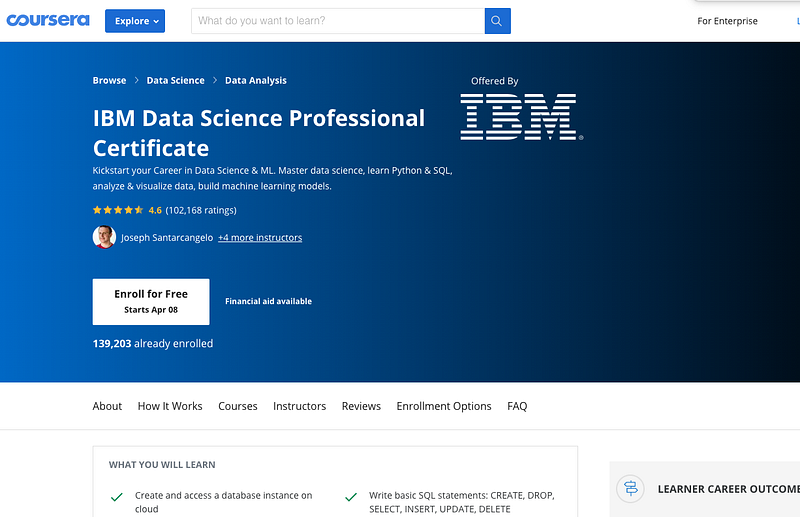
I’ve yet not come across a beginner course better than IBM Data Science Professional Certification. The first-ever course I took to begin my Data Science journey was this. I can vouch for this one — the best beginner-level data science certification program for enthusiasts looking to kickstart their professional data science career.
From explaining what data science is, why is it so popular, writing basic SQL statements, Machine Learning, Python basics, Data Science modeling to ending the course with a capstone — I highly recommend taking up this 9-course challenge!
Courses
- What is Data Science?
- Open Source tools for Data Science
- Data Science Methodology
- Python for Data Science and AI
- Databases and SQL for Data Science
- Data Analysis with Python
- Data Visualization with Python
- Machine Learning with Python
- Applied Data Science Capstone
You can work on projects with Chicago Crime data, Google Geocoding API, Foursquare API, Numpy, Scipy, and more.
2. HarvardX’s Data Science Professional Certificate
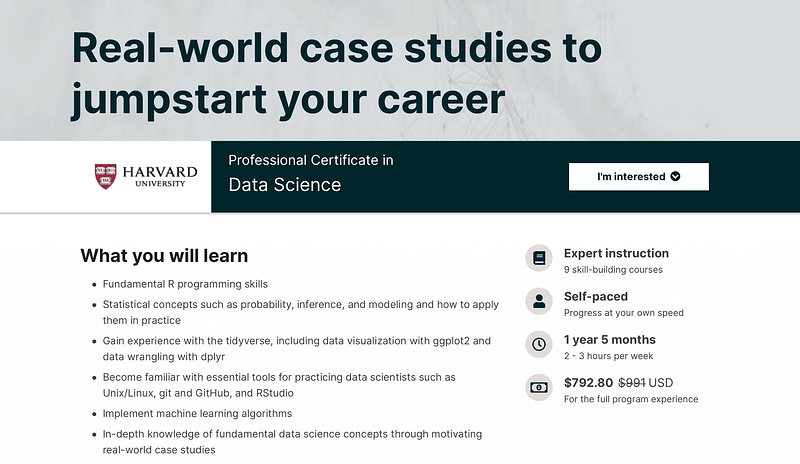
Duration — 1 year 5 months (flexible) Level — Beginner Platform — edX Cost — $991 (The course is usually discounted or look for coupon codes) Language: R
You get: Digital Certificate
This Data Science course on edX is instructed by Rafael Irizarry, Professor of Biostatistics at Harvard University.
Courses
- Data Science: R Basics
- Data Science: Visualization
- Data Science: Probability
- Data Science: Inference and Modeling
- Data Science: Productivity Tools
- Data Science: Wrangling
- Data Science: Linear Regression
- Data Science: Machine Learning
- Data Science: Capstone
You work on case studies including Trends in World Health and Economics, US Crime Rates, Financial Crisis of 2007–2008, Election Forecasting, Moneyball inspired Baseball Team building and the famous — Movie Recommendation System.
3. Data Scientist Track with Python| DataCamp
Duration — 88 hours Level — Beginner Platform — DataCamp Language: Python
You get: Statement of accomplishment
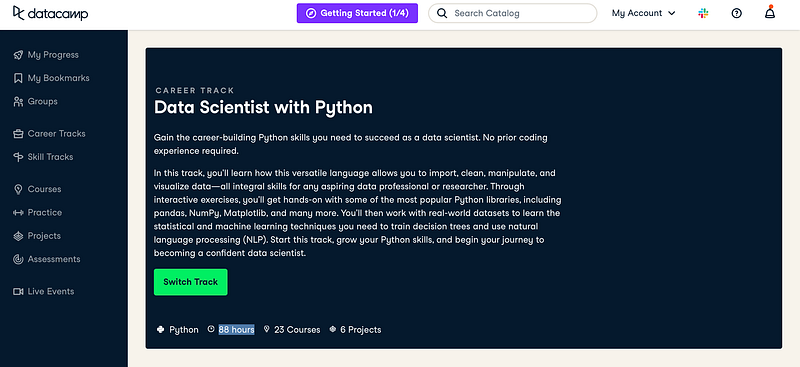
There are 23 courses on the track starting from no prior coding experience as an introduction to Python to ending with supervised learning, unsupervised learning, and cluster analysis in Python
The course is taught by multiple instructors across academia, professors, Data Scientists in companies, and the likes with guided and unguided projects.
Projects
- Analyzing TV Data
- The Android App Market on Google Play
- GitHub history of Scala Language
- A Visual History of Nobel Prize Winners
- Dr. Semmelweis and the Discovery of Handwashing
- Predicting Credit Card Approvals
Alternatively, you can take up the same track with coding language as R from here.
4. Data Science Specialization (John Hopkins)
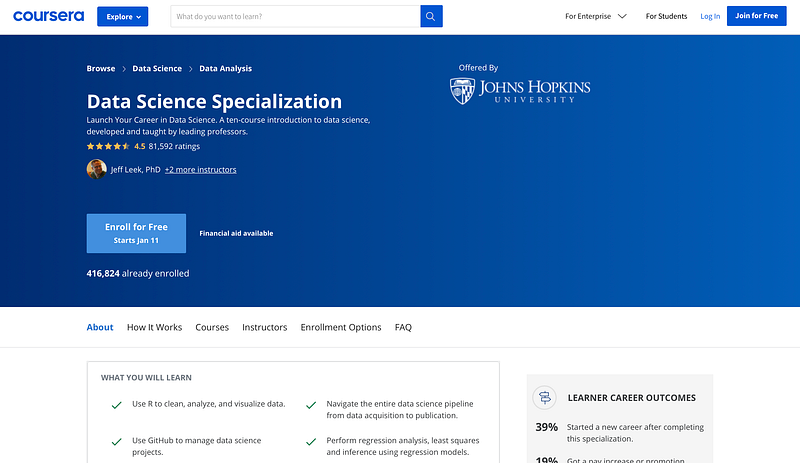
Duration — 11 months (flexible) Level — Beginner Platform — Coursera Language: R
You get: Digital Certificates
Courses
- The Data Scientist’s Toolbox
- R Programming
- Getting and Cleaning Data
- Exploratory Data Analysis
- Reproducible Research
- Statistical Inference
- Regression Models
- Practical Machine Learning
- Developing Data Products
- Data Science Capstone
You will work on the basics of R, EDA, data modeling, and end the course with a capstone — projects from the real-world. One of the industry partners for the course is Yelp — you can expect good datasets to work on!
5. Data Science Nanodegree Program | Udacity
Duration — 4 months (~10 hours/week) Level — Intermediate Platform — Udacity Language: Python
You get: A digital certificate
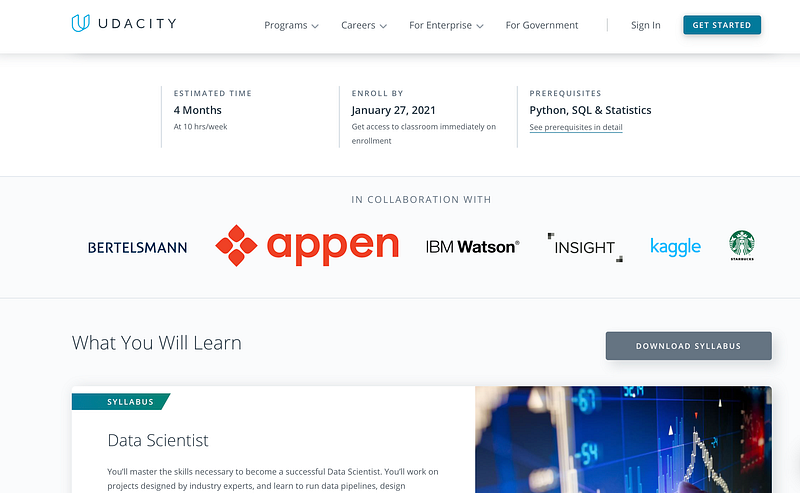
This Data Science track recommends students to be familiar with basic machine learning concepts, Python programming, probability, and statistics. If you are someone who does not know a single thing — The intro to Machine Learning Nanodegree Program is your start.
Courses
- Solving Data Science Problems
- Software Engineering for Data Scientists
- Data Engineering for Data Scientists
- Experiment Design and Recommendations
- Data Science Capstone
I appreciated an introduction to the comprehensive data science process, from building and implementing data pipelines, transforming data, building solutions, and deploying those to the cloud with this nanodegree. You work on projects designed by industry experts like IBM Watson, Kaggle, Starbucks, Appen, Bertelsmann, and build recommendation systems.
6. Data Science A-Z: Real-Life Data Science Exercises
Duration — 21h 13m hours of content (28 sections) Level — Beginner Platform — Udemy
You get: Certificate of completion
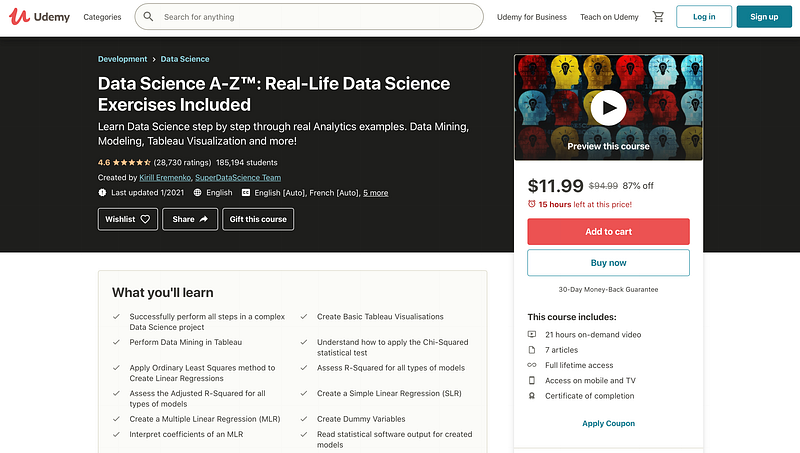
I personally wasn’t a great fan of Udemy and the courses listed there but when I came across this particular course by Kirill Eremenko, I was taken away by the breadth and depth of coverage of the data science process.
Modules
- Visualization
- Modeling
- Data Preparation
- Communication
You work on Data Mining in Tableau, CAP curve in Excel, stored procedures and queries in SQL, ETL, Machine Learning concepts like regression, confusion matrix, and more.
7. Applied Data Science with Python Specialization
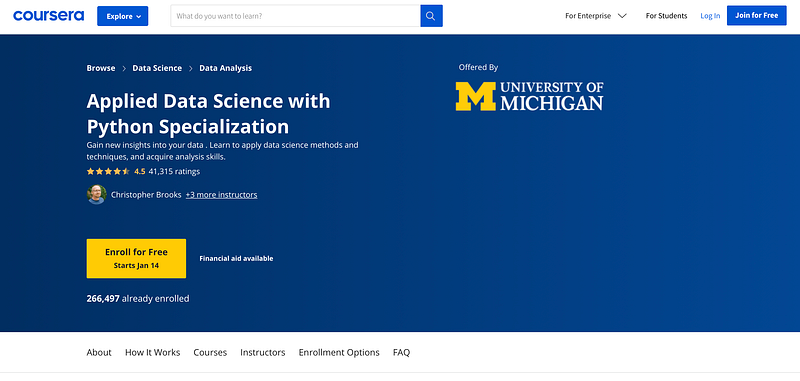
Duration — 5 months (flexible) Level — Advanced Platform — Coursera Language: Python
You get: Digital Certificates
Courses
- Introduction to Data Science in Python
- Plotting, Charting & Representation of Data in Python
- Applied Machine Learning in Python
- Applied Text Mining in Python
- Applied Social Network Analysis in Python
You will work on inferential statistical analysis, data visualization, text mining, data analysis with applied machine learning and analyze the connectivity of a social network using Natural Language Toolkit (NLTK), Scikit-Learn, Numpy.
8. Machine Learning | Stanford
Duration — 11 weeks /60 hours (flexible) Level — Beginner Platform — Coursera Language: Octave/Matlab
You get: Digital Certificates
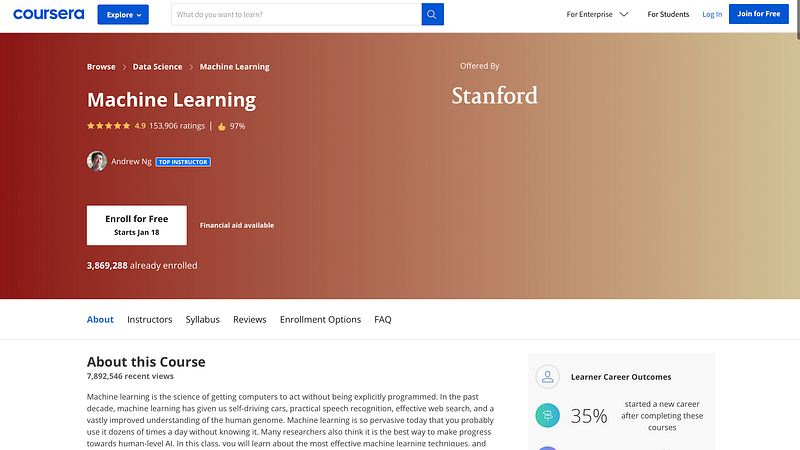
The Machine Learning course by Andrew Ng, Coursera’s co-founder and a Stanford professor was THE course when I heard of Data Science. With not many courses published online back in 2016, everyone wanting to do something with data had completed this course around me. I started as well but dropped out after 3 weeks of learning.
For some reason, I did not find my calling for Data Science with this course back in 2016–17 but now, for someone, who has an interest in how universities teach Data Science without going to school, this can be your starting point.
Courses
- Linear Regression with One Variable
- Linear Algebra
- Linear Regression with Multiple Variables
- Octave/Matlab Tutorial
- Logistic Regression
- Regularization
- Neural Networks: Representation
- Neural Networks: Learning
- Advice for Applying Machine Learning
- Machine Learning System Design
- Support Vector Machines
- Unsupervised Learning
- Dimensionality Reductions
- Anomaly Detection
- Recommender Systems
- Large-scale Machine Learning
- Application Example: Photo OCR
You will work on (Source: About the course [Coursera]) —
- Introduction to machine learning, Data Mining, and statistical pattern recognition
- Supervised learning: parametric/non-parametric algorithms, support vector machines, kernels, neural networks
- Unsupervised learning: clustering, dimensionality reduction, recommender systems, deep learning
- Concepts in machine learning: Bias/Variance tradeoff; innovation process in machine learning and AI
- Smart robots, computer vision, medical informatics, and more such areas
9. Data Scientist Career Path | Codecademy
Duration — 35 weeks Level — Beginner Platform — Codecademy Language: Python
You get: Certificate of completion
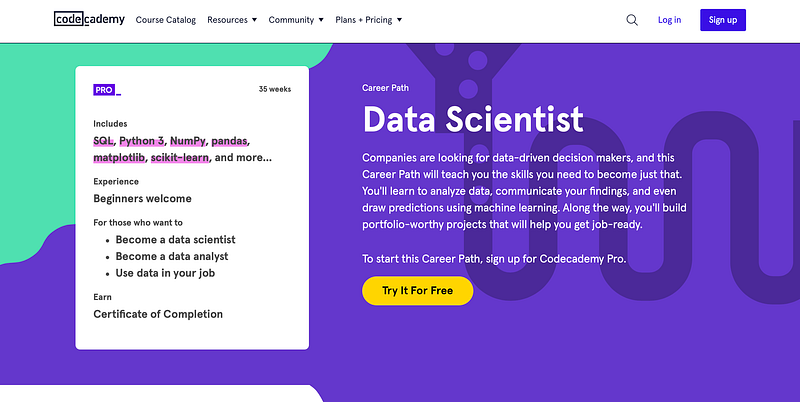
There are 21 modules to work on starting with Python fundamentals, data acquisition, manipulation, wrangling, visualization, Natural Language Processing, Supervised and Unsupervised Machine Learning, Deep Learning, and complete the course with a Data Scientist Portfolio Project.
You will work on analyzing data with SQL, Python, and build machine learning algorithms using NumPy, pandas, matplotlib, scikit-learn, and more.
That’s it from my end for this blog. Thank you for reading! I hope you enjoyed the article. Do let me know what courses have you taken or are planning to take in your Data Science journey.
If you enjoy reading stories like these and want to support me as a writer, consider signing up to become a Medium member using this link (and I can earn a small commission with no extra cost to you!)
Happy Data Tenting!
Rashi is a grad student at the University of Illinois, Chicago. She loves to visualize data and create insightful stories to communicate implicit insights. When not rushing to meet school deadlines, she enjoys blogging about data with a good cup of coffee...


