
Top 5 Things You Need to Know About Education in France
Admissions, institutions, costs, and much more.

The intended readers of this article are not only people who want to go abroad for higher studies.
But also the parents who intend to migrate. They need to look into the education system of the country w.r.t. overall standards, international acceptability, and costs involved.
So, let’s talk about the French education system.
1. The French education system at a glance
French educational system has five levels i.e. Maternelle, École, Collège, Lycée, and Université.
- Maternelle Nursery (up to grade 1)
- École Primary School (grades 1–5)
- Collège Junior High School (grades 6-9)
- Lycée High School (grades 10-12)
- Université Same concept
Some more details about:
Lycée
- It is further divided into two groups i.e. général and professional.
- Général lycée is for students who commit to long-duration studies to become doctors, engineers, lawyers…etc.
- Professional lycées are for early starters with respect to working and earning for becoming technicians, graphic designers, and so on.
- Upon completing the lycée, students earn BAC (Baccalaureate), in other words, it is the high school diploma.
Université
- Bachelor’s degree requires a high school diploma and 3 years of university education (BAC+3).
- In some cases, the need is BAC+4.
- Some programs offer two degrees instead of just one.
- Master’s degree requires 2 more years of university study that is (BAC+5).
2. Language requirements
French is essential to study in France at all levels. The only exception is to study in private institutions. Up to lycée, it is possible.
But, at the university level, if you enroll in a program which is only taught in English, you will have to spend at least one-third time in another English speaking country. Yet, it may be possible to find an English medium program but chances of the same are very slim.
So, it is suggested to learn French up to B1/B2 (advanced level).
There are countless schools, computer applications, and best practice sharing from the polyglots to help you achieve this daunting task.
3. Finding the right institution
(Maternelle, École, Collège) As per the rules of France, children must attend a school from the ages of 6 to 16 that is closest to their house. So, there is no pick and choose.
(Lycée) There are separate lycées for both general and professional studies. But, depending on the student’s inclination towards study/profession and scholastic aptitude, admission to the respective institution is initiated. It is also required to enroll in a lycée which is close to the child’s residence but there can be a few exceptions to this rule.
Note of caution: If you intend to study at zero cost then better settle in France at the beginning of Collège (grade 6 or 7). The reason is simple i.e. French is a must for all levels of studies and mandatory for addmission in a general Lycée.
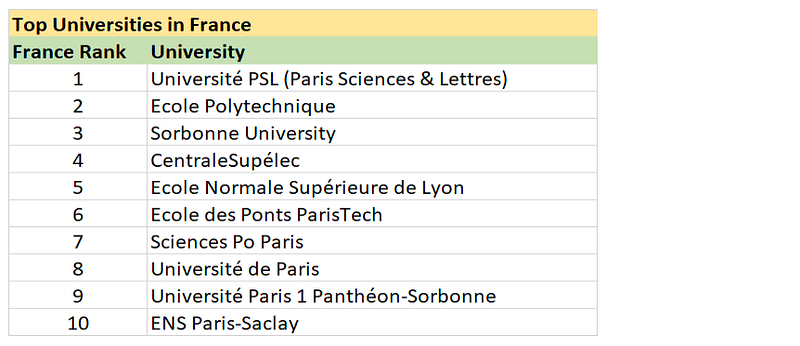
(Université) As per the statistics of 2018, there are 620+ universities in France having more than 1.6 million registered students. Out of the total count, approximately 10% are international students.

4. Costs involved
Saying that education in France is free for all French residents won’t be an overstatement. But, it is good to know some details and exceptions.
(Maternelle to Lycée) There is no tuition fee and the school provides free books to all students. Moreover, in most cases, lunch cost is also absorbed by the government and some students also get a monthly scholarship. Most lycées also provide a brand new laptop to incoming students.
(Université) The public universities are essentially free for all French residents. Yet, there is a minor cost that students need to pay annually.
Residents of France
- € 170 per year for Bachelor’s (Licence) programs.
- € 243 per year for Master’s programs.
- € 601 per year in Engineering courses at certain institutions.
- € 380 per year for Doctorate (Ph.D.) programs.
International students
- € 2,770 per year for Bachelor’s (Licence) programs.
- € 3,770 per year for Master’s programs.
- € 380 per year for Doctorate (Ph.D.) programs.
Cost of studying in public or private universities vary. Whereas, the tution fee at private universities are generally higher. They range between € 3,000 to € 20,000 annually.

5. Vacations
Ministere de l’Education Nationale in France (Ministry of National Education) annually approves holidays' calendar.
French educational institutions have five sets of holidays as per the 3 zones i.e. A, B, and C. Each zone has different dates.
- All Saints’ (17 Oct — 2 Nov)
- Christmas (19 Dec — 4 Jan)
- Winter (20 Feb — 8 Mar)
- Spring (10 — 26 April)
- Summer (6 Jul — 1 Sep)
The vacations are for two weeks each with the exception of summer holidays, which lasts for eight weeks from Jul. to Sep.
If you need specific information then drop me line in the response section, and I will get back to you as soon as possible.