
Top 5 Must-read Computer Vision Books in 2024
Absorb, Reflect, Repeat: The Value of Books in Learning
When I think about learning something new, especially something as complex and challenging as computer vision, my go-to resource is always a book. There’s just something about the way a book is structured, written by industry experts who know their field inside out, that makes the learning process feel more complete. While video tutorials and online courses have their place, and they can be incredibly useful for visual learners or those who prefer a more interactive approach, books provide a depth and breadth of knowledge that’s hard to match.
Of course, everyone learns differently, and there’s no right or wrong way to acquire knowledge. But I can confidently say that books remain one of the most important tools for learning anything new.
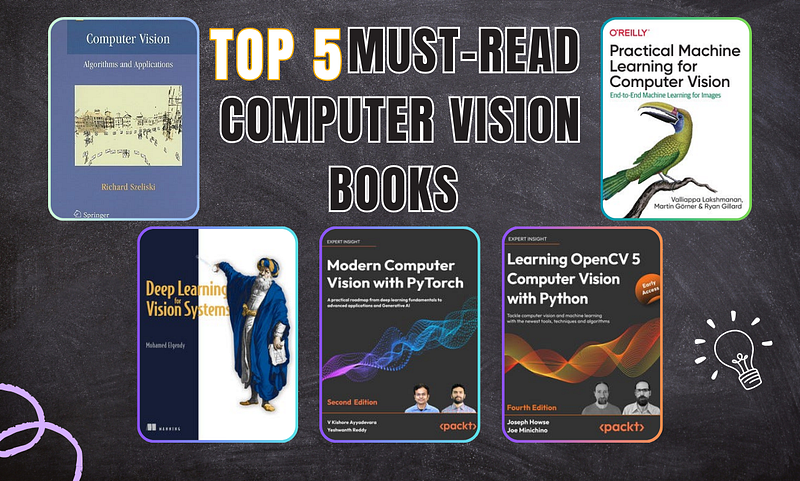
As I sit down to write this article, I am surrounded by stacks of books on computer vision. Each book represents a new idea, a new way of thinking about how computers can see and understand the world. In 2024, the field of computer vision continues to grow, and several new books have emerged as essential reads. But if you want to understand computer vision deeply, I highly recommend adding these top 5 books to your reading list.
Table of content:
- Computer Vision: Algorithms and Applications by Richard Szeliski
- Practical Machine Learning for Computer Vision by Valliappa Lakshmanan, Martin Görner, Ryan Gillard
- Deep Learning for Vision Systems by Mohamed Elgendy
- Modern Computer Vision with PyTorch: Deep learning fundamentals to advanced applications By V Kishore Ayyadevara, Yeshwanth Reddy
- Learning OpenCV 5 Computer Vision with Python — Fourth Edition
Computer Vision: Algorithms and Applications by Richard Szeliski
The first book is Computer Vision: Algorithms and Applications book by Richard Szeliski. This book is a masterpiece. What I love most is how it covers everything from the basics of how images are formed to advanced topics like recreating 3D scenes and recognizing objects. Szeliski explains complex ideas in a clear and detailed way, using math to help us understand how these algorithms really work. Some readers might find this challenging, but I believe it’s worth the effort to gain a deep understanding of computer vision.
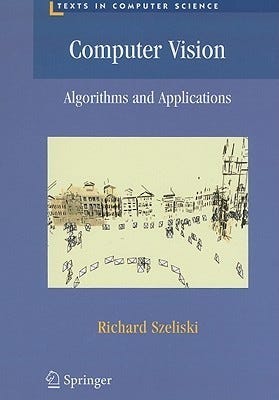
It also describes challenging real-world applications where vision is being successfully used, both in specialized applications such as image search and autonomous navigation, as well as for fun, consumer-level tasks that students can apply to their own personal photos and videos.
The table of contents for this book is as follows:
- Introduction
- Image formation
- Image processing
- Feature detection and matching
- Segmentation
- Feature-based alignment
- Structure from motion
- Dense motion estimation
- Image stitching
- Computational photography
- Stereo correspondence
- 3D reconstruction
- Image-based rendering
- Recognition
Practical Machine Learning for Computer Vision by Valliappa Lakshmanan, Martin Görner, Ryan Gillard
The second book on this list is Practical Machine Learning for Computer Vision. It is exactly what the title suggests — a hands-on guide to applying machine learning techniques to real-world computer vision problems. The book focuses on practical applications, providing step-by-step instructions for building and deploying models in various environments, including cloud and mobile.
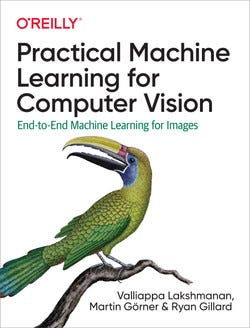
This practical book shows you how to employ machine learning models to extract information from images. ML engineers and data scientists will learn how to solve a variety of image problems including classification, object detection, autoencoders, image generation, counting, and captioning with proven ML techniques. This book provides a great introduction to end-to-end deep learning: dataset creation, data preprocessing, model design, model training, evaluation, deployment, and interpretability.
The table of contents for this book is as follows:
- Machine Learning for Computer Vision
- ML Models for Vision
- Image Vision
- Object Detection and Image Segmentation
- Creating Vision Datasets
- Preprocessing
- Training Pipeline
- Model Quality and Continuous Evaluation
- Model Predictions
- Trends in Production ML
- Advanced Vision Problems
- Image and Text Generation
Deep Learning for Vision Systems by Mohamed Elgendy
The third book on this list is Deep Learning for Vision Systems by Mohamed Elgendy. This book has quickly become a cornerstone in the computer vision community. What sets this book apart is its perfect balance of theory and practical application, making it an ideal resource for those looking to bridge the gap between academic knowledge and real-world implementation.
Elgendy starts with the basics of deep learning and gradually builds up to advanced concepts in computer vision. The book covers a wide range of topics, including convolutional neural networks (CNNs), object detection, image segmentation, and generative adversarial networks (GANs). What I particularly appreciate about this book is how seamlessly it integrates code examples with theoretical explanations, allowing readers to get hands-on experience as they learn.
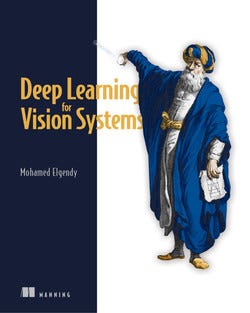
How does the computer learn to understand what it sees? Deep Learning for Vision Systems answers that by applying deep learning to computer vision. You’ll understand how to use deep learning architectures to build vision system applications for image generation and facial recognition.
The table of contents for this book is as follows:
PART 1 — DEEP LEARNING FOUNDATION
- Welcome to computer vision
- Deep learning and neural networks
- Convolutional neural networks
- Structuring DL projects and hyperparameter tuning
PART 2 — IMAGE CLASSIFICATION AND DETECTION
- Advanced CNN architectures
- Transfer learning
- Object detection with R-CNN, SSD, and YOLO
PART 3 — GENERATIVE MODELS AND VISUAL EMBEDDINGS
- Generative adversarial networks (GANs)
- DeepDream and neural style transfer
- Visual embeddings
Modern Computer Vision with PyTorch: Deep learning fundamentals to advanced applications By V Kishore Ayyadevara, Yeshwanth Reddy
The fourth book is Modern Computer Vision With Pytorch by V Kishore Ayyadevara and Yeshwanth Reddy 2nd edition Released in June 2024. Whether you are a beginner or are looking to progress in your computer vision career, this book guides you through the fundamentals of neural networks (NNs) and PyTorch and how to implement state-of-the-art architectures for real-world tasks.
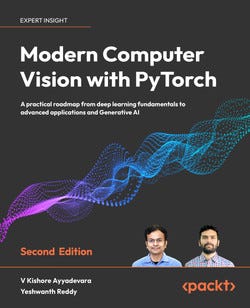
This second edition of Modern Computer Vision with PyTorch is fully updated to explain and provide practical examples of the latest multimodal models, CLIP, and Stable Diffusion.
You’ll discover best practices for working with images, tweaking hyperparameters, and moving models into production. As you progress, you’ll implement various use cases for facial keypoint recognition, multi-object detection, segmentation, and human pose detection. This book provides a solid foundation in image generation as you explore different GAN architectures. You’ll leverage transformer-based architectures like ViT, TrOCR, BLIP2, and LayoutLM to perform various real-world tasks and build a diffusion model from scratch. Additionally, you’ll utilize foundation models’ capabilities to perform zero-shot object detection and image segmentation. Finally, you’ll learn best practices for deploying a model to production.
The table of contents for this book is as follows:
- Artificial Neural Network Fundamentals
- PyTorch Fundamentals
- Building a Deep Neural Network with PyTorch
- Introducing Convolutional Neural Networks
- Transfer Learning for object Classification
- Practical Aspects of Image Classification
- Basics of Object detection
- Advanced object detection
- Image segmentation
- Applications of object detection and segmentation
- Autoencoders and Image Manipulation
- Image generation using GANs
- Advanced GANs to manipulate images
- Combining Computer Vision and Reinforcement Learning
- Combining Computer Vision and NLP techniques
- Foundation models in Computer Vision
- Application of Stable Diffusion
- Moving a model to Production
Learning OpenCV 5 Computer Vision with Python — Fourth Edition
The fifth book is Learning OpenCV 5 Computer Vision with Python written by Joseph Howse and Joe Minichino. This book will not only help those who are getting started with computer vision but also experts in the domain. You’ll be able to put theory into practice by building apps with OpenCV 5 and Python 3.
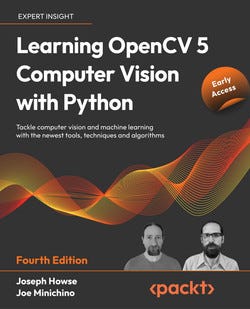
You’ll learn how to perform basic operations such as reading, writing, manipulating, and displaying images, videos, and camera feeds. From taking you through image processing, video analysis, depth estimation, and segmentation, to helping you gain practice by building a GUI app, this book ensures you’ll have opportunities for hands-on activities. You’ll tackle two popular challenges: face detection and face recognition. You’ll also learn about object classification and machine learning, which will enable you to create and use object detectors and even track moving objects in real time. Later, you’ll develop your skills in augmented reality and real-world 3D navigation. Finally, you’ll cover ANNs and DNNs, learning how to develop apps for recognizing handwritten digits and classifying a person’s gender and age, and you’ll deploy your solutions to the Cloud.
The table of contents for this book is as follows:
- Setting Up OpenCV
- Handling Files, Cameras, and GUIs
- Processing Images with OpenCV
- Depth Estimation and Segmentation
- Detecting and Recognizing Faces
- Retrieving Images and Searching Using Image Descriptors
- Building Custom Object Detector
- Tracking Objects
- Camera Models and Augmented Reality
- 3D Reconstruction and Navigation
- Neural networks with OpenCV — an Introduction
- OpenCV Applications at Scale
Thanks for reading✨ If you like the article make sure to:


