
Data Science | Machine Learning | Artificial Intelligence
Top 20 free Data Science, ML and AI MOOCs on the Internet.
Here is a list of the best free online courses on Data Science, Machine Learning, Deep Learning, and Artificial Intelligence.

Formal education in the 21st century has transformed into a choice instead of a mandatory step in life. With the internet boom and the rise of Massive Open Online Courses (MOOCs), one can opt for learning data science online and avoid the burden of student debt. Statistics show that eLearning enables students to learn 5x more material for every hour of training. The benefits of online learning are limitless — from the cost-cutting aspect to the flexible schedule and environment.
The democratization of Data Science
It’s the year 2020, and data science is more democratized than ever. This means any individual can do data science with little to no expertise, as long as the proper tools and a substantial amount of data are provided. As data drenched every part of the industry, possessing the skills of data scientists will be imperative, as it engenders a workforce that speaks the language of data.
With this in mind, by utilizing online courses, it is feasible for a complete beginner to start pursuing data science. All it takes is a properly structured learning curriculum, the right methodology to learning(Ultralearning), motivation and passion to persevere and side hustles/projects.
How to learn data science on the internet?
The best MOOCs + correct learning methodology + passion + projects
So in this article, I will be covering the best MOOCs which are FREE and extremely valuable in your journey towards becoming data scientists.
Data Science Venn Diagram
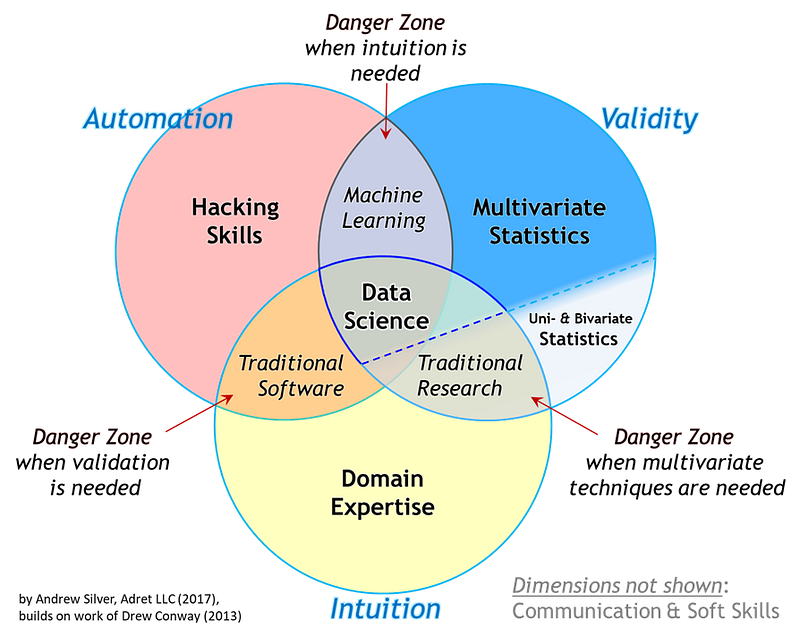
The multidisciplinary field of Data Science can be visualized with this infamous Venn Diagram by Drew Conway. With this diagram, it can be deduced that data science encompasses hacking skills, machine learning, and multivariate statistics.
I have excluded domain expertise because that is dependent on the company you are working for, and hard skills such as communication skills cannot be acquired with online courses, you need to talk to people in real life to do that (as daunting as that can be).
The 20 courses listed below will be divided into 3 segments:
1. Data Science2. Hacking skills
- Python
- R
- SQL3. Machine Learning & AI
- Basics of ML & AI
- Deep Learning
- NLP
- Computer VisionInstead of scrolling through class central or spend hours filtering through the noise on the internet, I have compiled this list which contains courses I found useful in learning Machine Learning, AI, Data Science, and programming.
So, scroll down and see the list now!
The MOOCs

0. Learning How to Learn
This is a course that teaches you one of the most important skills in your life, which is to learn how to learn. It teaches you techniques and methodologies that ensure you can retain what you’ve learned and helps you apply them in real life. Since learning how to learn is an important prerequisite in learning just about anything, that’s why it’s listed as number 0, meaning it builds the foundation for every other course below.
Data Science
1. CS109 Data Science —Harvard
CS109 is a course that introduces methods for five key facets of an investigation:
- data wrangling, cleaning, and sampling to get a suitable data set
- data management to be able to access big data quickly and reliably
- exploratory data analysis to generate hypotheses and intuition
- prediction based on statistical methods such as regression and classification
- communication of results through visualization, stories, and interpretable summaries.
Plus, its taught in Python!
2. Learning from Data — Caltech
It’s fundamental for all data enthusiasts to have a profound understanding of how machines can learn from data and ways to improve the process. This is an introductory ML course that covers the basic theory, algorithms, and applications.
What you’ll learn:
- What is learning?
- Can a machine learn?
- How to do it?
- How to do it well?
3. Introduction to Big Data — UC San Diego
This is the Big data era and all data science enthusiasts are obligated to learn about what it is and why it matters.
What you’ll learn:
- Terminology and the core concepts behind big data problems, applications, and systems.
- How Big Data might be useful in their business or career.
- An introduction to one of the most common frameworks, Hadoop
4. Data Science — John Hopkins University
This course, in a nutshell, teaches you to ask the right questions, manipulate data sets, and create visualizations to communicate results.
What you’ll learn:
- Use R to clean, analyze, and visualize data.
- Navigate the entire data science pipeline from data acquisition to publication.
- Use GitHub to manage data science projects.
- Perform regression analysis, least squares, and inference using regression models.
In the end, you’ll have a capstone project where you’ll apply the skills you have learned by building a real product using real-world data. Then, this portfolio will portray your newly acquired prowess in data science.
Mathematics
5. Mathematics for Machine Learning specialization — Imperial College London
This course is mathematics for ML specialization which covers all the math you need and helps you freshen up on all the concepts and theories you may have forgotten in school. The great thing is this course teaches you about its application in Computer Science, giving you a more intuitive sense of how matrices and regression relate to ML and Data Science.
This specialization is divided into three main courses:
- Linear Algebra
- Multivariate Calculus
- Dimensionality Reduction with Principal Component Analysis
At the end of this specialization, you will have gained the prerequisite mathematical knowledge to continue your journey and take more advanced courses in machine learning.
6. Linear Algebra — MIT
Taught by the one and only — Prof. Gilbert Strang. Mr. Strang is the best linear algebra lecturer out there (my opinion). So if you’re looking for a great course for linear algebra, this is it.
This course covers matrix theory and linear algebra, emphasizing topics useful in other disciplines.
7. Multivariable Calculus — MIT
Multivariable calculus is another imperative concept in Data Science. From the simple linear regression to support vector machines and neural networks, calculus is demanded.
This course covers differential, integral and vector calculus for functions of more than one variable.
8. Probability and Statistics — Stanford
Probability and Statistics are the underlying foundations that allow all the magic in Data Science to happen. Without p-value and binomial distributions and all that jargon, making predictions with data will be impossible.
What you’ll learn:
- Exploratory Data Analysis
- Producing Data
- Probability
- Inference
Sadly that the course is closed so here is a refresher below! Or if you want a similar course by Carnegie Mellon, click here.
Hacking Skills
9. Google’s Python course
A free class by Google which is made for beginners. This class is mainly composed of notes, videos, and lots of coding exercises to get you started in coding in Python. I found it useful and I recommend it to all those who are looking to start learning Python.
10. Applied Data Science with Python — UMich
The 5 courses in this University of Michigan specialization introduce learners to data science through the python programming language. The course uses Jupyter notebooks which are convenient and intuitive.
The 5 courses:
- Introduction to Data Science
- Applied Plotting, Charting & Data Representation
- Applied Machine Learning
- Applied Text Mining
- Applied Social Network Analysis
Another Python course!
11. Statistics with R Specialization — Duke University
This specialization helps you master analyzation and visualization in R, one of the top programming languages in the field of data science.
What you’ll learn:
- create reproducible data analysis reports
- the unified nature of statistical inference
- perform frequentist and Bayesian statistical inference and modeling to understand natural phenomena and make data-based decisions
- communicate statistical results correctly, effectively, and in context without relying on statistical jargon, critique data-based claims and evaluated data-based decisions
- wrangle and visualize data with R packages for data analysis.
12. SQL for Data Science — UC Davis
SQL — established language for interacting with database systems — is a crucial tool for data scientists to retrieve and work with data. This course is tailor-made for beginners looking to add SQL to their LinkedIn skill section and start using it to mine data and mess around with it. Most importantly, they will learn to ask the right questions and come up with good answers to deliver valuable insights for your organization.
What you’ll learn:
- Creating tables and be able to move data into them
- Common operators and how to combine the data
- Case statements and concepts like data governance and profiling
- Discuss topics on data, and practice using real-world programming assignments
- Interpret the structure, meaning, and relationships in source data and use SQL as a professional to shape your data for targeted analysis purposes.
Machine Learning and AI
13. Machine Learning Crash Course — Google
This crash course is a self-study guide for aspiring machine learning practitioners and it features a series of lessons with video lectures, real-world case studies, and hands-on practice exercises. This is one of the courses under the Learn with Google AI initiative, encouraging all to learn AI.
14. Elements of AI — University of Helsinki
The Elements of AI is a series of free online courses created by Reaktor and the University of Helsinki. It was made to encourage everyone to learn what AI is, what can (and can’t) be done with AI, and how to start creating AI methods. The courses combine theory with practical exercises and can be completed at your own pace.
15. Machine Learning — Andrew Ng
Machine Learning with Andrew Ng is one of the most popular online courses on the internet, it has it all. From the basics to neural networks and SVM, plus an application project at the end. The good thing about this course is Andrew Ng is an incredible teacher. The bad, it’s taught in MATLAB (I would prefer Python).
16. Practical Deep Learning for Coders — Fast.ai
Fast.ai is the online course to go if you want to learn deep learning for free. Everyone on the internet recommends it and it surely is a valuable resource for those who want to learn deep learning. This course utilizes Jupyter notebooks for your learning and PyTorch as the main tool for coding deep learning.
17. CS230 Deep Learning — Stanford
Deep Learning is one of the most highly sought after skills in AI. In this course, you will learn the foundations of Deep Learning, understand how to build neural networks, and learn how to lead successful machine learning projects. You will learn about Convolutional networks, RNNs, LSTM, Adam, Dropout, BatchNorm, Xavier/He initialization, and more.
18. CS224N Natural Language Processing with Deep Learning — Stanford
Natural language processing (NLP) is one of the most important technologies of the information age and a crucial part of Data Science. Applications of NLP are ubiquitous — in web search, emails, language translation, chatbots, etc. In this course, students will gain a thorough introduction to cutting-edge research in Deep Learning for NLP.
What you’ll learn:
- Design, implement and understand your neural network models.
- PyTorch!
Watch it on Youtube here.
19. CS231n: Convolutional Neural Networks for Visual Recognition — Stanford
Computer Vision has become ubiquitous in our society, with applications in search, facial recognition, drones, and most notably, Tesla cars. This course is a deep dive into details of the deep learning architectures with a focus on learning end-to-end models for these tasks, particularly image classification.
What you’ll learn:
- Implement, train and debug their neural networks
- Gain a detailed understanding of cutting-edge research in computer vision.
The final assignment involves training a multi-million parameter convolutional neural network and applying it to the largest image classification dataset (ImageNet).
Watch it on Youtube here.
Supplementary courses
- Khan Academy
- Kaggle courses
- 3Blue1Brown Essence of Linear Algebra & Calculus & Neural Networks
- Towards Data Science Learning section
Action Plan

Learning Data Science online can be hard at times since you don’t have a structured curriculum telling you what to do. But instead of seeing it that way, realize that you have the freedom to construct a learning path that suits you and can bring out the best in you. One good thing is you can learn at times where your brain is at peak efficiency and rest when it’s less efficient. Moreover, you get to decide what you learn according to your interest and passion.
Advice
A few tips while learning online is to always take simple notes, writing takeaways at the end of the day or blogging about what you’ve learned. By the same vein, utilizing the Feynman Technique by explaining what you have learned to friends and family is important, especially for a complex subject such as Data Science.
Moreover, when learning machine learning algorithms and neural networks, it’s crucial to learn it along with writing the code, this way you can see what you’re learning, and have a better understanding of the topic at hand. It’s also good to be a part of online communities such as Reddit, Discord, etc. so you can ask questions and obtain great answers from experts.
To summarize:
- Taking notes/blogging
- Use the Feynman Technique
- Code along with concepts (Create a neural network from scratch)
- Join data science online communities to ask questions
To end, here is a quote by Arthur W. Chickering and Stephen C. Ehrmann
“Students do not learn much just sitting in classes listening to teachers, memorizing prepackaged assignments, and spitting out answers. They must talk about what they are learning, write reflectively about it, relate it to past experiences, and apply it to their daily lives. They must make what they learn part of themselves.”
Thanks for reading and I hope this article was resourceful for you.
Please leave in the comments any other free online courses for Data Science you would suggest!
Check out my other articles here!
Data Science toolbox — An introductory series to Data Science
Read my series on Ultralearning Data science that proffers a profusion of advice and tips on learning effectively.
Here’s some great resources for Data Science!
Contacts
If you want to be updated with my latest articles follow me on Medium.
Other means of contact:
Happy learning!


