
Top 10 Trending GitHub Repositories to Watch in 2024

As we progress through 2024, the world of software development continues to evolve at a rapid pace. GitHub, the largest platform for open-source collaboration, serves as a hub for innovative projects that shape the future of technology. In this blog post, we’ll take a closer look at the top 10 trending GitHub repositories that have captured the attention of developers worldwide.
- Grok-1: Revolutionizing AI Interpretability The Grok-1 repository, created by xai-org, has made waves in the AI community with its open release. This groundbreaking project focuses on improving the interpretability of artificial intelligence models, enabling developers and researchers to gain deeper insights into how AI systems make decisions.
Grok-1 tackles one of the most significant challenges in the field of AI: understanding the reasoning behind the predictions and outputs of complex models. By providing a suite of tools and techniques for AI interpretability, Grok-1 aims to demystify the “black box” nature of many AI systems.
The repository offers a comprehensive framework for analyzing and visualizing the inner workings of AI models. It provides intuitive interfaces and visualizations that allow users to explore the features, weights, and decision-making processes of neural networks and other machine learning models. By shedding light on these intricate details, Grok-1 empowers developers to identify potential biases, debug models, and improve the overall reliability and trustworthiness of AI systems.
One of the key strengths of Grok-1 is its flexibility and extensibility. The framework is designed to work with a wide range of AI models and architectures, making it applicable to various domains and use cases. Whether you’re working on computer vision, natural language processing, or any other AI-driven application, Grok-1 provides the tools and insights needed to understand and optimize your models.
Moreover, Grok-1 promotes collaboration and knowledge sharing within the AI community. By open-sourcing the project, xai-org encourages researchers and practitioners to contribute to the development and improvement of AI interpretability techniques. This collaborative approach accelerates the progress of explainable AI and fosters a deeper understanding of how AI systems operate.
With Grok-1, the future of AI becomes more transparent and accountable. By promoting interpretability and understanding, this project contributes to the development of more trustworthy and reliable AI solutions. As AI continues to shape our world, the importance of projects like Grok-1 cannot be overstated, as they ensure that we can harness the power of AI while maintaining transparency and accountability. Link: GitHub — xai-org/grok-1: Grok open release
2. privateGPT: Harnessing the Power of GPT for Private Document Interaction The privateGPT repository, created by imartinez, has garnered significant attention for its innovative approach to interacting with documents using the power of GPT (Generative Pre-trained Transformer) models. What sets privateGPT apart is its unwavering commitment to privacy and security. With this tool, users can leverage the capabilities of GPT to analyze and interact with their documents without any risk of data leaks.

privateGPT ensures that all document processing and GPT interactions occur entirely on the user’s local machine, eliminating the need for data to be sent to external servers. This local processing guarantees that sensitive information remains confidential and secure. By combining the power of GPT with a privacy-first approach, privateGPT opens up new possibilities for individuals and organizations looking to extract insights from their documents while maintaining complete control over their data.
Whether you need to analyze legal contracts, research papers, or personal documents, privateGPT provides a seamless and secure way to interact with your content. With its user-friendly interface and robust privacy features, this repository empowers users to unlock the potential of GPT without compromising the confidentiality of their information. Link: GitHub — imartinez/privateGPT: Interact with your documents using the power of GPT, 100% privately, no data leaks
3. Playwright: Seamless Web Testing and Automation Across Browsers The Playwright repository, developed by Microsoft, has become a go-to framework for web testing and automation. With its powerful and intuitive API, Playwright simplifies the process of testing web applications across multiple browsers, including Chromium, Firefox, and WebKit.

One of the standout features of Playwright is its ability to provide a single, unified API for interacting with different browser engines. This means developers can write tests once and run them seamlessly across various browsers, saving time and effort in the testing process. Playwright’s cross-browser compatibility ensures that web applications are thoroughly tested and validated, reducing the risk of browser-specific issues.
In addition to its cross-browser testing capabilities, Playwright offers a wide range of features that enhance web automation. It provides robust selectors for locating elements on web pages, enabling reliable and efficient interaction with the application under test. Playwright also supports advanced scenarios, such as handling file uploads, downloads, and network interception, giving developers fine-grained control over the testing process. Link: GitHub — microsoft/playwright: Playwright is a framework for Web Testing and Automation. It allows testing Chromium, Firefox and WebKit with a single API.
With its extensive documentation, active community, and regular updates, Playwright has become a trusted tool for developers and QA professionals alike. Its ability to streamline web testing and automation has made it a valuable addition to the testing ecosystem, helping teams deliver high-quality web applications faster and with greater confidence.
4. Open-Sora: Democratizing Efficient Video Production for All The Open-Sora repository, developed by hpcaitech, is revolutionizing the world of video production by making it accessible and efficient for everyone. This innovative project aims to democratize the video creation process, empowering individuals and businesses to produce high-quality videos without the need for extensive technical expertise or expensive equipment.

Open-Sora leverages cutting-edge technologies, including artificial intelligence and machine learning, to streamline various aspects of video production. From intelligent video editing and automated content generation to real-time collaboration features, Open-Sora provides a comprehensive suite of tools that simplify and accelerate the video creation workflow.
One of the key advantages of Open-Sora is its user-friendly interface, which allows users to intuitively navigate the video production process. Whether you’re a beginner or a seasoned professional, Open-Sora’s intuitive design makes it easy to create engaging and visually appealing videos quickly and efficiently.
Moreover, Open-Sora promotes collaboration and teamwork in video production. With its real-time collaboration features, multiple users can work together seamlessly, regardless of their location. This collaborative approach fosters creativity, enhances productivity, and enables teams to produce high-quality videos in a fraction of the time traditionally required.
As an open-source project, Open-Sora benefits from a vibrant community of developers and contributors who continuously enhance and expand its capabilities. This collaborative effort ensures that Open-Sora remains at the forefront of video production technology, incorporating the latest advancements and best practices.
By democratizing efficient video production, Open-Sora is empowering individuals, small businesses, and large enterprises alike to create compelling video content without breaking the bank. Whether you’re creating marketing videos, educational content, or personal projects, Open-Sora provides the tools and flexibility needed to bring your vision to life. Link: GitHub — hpcaitech/Open-Sora: Open-Sora: Democratizing Efficient Video Production for All
5. MetaGPT: The Multi-Agent Framework for Natural Language Programming The MetaGPT repository, created by geekan, is pushing the boundaries of artificial intelligence and natural language programming. This groundbreaking project introduces a multi-agent framework that aims to revolutionize the way software development is approached.

At its core, MetaGPT is designed to provide an AI-powered software company that understands and executes natural language programming. By leveraging the power of advanced language models and multi-agent systems, MetaGPT enables developers to express their ideas and requirements in plain English, and the framework takes care of the rest.
One of the key advantages of MetaGPT is its ability to bridge the gap between human-readable instructions and machine-executable code. Developers can simply describe their desired software functionality using natural language, and MetaGPT’s intelligent agents work together to interpret the requirements, generate code, and build functional applications.
The multi-agent architecture of MetaGPT allows for a collaborative and efficient development process. Different agents specialize in various aspects of software development, such as understanding user requirements, designing system architectures, writing code, and testing applications. These agents communicate and coordinate with each other to deliver high-quality software solutions based on natural language input.
MetaGPT’s potential extends beyond traditional software development. It can be applied to a wide range of domains, including web development, mobile app creation, data analysis, and more. By democratizing the software development process and making it accessible to a broader audience, MetaGPT has the potential to empower individuals and businesses to bring their ideas to life without the need for extensive programming expertise.
As an open-source project, MetaGPT benefits from the contributions and innovations of a global community of developers and researchers. This collaborative effort ensures that MetaGPT continues to evolve and improve, pushing the boundaries of what is possible with natural language programming.
With MetaGPT, the future of software development looks brighter than ever. By harnessing the power of AI and natural language processing, this multi-agent framework is paving the way for a new era of intuitive, efficient, and accessible software creation. Link: GitHub — geekan/MetaGPT: 🌟 The Multi-Agent Framework: Providing AI Software Company, Towards Natural Language Programming
6. Planka: The Real-Time Kanban Board for Efficient Collaboration The Planka repository, developed by plankanban, introduces a powerful and intuitive kanban board designed for seamless collaboration among workgroups. Built using the renowned React and Redux frameworks, Planka offers a real-time experience that streamlines task management and enhances productivity.
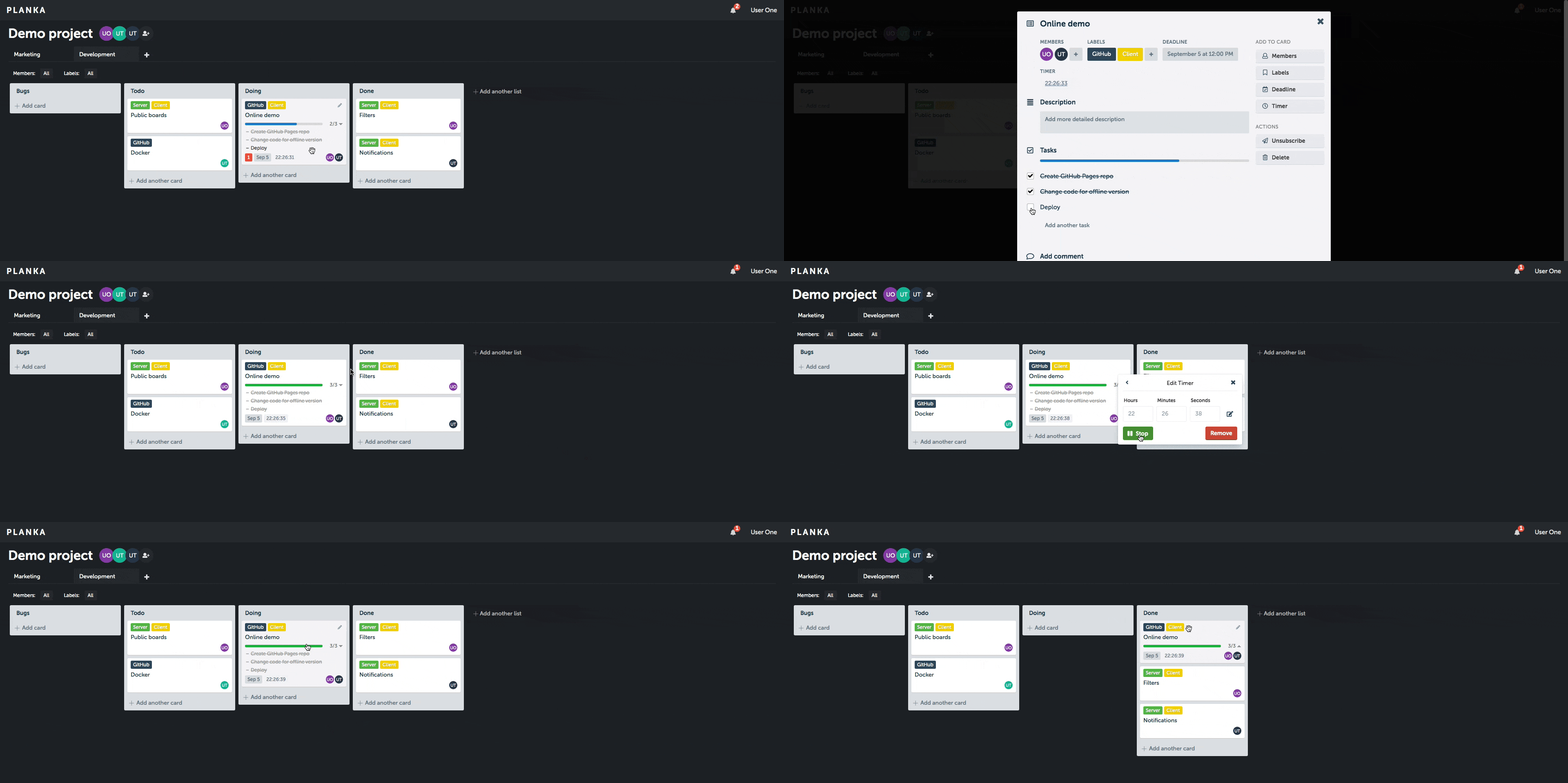
Kanban boards have become a popular tool for visualizing and organizing workflows, and Planka takes this concept to the next level. With its sleek and user-friendly interface, Planka allows teams to create, manage, and track tasks effortlessly. The real-time synchronization ensures that all team members have access to the most up-to-date information, fostering effective communication and collaboration.
One of the standout features of Planka is its flexibility and customization options. Teams can easily adapt the kanban board to their specific needs, creating custom columns, labels, and filters to reflect their unique workflows. This adaptability makes Planka suitable for a wide range of industries and project types, from software development and marketing to personal task management.
Planka’s real-time capabilities enable instant updates and notifications, keeping team members informed about task assignments, deadlines, and progress. The ability to collaborate in real-time eliminates the need for constant meetings and email exchanges, streamlining communication and reducing unnecessary overhead.
The repository leverages the power of React and Redux, two widely adopted technologies known for their performance and scalability. React’s component-based architecture allows for modular and reusable code, making it easier to maintain and extend the application. Redux, on the other hand, provides a predictable state management system, ensuring a consistent and reliable user experience.
Planka’s open-source nature encourages community involvement and contributions. Developers can explore the codebase, suggest improvements, and customize the kanban board to fit their specific requirements. The active community behind Planka ensures continuous development, bug fixes, and the addition of new features based on user feedback.
Whether you’re a small startup, a remote team, or a large enterprise, Planka offers a robust and user-friendly solution for managing tasks and collaborating effectively. Its real-time capabilities, combined with the power of React and Redux, make it a compelling choice for teams seeking a modern and efficient kanban board.
With Planka, workgroups can streamline their workflows, improve communication, and boost productivity. By providing a centralized and visually appealing platform for task management, Planka empowers teams to focus on what matters most: delivering high-quality work and achieving their goals. Link: GitHub — plankanban/planka: The realtime kanban board for workgroups built with React and Redux.
7. Flowise: Unleashing the Power of LLMs with Intuitive Drag & Drop UI The Flowise repository, developed by FlowiseAI, is revolutionizing the way developers and enthusiasts interact with Large Language Models (LLMs). With its innovative drag & drop user interface, Flowise empowers users to create customized LLM flows effortlessly, unlocking the full potential of these powerful language models.
LLMs have gained significant attention for their ability to generate human-like text, answer questions, and perform various natural language processing tasks. However, working with LLMs often requires technical expertise and complex programming. Flowise breaks down these barriers by providing an intuitive and accessible interface for building LLM flows.
With Flowise, users can visually construct their desired LLM workflows by simply dragging and dropping pre-built components onto a canvas. These components represent different stages of the LLM pipeline, such as data preprocessing, model selection, parameter configuration, and output formatting. By connecting these components together, users can create sophisticated LLM flows tailored to their specific needs.
One of the key advantages of Flowise is its flexibility and extensibility. The repository provides a rich library of components that cover a wide range of LLM functionalities, including text generation, sentiment analysis, named entity recognition, and more. Users can easily customize these components or create their own, enabling them to adapt Flowise to their unique requirements.
Flowise’s drag & drop interface not only simplifies the process of building LLM flows but also promotes experimentation and exploration. Users can quickly iterate on their designs, test different configurations, and observe the results in real-time. This interactive approach encourages users to discover new possibilities and push the boundaries of what LLMs can achieve.
The repository leverages cutting-edge technologies and frameworks to ensure a smooth and efficient user experience. Flowise is built using modern web technologies, such as React and Node.js, which provide a responsive and interactive interface. The underlying architecture is designed to handle large-scale LLM workflows, ensuring optimal performance and scalability.
As an open-source project, Flowise benefits from a vibrant community of developers, researchers, and LLM enthusiasts. The repository encourages collaboration, knowledge sharing, and contributions from the community. Users can share their custom components, workflows, and insights, fostering a collaborative ecosystem that drives innovation in the field of LLMs.
Flowise is not only a tool for developers but also a gateway for non-technical users to harness the power of LLMs. By abstracting away the complexities of programming, Flowise democratizes access to LLMs, enabling individuals from diverse backgrounds to leverage these advanced language models for their own projects and applications.
With Flowise, the possibilities are endless. Whether you’re a researcher exploring new LLM architectures, a developer building intelligent chatbots, or a content creator generating engaging narratives, Flowise provides the tools and flexibility to bring your ideas to life. By combining the power of LLMs with an intuitive drag & drop interface, Flowise is reshaping the landscape of natural language processing and opening up new avenues for innovation. Link: GitHub — FlowiseAI/Flowise: Drag & drop UI to build your customized LLM flow
8. DevToys: The Swiss Army Knife for Developers The DevToys repository, created by DevToys-app, is a game-changer for developers, offering a versatile and powerful toolset that streamlines their workflow and boosts productivity. Just like a Swiss Army knife, DevToys provides a wide range of tools and utilities in a single, convenient package.
DevToys is designed to be the ultimate companion for developers, catering to their diverse needs and challenges. Whether you’re working on web development, data manipulation, or system administration, DevToys has you covered. The repository offers a comprehensive collection of tools that address common tasks and pain points encountered by developers in their daily work.
One of the standout features of DevToys is its intuitive and user-friendly interface. The tools are organized into logical categories, making it easy to find and access the desired functionality. The interface is clean, responsive, and optimized for efficiency, allowing developers to focus on their core tasks without getting bogged down by complicated menus or settings.
The range of tools provided by DevToys is truly impressive. From text manipulation and code formatting to network analysis and API testing, the repository covers a wide spectrum of development needs. Developers can easily convert between different data formats, encode and decode strings, generate random data, and perform various calculations and transformations.
DevToys also includes powerful tools for debugging and troubleshooting. The repository offers utilities for inspecting network traffic, analyzing HTTP requests and responses, and visualizing data structures. These tools empower developers to quickly identify and resolve issues, saving valuable time and effort in the debugging process.
The repository places a strong emphasis on customization and extensibility. Developers can tailor DevToys to their specific requirements by configuring settings, creating custom profiles, and even extending the toolset with their own plugins or scripts. This flexibility allows developers to adapt DevToys to their unique workflows and integrate it seamlessly into their existing development environment.
As an open-source project, DevToys benefits from a passionate and engaged community of developers. The repository encourages contributions, bug reports, and feature requests from the community, ensuring that DevToys remains up-to-date and aligned with the evolving needs of developers. The collaborative nature of the project fosters innovation and knowledge sharing, making DevToys a valuable resource for developers of all skill levels.
Whether you’re a seasoned developer or just starting your programming journey, DevToys is an indispensable tool that will enhance your productivity and streamline your development process. With its extensive collection of utilities, intuitive interface, and customization options, DevToys is the Swiss Army knife that every developer needs in their toolkit.
By leveraging the power of DevToys, developers can focus on what they do best: writing high-quality code and building innovative applications. The repository empowers developers to work smarter, not harder, by providing a centralized and efficient platform for tackling common development tasks.
If you’re looking to simplify your development workflow, boost your productivity, and have a reliable companion by your side, look no further than DevToys. This Swiss Army knife for developers is ready to transform the way you work and help you achieve your development goals with ease. Link: GitHub — DevToys-app/DevToys: A Swiss Army knife for developers.
9. GPT-Pilot: The First Real AI Developer The GPT-Pilot repository, created by Pythagora-io, marks a significant milestone in the world of software development. This groundbreaking project introduces the first real AI developer, revolutionizing the way we approach coding and problem-solving.
GPT-Pilot leverages the power of advanced language models, such as GPT (Generative Pre-trained Transformer), to create an intelligent coding assistant that can understand and generate code in various programming languages. With GPT-Pilot, developers now have a powerful ally that can help them write code faster, identify and fix errors, and explore new programming concepts.
One of the key strengths of GPT-Pilot is its ability to understand natural language instructions and convert them into functional code. Developers can simply describe their desired functionality or provide a high-level overview of the problem they want to solve, and GPT-Pilot will generate the corresponding code. This natural language interface makes coding more accessible and intuitive, even for those who are new to programming.
GPT-Pilot goes beyond simple code generation. It possesses a deep understanding of programming concepts, best practices, and design patterns. The AI developer can analyze existing codebases, provide suggestions for optimization and refactoring, and even identify potential bugs or security vulnerabilities. This intelligent assistance empowers developers to write cleaner, more efficient, and more secure code.
The repository offers a user-friendly interface that seamlessly integrates with popular development environments and code editors. Developers can interact with GPT-Pilot directly within their preferred tools, receiving real-time suggestions, auto-completions, and code snippets. This integration enhances the developer’s workflow, reducing context switching and increasing productivity.
GPT-Pilot is not limited to a specific programming language or domain. It supports a wide range of languages, including Python, JavaScript, Java, C++, and more. Whether you’re working on web development, data analysis, machine learning, or any other programming task, GPT-Pilot can adapt to your needs and provide relevant assistance.
As an open-source project, GPT-Pilot encourages collaboration and contributions from the developer community. Developers can explore the codebase, provide feedback, and contribute to the improvement and expansion of GPT-Pilot’s capabilities. The repository serves as a hub for innovation, where developers can share their experiences, learn from each other, and push the boundaries of what’s possible with AI-assisted programming.
The potential impact of GPT-Pilot on the software development industry is immense. By leveraging AI to augment human intelligence, GPT-Pilot can accelerate the development process, reduce the learning curve for new developers, and enable more people to participate in coding. It has the power to democratize software development, making it more accessible and inclusive.
Furthermore, GPT-Pilot can help bridge the gap between domain experts and developers. Non-technical individuals can express their ideas and requirements in natural language, and GPT-Pilot can translate those concepts into functional code. This collaboration between humans and AI opens up new possibilities for rapid prototyping, domain-specific solutions, and innovative applications.
With GPT-Pilot, the future of software development looks brighter than ever. By harnessing the power of AI and natural language processing, this repository is paving the way for a new era of intelligent, efficient, and collaborative coding. As the first real AI developer, GPT-Pilot is set to reshape the landscape of programming and empower developers to push the boundaries of what’s possible. Link: GitHub — Pythagora-io/gpt-pilot: The first real AI developer
10. Qdrant: High-Performance Vector Database for Next-Gen AI The Qdrant repository, developed by qdrant, introduces a groundbreaking vector database designed to power the next generation of AI applications. Qdrant is a high-performance, massive-scale solution that enables efficient storage, retrieval, and similarity search of vector data.
In the era of AI and machine learning, vector databases have become essential for handling the ever-growing volume of high-dimensional data. Qdrant addresses this need by providing a robust and scalable platform that can handle billions of vectors with ease. Its cutting-edge architecture ensures exceptional performance, making it suitable for a wide range of AI-driven applications.
One of the key features of Qdrant is its ability to perform ultra-fast similarity searches. With Qdrant, you can quickly find the most similar vectors to a given query vector, enabling applications such as recommendation systems, image and video search, natural language processing, and more. The repository employs advanced indexing techniques and algorithms to guarantee efficient and accurate search results.
Qdrant is designed to scale seamlessly, allowing you to handle massive datasets without compromising performance. It supports distributed deployments, enabling you to distribute the workload across multiple nodes and scale horizontally as your data grows. This scalability makes Qdrant suitable for enterprise-level applications and big data scenarios.
The repository provides a flexible and intuitive API that simplifies the integration of Qdrant into your existing applications. With support for popular programming languages and frameworks, such as Python, Java, and Go, Qdrant ensures a smooth development experience. The API allows you to easily index, update, and query vector data, making it effortless to incorporate vector similarity search into your AI-powered applications.
Qdrant also offers advanced features like real-time updates, allowing you to dynamically add, delete, or modify vectors without interrupting the search process. This real-time capability is crucial for applications that require up-to-date information and real-time recommendations.
In addition to its outstanding performance and scalability, Qdrant prioritizes data security and privacy. The repository implements robust security measures to protect your vector data, ensuring that sensitive information remains confidential and secure.
To make Qdrant even more accessible, the repository is also available as a cloud service at https://cloud.qdrant.io/. The cloud offering provides a fully managed and scalable solution, eliminating the need for infrastructure setup and maintenance. With Qdrant in the cloud, you can focus on building your AI applications while leaving the vector database management to the experts.
As an open-source project, Qdrant benefits from a vibrant community of developers and contributors. The repository encourages collaboration, feedback, and contributions from the community, fostering continuous improvement and innovation. By leveraging the collective knowledge and expertise of the community, Qdrant stays at the forefront of vector database technology.
Whether you’re building recommendation engines, search engines, or any other AI-driven application, Qdrant provides a powerful and reliable foundation. Its high-performance, massive-scale capabilities, combined with its ease of use and cloud availability, make it the go-to choice for the next generation of AI.
With Qdrant, you can unlock the full potential of vector data and take your AI applications to new heights. Experience the power of a cutting-edge vector database that delivers unparalleled performance, scalability, and flexibility. Embrace the future of AI with Qdrant and revolutionize the way you store, retrieve, and analyze high-dimensional data. Link: GitHub — qdrant/qdrant: Qdrant — High-performance, massive-scale Vector Database for the next generation of AI. Also available in the cloud https://cloud.qdrant.io/
Conclusion: As we explore the top 10 trending GitHub repositories in 2024, it becomes evident that the future of software development is filled with exciting possibilities. From AI-driven automation and augmentation to innovative frameworks and emulators, these projects demonstrate the creativity and ingenuity of the developer community. By staying up-to-date with these trending repositories, developers can expand their skills, collaborate on cutting-edge projects, and contribute to the ever-evolving landscape of technology.


