
Top 10 Takeaways From “12 Months To 1 Million” By Ryan Daniel Moran.
Seven Figure Entrepreneur.
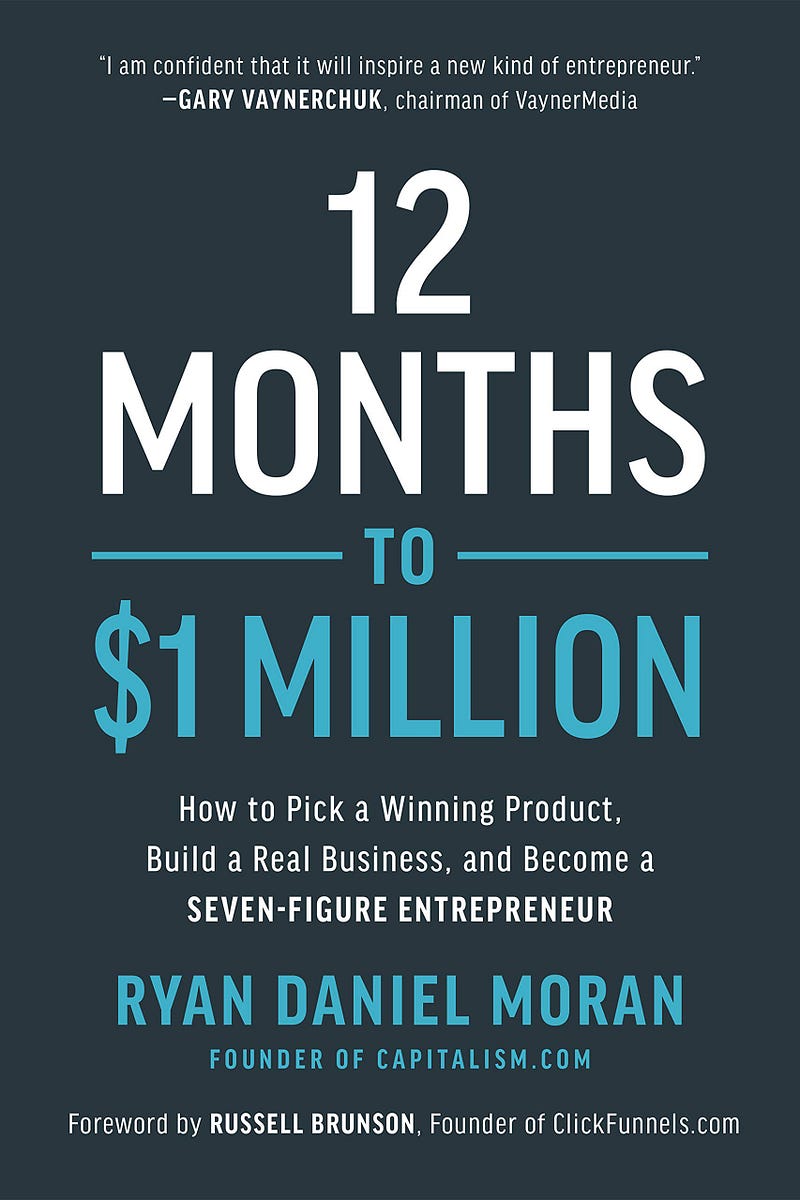
1. “All of that and you won’t even know right away if the resulting prototype will be the one that will make your brand. That’s why I recommend you come up with the idea, get samples, and improve over time. Perfectionists hate the approach, but you can’t expect to make it to a million dollars in twelve months if it takes twelve months just to get a look at what you’re creating.”
2. “There’s a common startup model called “scratch your own itch,” and it involves finding a problem you yourself have, solving that problem, and then allowing that solution to form a business. That’s what inspired Suzy to start Poo-Pourri.”
3. “You can sell things and make money, and your business will be purely transactional. You can follow a formula that produces profits, and it can work for a while. But once you start thinking about people, you start building a real business. If you create something that people actually want, and you communicate to the person, you can create a million-dollar business in one year. That’s how you become a real entrepreneur.”
4. “A better deal for a better product was out there, but I didn’t put our momentum on hold to look for it. We made the adjustment as we progressed. That never-ending, purpose-driven quest for improvement gives you the freedom to direct your focus right now on getting that product on the market. Whenever I catch myself overthinking a product and delaying the crucial move from concept to sale, I remind myself, “Let’s make some mistakes.”
5. “No amount of preparation ensures a perfect process. Sometimes you’ll make a modest mistake, like going to market with the second-best supplier cutting slightly into your margins. Other times, you’ll commit a nastier error, like the time we lowered the price on our yoga mats without really thinking through our inventory limitations.”
6. “I get dozens of messages a day from entrepreneurs, and the most common question I get from people new to the startup process is “What product should I sell?” To figure out the answer to this question, you first need to understand you’re building a brand, not selling products.”
7. “you’re building a brand, you don’t want to get into the business of cutting prices. You want to be near the top price point in your market. The reason is simple: It’s much easier to scale a premium brand than it is to scale a low-priced brand. Only companies selling inventory in massive quantities can really win at that game. You’re not going to beat Walmart’s price, so don’t play Walmart’s game.”
8. “A word of warning: The absolute worst thing you can do is ask yourself, What products are super popular right now? For example, I can’t tell you how many people I know chased fidget spinners or tried to sell diet supplements. Both trends exploded brightly, and, sure, some people made some money — but they couldn’t build a business. “
9. “Amazon can be the best place to get started selling products, but if you just look at what’s selling on Amazon and try to sell that, you’ll struggle to build a real business. Why? Well, if someone else sells the same product for $30, you have to sell yours for $28. Then the next person will price his or her product at $26. Now there’s a race to the bottom on profit margin.”
10. “One of my mastermind members, Travis Killian, once told me about how he gets products to stand out in a busy, loud marketplace. His answer was simple: “We listen to people. We execute so many split tests, it’s insane. We’ll mock up the product and ask people, Which do you like better? This one or this other one from our competitor? We do that for all the top competitors in the market, all the ones we think have the best products in the niche.”
Note: If you want to receive OVER 5000 Business Templates and Tools, learn more here about how to do that.
If you are a confused entrepreneur that wants to start a business but don’t know where or how to start, take a look at my online business starter kit here, it is on a discount.
Thank You For Reading!
If you liked the above story, you can click this link to our Facebook group where you can receive support for your small business for FREE! You will also receive FREE access to my newsletter where I post updates once a week.
Delve into my other articles below about business and financial wellness. ⬇️⬇️


