
Too Many Daves: A Meditation on Family Size
It’s pretty damned hard when your cup runneth over with kids, but it might be better than the lonelier alternatives.
The Gosselin sextuplets are eighteen. And I still have questions about how the hell any of the Gosselins (especially older twin daughters, Cara and Mady) survived those first twelve months of the younger litter’s lives when everyone was juggling babies.
I imagine that, while the “end” (i.e., Jon and Kate’s beautiful kids) has more than justified the downsides to having such a huge family, it’s probably been hard for each of them to get their fill of attention and resources — parents included. It’s pretty damned hard on all parties when your cup runneth over with kids.
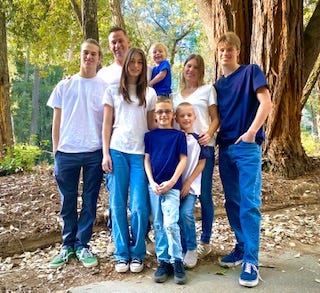
Our family isn’t the Gosselins, but we did have a lot of little kids at once. Like for the mother in Dr. Seuss’ Too Many Daves, all twenty-three Daves of ours came on the run. Okay, maybe it was only three little “Daves” at first, followed by three more after five years had passed. But it sure felt like a lot more kids than that when we were trying to go to the beach or something.
We don’t have multiples, so of course I can’t relate to this famous family in the fullest sense. Our first three were born in a two and a half year span, though. After our vasectomy and eventual reversal, we had #4 and #5 much later, and they were two years apart on the dot. Our sixth was more reasonably timed —he arrived three and a half years after his next-oldest brother. And then somehow we still thought it prudent to become foster parents to a teenager who was one month younger than our second child. You can’t ignore the huge difference between choices, here: making a fraught choice to spit out most of your kids in a litter versus conceiving triplets spontaneously (which happens!), versus giving birth to a singleton every time you turn around. Versus going out of one’s way to foster or adopt. Versus being a family of one, which is totally valid, too. Not everybody has these reproductive options, either.
So why in the name of Mrs. McCave did we do all of this? Why did we keep growing and growing, even past the point of my (fair) characterization by something that’s kind of a slur in Los Angeles County — “mother of FIVE!”
It’s an “I Hope You Dance” mentality, a privileged ideal that, “when you get the choice to sit it out or dance, I hope you dance.” And while it’s an overidentification on my part, I GET it.
I can’t comment on whether the Gosselin parents were ever counseled on selective reduction, but it’s easy to see why a couple wouldn’t (or would) opt to terminate some of their early-term pregnancies for the greater good of the rest. It’s not a simple issue at all — increased risk of fetal and maternal complications, and lasting injuries like cerebral palsy, doesn’t amount to certainty.
I had a medical IUI cycle to conceive our fifth child, almost immediately after which one healthy baby clawed his way into the world. (He’s still a clawer.) But if I’d been in Jon and Kate’s shoes, with major fertility challenges and having conceived six times at once with a relatively non-invasive procedure, I would have agonized over the choice. Regardless of how much someone may want a particular pregnancy, how much providing for one’s children is the right amount of providing? Do we owe our kids siblings — as many as humanly possible, at that? Less stress and financial hardship as they grow? Food and shelter, but everything else is icing on the cake?
The answer is different for everybody. I’m not naive enough to believe that having a special-needs child is any sort of easy. Collin Gosselin is said to have special needs related to ADHD. And even ADHD has got to feel like an intractable slog of heartbreak sometimes; Collin actually had to be institutionalized. And while my grandma’s the oldest of twelve kids, six of whom are profoundly disabled, this can’t and shouldn’t be a choice that everyone makes in an age of climate change, Planned Parenthood, and freely-flowing birth control.
Is it responsible to have a huge family? Hell no. I’m grateful every day for our big-ass family of eight, but I’ll admit it’s always at least a little bit self-absorbed to bring more of yourself into the world. Yes, this is true even if your religion says you totally should! Spirituality and selfishness notwithstanding, I’m glad I am here alongside my twenty-five first cousins, as much as it must have sucked for Aunt Janet when, as a child, she got left at church that one time. It’s even harder to justify having a shitload of kids it when you’re say, a single mom who leans heavily on her weary parents and has resorted to porn to support herself. Nadya Suleiman is tragic and blessed, and I will never forget that I am, too.
I hope that if you ever long to dance, you do.


