
Too Bad It’s Not 1970—We’d Already Have Trump’s Taxes
Things were different in the good old days
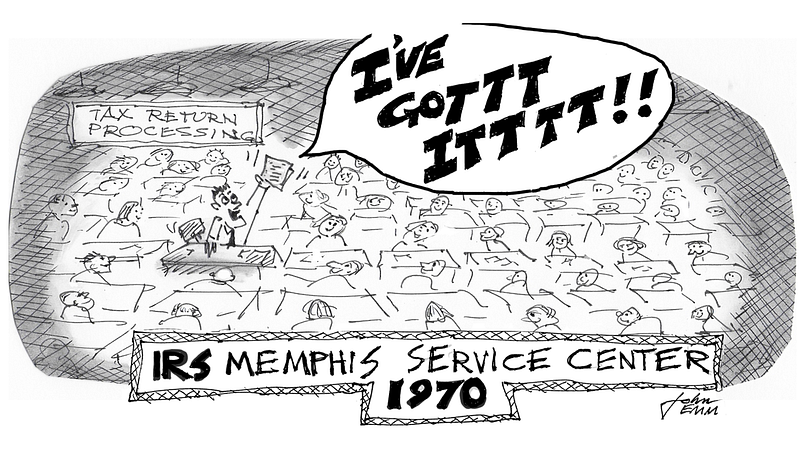
I love the IRS — yup, you read that right — I really love those folks. In truth, my long history of encounters with the fine men and women of our Internal Revenue Service has been businesslike and almost pleasant. While I’ve been hit with four tax audits over the years they all worked out fine. Minor errors were corrected. I wrote some small checks. No hard feelings on either side of the fence.
But my main dealings with the IRS were a bit more unusual. In 1996 the New York City ad agency I had founded twenty years earlier was doing pretty well. We had accounts in a bunch of industries, including financial services, magazine publishing, insurance, business aviation, skiing, fashion, fragrance, food, and alcoholic beverages. We also served one government account — a five-year contract to promote recruiting for the U.S. Coast Guard. The guy who supervised our Coast Guard business was Fred Morris, a savvy ad exec with years of experience handling government accounts. Fred frequently made trips to Washington, D.C. — and he kept his ear to the ground.
One day he walked into my office.
“I just heard there’ll be an RFP coming out for the IRS account.”
“Can we pitch it,” I asked. “Do we have the horsepower?”
“If you’ll clear the decks for me,” he said. “I’ll need an assistant — and we’ll have to work full blast for six weeks.”
“Let’s go for it,” I said.
Preparing an RFP (request for proposal) for any government contract is a grueling process. This one was officially announced a few days later; there would be a public competition for the five-year contract to handle all advertising and external communications for the IRS. (And, yes, the IRS does advertise.) We pulled together agency credentials and qualifications, outlined a staffing proposal, detailed our approaches to marketing strategy and media planning, and showcased some of our award-winning TV and print campaigns. Our competition included a flock of other agencies; apparently no one was spooked by the idea of working for the IRS.
Anyway — long story short — we won.
One of our primary tasks would be creating and producing PSAs (public service announcements) for TV and radio stations, videos for IRS offices, print ads, website design, online messaging, posters, billboards, mailers, and anything else we could use to spread the word about the broad range of IRS services.
After the win our team flew to Washington, D.C., for the initial briefing meeting at IRS headquarters. We met in a spacious office occupied by the IRS director of communications. For an entire morning, he and his key staff members gave us a soup-to-nuts review of IRS services. Toward the end of the meeting, the director emphasized how the new IRS computer security system meant that every taxpayer’s financial information remained strictly confidential. He explained that passwords were required, special secret codes had to be entered, that sort of thing. He said only the specific IRS employees who were officially authorized to process an individual or business tax return could actually access that return. Employees were forbidden to look at any return on the computer screen of the worker who sat next to them, and when someone left for a coffee break the system forced them to log off.
“So you might be wondering if your own tax return is being protected?” the director said. “Well, for example, let’s say I wanted to know how much John earned last year?”
(HE WAS LOOKING AT ME)
“See that computer on my desk,” he continued. “It’s got the ability to access hundreds of millions of tax returns. And John’s 1995 tax return is definitely in there. But can I walk over there and pull it up? Nope. Not possible.”
That was probably reassuring to my team, although I did find it a bit unsettling. Hmmm. Was last year’s return fudge-free? Better call my accountant tomorrow.
He talked for another five minutes about their new ironclad security precautions. Yes. Total privacy was assured for the taxpayer.
About that time a senior IRS executive who had been sitting in as an observer, spoke up.
“Didn’t used to be that way,” he said.
This gent leaned back in his chair and started to reminisce about the old days. Smiling, he told us that in the early 1970s he had been running the IRS Service Center in Memphis — one of ten gigantic IRS Service Centers that processed tax returns for the entire nation. His words painted a picture of an arena-sized processing room where tens of millions of paper tax forms were received and processed. It was a sea of people — hundreds of IRS employees — hunched over hundreds of desks, each piled high with towering stacks of sealed envelopes.
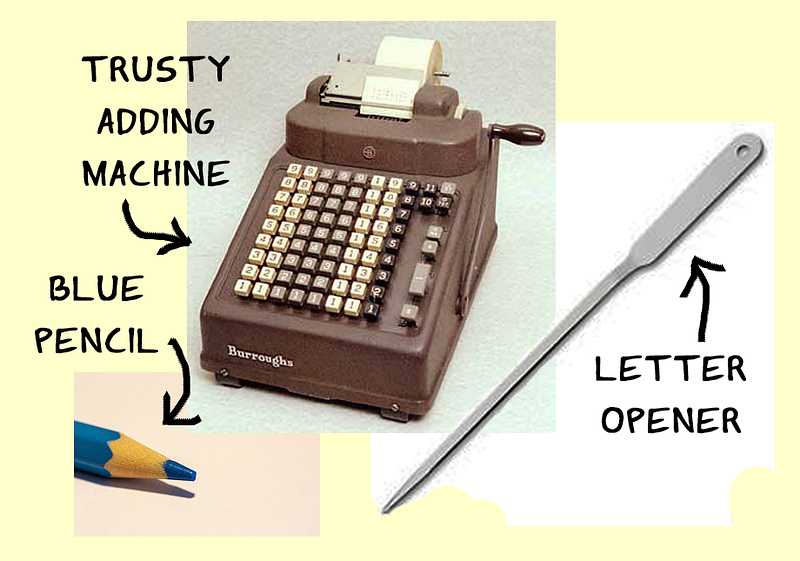
These jobs were repetitive and boring. Workers would first slit open each envelope (using a metal letter opener) and take out the return. Next, they’d check some of the math (using a mechanical calculator) and circle any questionable numbers (using a blue pencil.) Finally, they’d pass the return along for further processing. It was a numbing procedure that went on for hour after hour — a blurred parade of paper passing before glazed eyes.
This former Memphis center manager told us things got really crazy right after the April 15th tax deadline. Every morning big 18-wheeler trucks operated by the post office would roll up to the loading dock and belch out tons of tax returns from all over Tennessee and the surrounding southern states.
“But, here’s something odd,” he said, “in spite of all that incoming activity, the processing room itself would be fairly quiet — no loud babble of conversation, no idle chit chat, just the muffled sound of calculators clacking and papers being shuffled.”
The guy was a great storyteller — we were hooked — hanging on his every word.
“I can remember back in the early ’70s,” he said, “after tax day there was always tension in the air. Everybody in that huge room knew something special was about to happen. It was only a matter of time. Finally, the moment would arrive. Someone — often a temp worker sitting off in a far corner — would jump up and wave a tax return overhead. A victorious shout would electrify the room:
‘I’VE . . . GOTTT . . . ITTTT!!!’
“Y’know how when a NASCAR stock car race ends,” he said, “and the winning driver hoists up his huge silver victory cup? Well, the lucky IRS worker would look just like that driver — a champion waving a prized trophy overhead. And, of course, we all knew exactly whose tax return was being waved.”
(Note: keep in mind this was Memphis.)
He told us hundreds of workers would rush over and crowd around the grinning employee. They all wanted the answer to a burning question:
How much did he make?
The exec explained that if you knew The Number — if you could actually hold the return in your hands for a moment — you automatically got a year’s worth of bragging rights. You’d be sought out at church socials, PTA meetings, down at the Elks Lodge, and at all family barbecues.
Did you really see the number? people would ask.
Yep, you’d say. Saw it myself — saw his signature, too.
He assured us that even if some poor soul couldn’t break through the mob and actually touch the return, just being able to say, “I was there — I heard ’em shout out that bigass number,” conferred a sort of mini-celebrity status.
“And whose whose name was on that return?” he teased.
(HE PAUSED FOR DRAMATIC EFFECT)
“Elvis.”
I’ve always loved that story — particularly in light of the exasperating roadblocks that congressional committees have run into as they pursue constitutionally authorized, empowered-by-subpoena attempts to get a peek at Trump’s tax returns.
Bring back the old days.
Let’s have a look at those returns, Donald.