
Tonga and Toba eruption
Two eruptions in different times
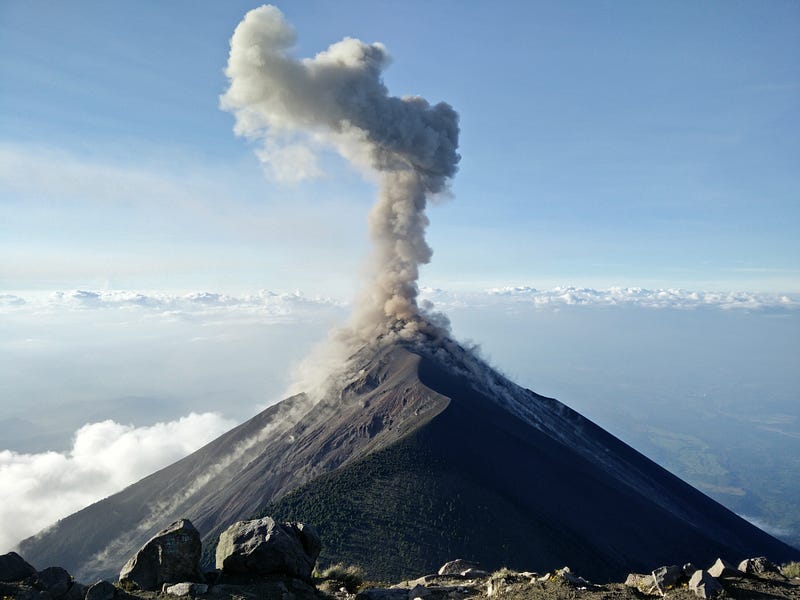
A volcano erupted on Toga Island on 15th January after being active — minor explosions — in the days before the January 15th explosion. The explosion was heard as far as Fiji (400 miles away). The earth rumbled as magma, smoke, ash came out of the volcano, and the explosion thrust plumes of smoke and ash into the atmosphere.
Early images of the eruption showed clouds of smoke rising from the volcano. The whole world gawked at the eruption before the lone cable connecting Tonga to the world snapped. It only left people to speculate the fate of the islands circling the volcano.
Early reports showed rocks showering on the island; what goes up will come down, says the gravity. Rocks would have been hurled up into the atmosphere: thanks to the force of the eruption, but then at some point, gravity overcame the eruption force and hence, the shower.
Toba eruption
Around 74,000 years ago, another volcano erupted: the Toba eruption. A volcano erupted on the island of what we now call Sumatra (Indonesia). The Toba eruption was the biggest in 28 million years.
The eruption covered parts of Indonesia, India and the Indian Ocean with 15 centimetres (6 inches) of volcanic debris. Researchers opine that 1,700 cubic miles of rocks equal to 3 million Empire State buildings were emitted from the volcano.
The ash and volcanic gases released by the eruption led to a volcanic winter: it partially blocked sunlight. Temperatures globally dopped by 3 to 5 degrees.
Research through climate simulation has assessed how the Toba explosion affected the climate globally. Researchers came out with 42 climate model simulations, varying parameters in each simulation: magnitude of volcanic emissions, time of year of explosion.
Stanley Ambrose theory
And these simulations were important in the context of Stanley Ambrose theory. The theory links Toba explosion and low genetic variability.
Around 74,000 years ago human population declined. The theory states around 74,000 years ago humans, in Asia and Europe didn’t survive, but a few small groups of humanoids in Africa did survive. Therefore, humans have a common ancestor and have low genetic variability.
But the climate simulation estimated cooling in the northern hemisphere of at least 4 degrees, with a few places seeing 10 degrees fall in temperature.
In contrast, the Southern hemisphere was relatively less affected. Even considering the worst eruption scenario, cooling in the Southern hemisphere didn’t exceed 4 degrees. However, parts of Southern Africa and India would have received less rainfall.
Researchers have concluded that the Toba eruption didn’t have a significant impact on the development of hominid species in Africa.


