avatarStephenie Magister ✨

Free AI web copilot to create summaries, insights and extended knowledge, download it at here

3488

Abstract

on strict order but will be set free by jazz. His name is Max, played by Jamie Foxx ten years before he would play another Max in the infamously awful (and infamously redeemed) <i>Amazing Spiderman 2</i>.</p><p id="cfbe">From Wikipedia:</p><blockquote id="edb0"><p>[Michael] Mann’s reasons for casting Foxx, with whom he worked with on <a href="https://en.wikipedia.org/wiki/Ali_(film)"><i>Ali</i></a>, was that he held a similar quality in his performances to Cruise. “I saw that [quality of Tom’s] in Jamie on <a href="https://en.wikipedia.org/wiki/In_Living_Color"><i>In Living Color</i></a> — his characters were so vivid.”</p></blockquote><p id="1be4">If you squint even harder at <i>Collateral</i>, you’ll see the inverse of the hilarious <i>Nothing to Lose</i> with Tim Robbins and Martin Lawrence, wherein Robbins is the disgruntled driver telling the hijacker played by Lawrence, “Oh boy did you pick the wrong guy on the wrong day.”</p><p id="374b"><i>Note: If you haven’t seen you Nothing to Lose, <a href="https://www.youtube.com/watch?v=98qHITM4MXM">here’s the trailer</a>. You absolutely should see it if for no other reason than the other familiar faces: Giancarlo Esposito, John C. McGinley, Kelly Preston, Irma P. Hall, Patrick Cranshaw</i></p><h2 id="b5bf">Like Tim Robbins, Tom Cruise expresses himself through intensity</h2><figure id="53db"><img src="https://cdn-images-1.readmedium.com/v2/resize:fit:800/1*_ior0H_TkFLllUlwr3nxBg.png"><figcaption>Collateral (Dreamworks, Paramount), Nothing to Lose (Warner Bros)</figcaption></figure><p id="4232">Franich describes Cruise as “always on the move, staring out windows, checking his six. He looks like a man who’s ready to counterattack… Cruise’s gray hair glows neon-bright in the LA darkness. [His] gray stubble never looks real, but it looks better than real: It looks unearthly.”</p><p id="3137">I’m impressed by how far Tom went to prepare for the role. It’s become part of his prestige.</p><p id="cdc7">But while Tom running across the sides of buildings or strapping himself to the exterior of a plane during takeoff makes for cool scenes, <a href="https://www.cnn.com/2004/SHOWBIZ/Movies/12/27/mann.collateral/">his training for <i>Collateral</i></a> was probably the last time he was able to pose as a FedEx driver.</p><p id="16f9">It’s just the nature of celebrity. Like Mark Ruffalo’s superhero alter ego, Tom Cruise embracing the fullness of his powers meant eventually losing his secret identity.</p><p id="a082">So of course when he plays an unstoppable assassin in <i>Collateral</i>, the one man the audience believes might be able to stop him is a future Avenger.</p><h2 id="9c55">Mark Ruffalo, the Incredibly Mortal Hulk</h2><p id="30b5">“For some reason that you can’t really explain,” Franich describes, “Mann introduces Ruffalo in a shot that perfectly mirrors a previous shot of Cruise: The two men, walking, slightly out-of-focus, downtown Los Angeles behind them.”</p><p id="ec1b">The majority of the movie sets up Ruffalo as Detective Fanning, hot on the heels of Cruise’s gray-suited assassin. Despite orders from his superior, Fanning refuses to back down. It’s almost like he knows he can turn into the Hulk if things get too dangerous.</p><p id="8aa2">After several near confrontations, Fanning finally closes in.</p><h2 id="ee56">Unfortunately, this was 2004</h2><p id="77e1">It would be another eight years before Mark Ruffalo was injected with gamma radiation. To be fair, it would only b

Options

e another four before Ed Norton blew our one shot at keeping Liv Tyler in the MCU.</p><p id="c866">Without a Hulk form for protection, a bullet is a bullet.</p><p id="4a74">We never get the final confrontation between the cop and the criminal. There is, in fact, much more movie left to go when Tom Cruise unceremoniously shoots Fanning, because the story isn’t about the cop and the criminal. If you thought it was, that is its own kind of Rorschach test.</p><p id="e3de">It’s what makes the movie not just a meaningful inversion of <i>Nothing to Lose</i>, but an even more meaningful inversion of <i>No Country for Old Men</i>.</p><p id="b984">The connection isn’t just a metaphor. He’s only in a single scene, but the villain at the center of <i>Collateral </i>is played by Javier Bardem, who also played the iconic villain Chigurh.</p><h2 id="a223">No Country for Old Men</h2><figure id="f2ac"><img src="https://cdn-images-1.readmedium.com/v2/resize:fit:800/1*N7uNQYRt1VfeZOqQ8nvf2Q.png"><figcaption>Collateral (Dreamworks, Paramount), No Country for Old Men (Miramax, Paramount)</figcaption></figure><p id="a5f4">In <i>No Country for Old Men</i>, neither the hero nor the villain gets a chance to confront their enemies.</p><p id="4452">In the movie, Chigurh chases the presumed main character of the story, only for that character to get killed off-screen. His fate in the book isn’t much better.</p><p id="b838">Sheriff Bell similarly chases Chigurh to no avail. He quits his job rather than face what he can’t understand.</p><p id="5405">In <i>Collateral</i>, Mark Ruffalo, sometimes known as the Incredible Hulk, barely gets a shot at Tom Cruise. But where the dualism in <i>No Country for Old Men </i>leads to parallel disappointment, <i>Collateral </i>denies Mark Ruffalo as much as it gives its true star: Jamie Foxx.</p><p id="ad72">The final moments feel fulfilling, but because of our connection to Max. The very premise of the story has been shot to hell and back. The assassin killed all of his targets. The case against Javier Bardem is now a no go.</p><p id="af3f">But Max’s journey wasn’t to save the targets. It wasn’t even to stop the assassin.</p><p id="af1b">It was to stop hesitating when he knows the time is now.</p><p id="e60d">And what better time than now to take a shot at Top Gun himself?</p><div id="bd87" class="link-block"> <a href="https://readmedium.com/christopher-nolans-inception-wouldn-t-exist-without-these-three-movies-2528a74040c6"> <div> <div> <h2>Christopher Nolan’s INCEPTION Wouldn’t Exist Without These Three Movies</h2> <div><h3>A hacker, a programmer, and a potential murderer walk into a bar on the thirteenth floor</h3></div> <div><p>medium.com</p></div> </div> <div> <div style="background-image: url(https://miro.readmedium.com/v2/resize:fit:320/1*tEAqroy4zwOt3E4xN9wxRA.png)"></div> </div> </div> </a> </div><p id="0a25"><i>If you like my work and want to support it, <a href="https://ko-fi.com/stephenieedits">send me a tip</a> or become a subscriber for Queer History on <a href="https://www.patreon.com/translatingeverything">Patreon</a>, <a href="https://medium.com/@TransgenderSoapbox">Medium</a>, <a href="https://www.youtube.com/@translatingeverything101">YouTube</a>, or <a href="https://cooltransmom.substack.com/">Substack</a></i></p></article></body>

Tom Cruise Vs The Incredible Hulk

Tom’s journey from boy to Mann wasn’t without a little Collateral

Collateral (Dreamworks/Paramount)

A FedEx delivery driver brings your neighbor a package. The driver’s gray hair and weirdly merged upper middle teeth seem sort of familiar but…

A plane lands and a man in a gray suit, gray tie, gray stubble arrives in Los Angeles. It’s perhaps the last time these disguises will ever work for him.

A movie stars jumps on Oprah’s couch and declares his undying love for the former star of Dawson’s Creek.

And with that jump, Tom Cruise is no longer just a movie star. Despite his OT-8 status as a kind of deity for adherents to Scientology (The Daily Beast), he’ll never again have enough control over his image to be free from scandal.

You know what they say? The higher you climb, the faller you fall.

And it was in Michael Mann’s 2004 film Collateral that Tom Cruise nearly fell into the hands of the Incredible Hulk (or at least the actor who played him).

“The standard parts that are supposed to be in people aren’t in you.”
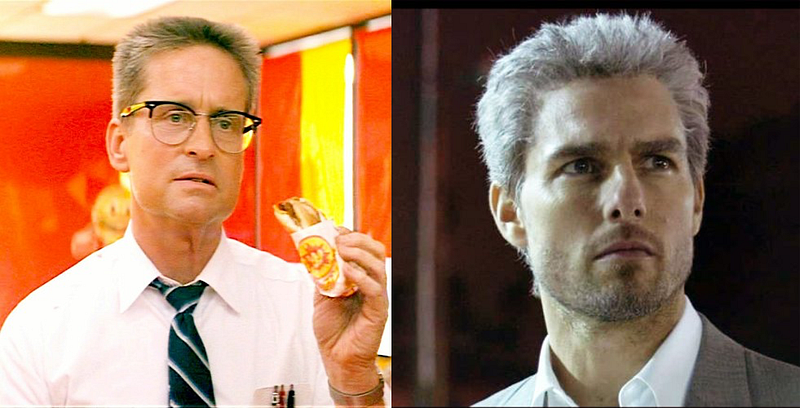
Falling Down (Warner Bros), Collateral (Dreamworks/Paramount)

Darren Franich, a critic for Entertainment Weekly, suggests the movie Collateral is “a bit like Falling Down, if you squint.” That movie, if you’ll recall, starred Michael Douglas as an aggrieved middle-aged man taking increasingly violent means to express increasingly racist resentments. Back when it came out in 1993, a critic for the NYT asserted that the movie “functions as something of a Rorschach test to expose the secrets of those who watch it.”

Is Douglas playing an empathetic hero? An unforgivable villain? The answer says something about the viewer.

The critic Franich describes Collateral, like Falling Down, as a “movie about a white dude rampaging across Los Angeles, fighting against the ‘other’ of Non-White/Non-Straight/Non-Dude Humanity. The difference is that, this time around, the ‘other’ is the white dude.”

That representation is in part why each scene with Tom Cruise in Collateral depicts the gray-suited assassin “as the intruder, the bringer of death and chaos.”

“How do you know my name?”

No matter their occupation, Michael Mann tends to make movies about men obsessed with work.

“Quiet men,” Franich says. “Tough men, troubled men, men who pour everything they have into their work, men who define themselves by their work, men who maybe don’t have much beyond their work.”

As Collateral opens, Cruise takes a few steps out of the airport and meets his inverse — a taxi cab driver whose past, present, and future rely on strict order but will be set free by jazz. His name is Max, played by Jamie Foxx ten years before he would play another Max in the infamously awful (and infamously redeemed) Amazing Spiderman 2.

From Wikipedia:

[Michael] Mann’s reasons for casting Foxx, with whom he worked with on Ali, was that he held a similar quality in his performances to Cruise. “I saw that [quality of Tom’s] in Jamie on In Living Color — his characters were so vivid.”

If you squint even harder at Collateral, you’ll see the inverse of the hilarious Nothing to Lose with Tim Robbins and Martin Lawrence, wherein Robbins is the disgruntled driver telling the hijacker played by Lawrence, “Oh boy did you pick the wrong guy on the wrong day.”

Note: If you haven’t seen you Nothing to Lose, here’s the trailer. You absolutely should see it if for no other reason than the other familiar faces: Giancarlo Esposito, John C. McGinley, Kelly Preston, Irma P. Hall, Patrick Cranshaw

Like Tim Robbins, Tom Cruise expresses himself through intensity
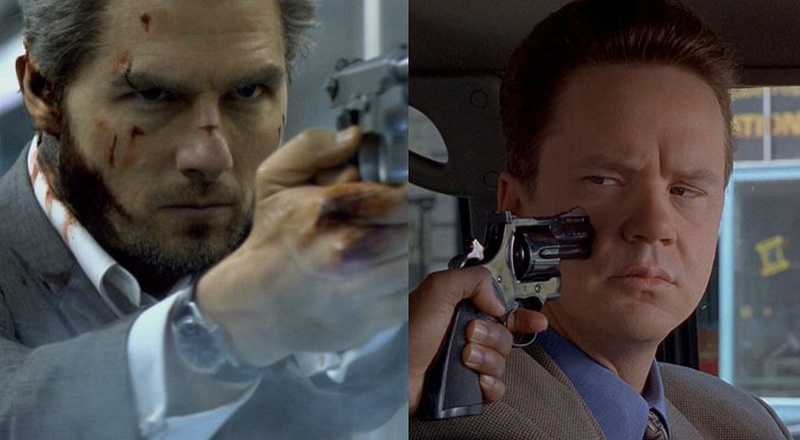
Collateral (Dreamworks, Paramount), Nothing to Lose (Warner Bros)

Franich describes Cruise as “always on the move, staring out windows, checking his six. He looks like a man who’s ready to counterattack… Cruise’s gray hair glows neon-bright in the LA darkness. [His] gray stubble never looks real, but it looks better than real: It looks unearthly.”

I’m impressed by how far Tom went to prepare for the role. It’s become part of his prestige.

But while Tom running across the sides of buildings or strapping himself to the exterior of a plane during takeoff makes for cool scenes, his training for Collateral was probably the last time he was able to pose as a FedEx driver.

It’s just the nature of celebrity. Like Mark Ruffalo’s superhero alter ego, Tom Cruise embracing the fullness of his powers meant eventually losing his secret identity.

So of course when he plays an unstoppable assassin in Collateral, the one man the audience believes might be able to stop him is a future Avenger.

Mark Ruffalo, the Incredibly Mortal Hulk

“For some reason that you can’t really explain,” Franich describes, “Mann introduces Ruffalo in a shot that perfectly mirrors a previous shot of Cruise: The two men, walking, slightly out-of-focus, downtown Los Angeles behind them.”

The majority of the movie sets up Ruffalo as Detective Fanning, hot on the heels of Cruise’s gray-suited assassin. Despite orders from his superior, Fanning refuses to back down. It’s almost like he knows he can turn into the Hulk if things get too dangerous.

After several near confrontations, Fanning finally closes in.

Unfortunately, this was 2004

It would be another eight years before Mark Ruffalo was injected with gamma radiation. To be fair, it would only be another four before Ed Norton blew our one shot at keeping Liv Tyler in the MCU.

Without a Hulk form for protection, a bullet is a bullet.

We never get the final confrontation between the cop and the criminal. There is, in fact, much more movie left to go when Tom Cruise unceremoniously shoots Fanning, because the story isn’t about the cop and the criminal. If you thought it was, that is its own kind of Rorschach test.

It’s what makes the movie not just a meaningful inversion of Nothing to Lose, but an even more meaningful inversion of No Country for Old Men.

The connection isn’t just a metaphor. He’s only in a single scene, but the villain at the center of Collateral is played by Javier Bardem, who also played the iconic villain Chigurh.

No Country for Old Men

Collateral (Dreamworks, Paramount), No Country for Old Men (Miramax, Paramount)

In No Country for Old Men, neither the hero nor the villain gets a chance to confront their enemies.

In the movie, Chigurh chases the presumed main character of the story, only for that character to get killed off-screen. His fate in the book isn’t much better.

Sheriff Bell similarly chases Chigurh to no avail. He quits his job rather than face what he can’t understand.

In Collateral, Mark Ruffalo, sometimes known as the Incredible Hulk, barely gets a shot at Tom Cruise. But where the dualism in No Country for Old Men leads to parallel disappointment, Collateral denies Mark Ruffalo as much as it gives its true star: Jamie Foxx.

The final moments feel fulfilling, but because of our connection to Max. The very premise of the story has been shot to hell and back. The assassin killed all of his targets. The case against Javier Bardem is now a no go.

But Max’s journey wasn’t to save the targets. It wasn’t even to stop the assassin.

It was to stop hesitating when he knows the time is now.

And what better time than now to take a shot at Top Gun himself?

If you like my work and want to support it, send me a tip or become a subscriber for Queer History on Patreon, Medium, YouTube, or Substack

Culture
Journalism
Movies
Marvel
Comics
Recommended from ReadMedium