
Tokyo or Cincinnati — (Pt. 2 • Hotels) Which City Is Less Expensive for a Vacation?
(Part 2 • Hotels) How much does it cost to go visit Tokyo for 10 days from the U.S.? How would that compare to a 10-day trip to Cincinnati?
Related articles:
• Tokyo or Cincinnati — Which City Is More Affordable for a Vacation? (Airfares • Hotels • Ground Transportation • Food) • How Did Japanese Society Improve in Recent Decades While the U.S. Declined? 1. Kaizen • 2. Shikata • 3. Peer Pressure • Ai Ninomiya’s 12 Best Japanese and English Cover Song Performances • Life Expectancy vs. Healthcare Costs in the U.S.
Recent articles:
• The 2 Reasons Populations Are Collapsing in Developed Countries • Fundamental Human Values Are Critically Important for Successful, Enduring Brands • Is It Up to Our Kids to Win the War Against Climate Change? • 3 Key Facts Everyone Is Missing About Biden’s Student Loan Debt Relief • The Terrible Damage We Do Voting Blue No Matter Who — (Part 1/9) Centrist Democrats Do Not Reflect the Will of their Voters
If you haven’t already read “Part 1 • Airfares” in this series, there is additional background info about the series — in addition to the discussion about airfares — that I have not included in today’s article about hotel options.
Here is the overall roadmap for this series as we look at general costs and expenses for a 10-day trip to Tokyo vs. a 10-day trip to Cincinnati, Ohio:
- Airfares to get there
- Hotels once you’ve arrived — this article
- Ground transportation and getting around locally
- Food and restaurants
- Things to do, cool places to visit
- “Insider tips” for each city
- “Creative” ways of saving money by getting airfares and/or hotels for a fraction of the regular cost
Someone recently mentioned that they hoped “to be able to save enough to someday visit Japan.” That surprised me, because in my experience, you can have an amazing visit to Japan while still spending less than it would cost for a vacation in many parts of the U.S.
So I wondered, category by category, how would the total cost of a trip to Tokyo compare to the total cost of a trip to, say, Cincinnati?
Today we’re focusing on hotel options after you’ve arrived in each of these two cities.
Up-front teasers: (1) I’m really excited about the hotel options I found for Tokyo. If I take a trip later this year — which I am hoping to do — the hotels I found will be at the top of my short list of places to stay in Tokyo! (2) You might be surprised at how the cost comparisons are looking between the two cities now that we have added in hotel expenses. (3) There’s a bonus section at the end in case you feel like splurging a bit in Tokyo.
First some Goals and Ground Rules for selecting hotels for Cincinnati and Tokyo
#1. Ground rules
- I am assuming that most of your time will be spent exploring and experiencing the cities.
- The hotel is primarily for sleeping, resting, and cleaning up.
- We are not looking for high-end, luxury “destination hotels” where you would spend most of your time just staying in the hotel and enjoying the services, shops, restaurants, etc. it has to offer. You are there to explore the city and have a good time!
- Mid-range hotels are the targets.
- Super low-end? No thanks. We’re not trying to minimize cost as close to zero as we can get it — this is a vacation. People on vacation want a reasonable amount of comfort, cleanliness, convenience, and amenities. You’re unlikely to get all of that at the least expensive hotel options in most cities, including Tokyo and Cincinnati.
- We’re also not looking at high-end, “destination hotel” options. These can be wildly expensive, and the goal for each city is to be a place for you to sleep, rest, and clean up before you head back out again for another day’s adventures.
- Hotels.com. I’m going to use Hotels.com for searches and for the prices I show. They are competitive on pricing with most other travel sites, and I think their rewards structure is generally better than the points reward structure with any of the individual hotel chains such as Marriott, Hilton, or IHG.
#2. Goals
- We are looking for comfortable, convenient, clean hotels with a good list of amenities, including self-serve laundry facilities and in-room safes (for easy storage of your laptops, tablets, and other valuables when you are out being a tourist.) Bonus points if the hotel has a fitness center, although this is not a requirement.
- A smartly and strategically chosen location is important. While we can’t know every place that you might want to visit during your stay, we can have a general sense of the areas you’re likely to want to be around, and this will inform our choices of hotels.
- Reservations. To the greatest extent possible, we want reservations that are fully cancellable up until a few days before arrival just in case your plans change. None of our selections will be for non-cancellable reservations. This is also useful because it allows you to check prices again as you get closer to the arrival date and see if the price of your room might have dropped. It is very possible that this hotel or other nearby alternatives will have substantially less expensive pricing at that point, and if that’s the case, you want the flexibility to change your reservation to potentially save a lot of money for very little effort.
- Hotel-specific features
- Dealbreakers / must-haves: (1) a Hotels.com rating of at least 7 or 8 out of 10 on Hotels.com; (2) an in-room safe; (3) on-premises laundry; and (4) reservation refundable up until a few days before arrival
- Almost-dealbreakers (but not quite): (1) Free wifi
- Nice-to-haves: (1) fitness center
Let’s start with Cincinnati!
Cincinnati Hotels — Info and Context
- A vacation to Cincinnati requires a car — it’s not optional. Things are spread out, and you are likely to want to go to a lot of places within a 50-mile to 100-mile radius of wherever you might be staying. This gives us geographical flexibilityin looking for hotels, and it also means we will not be locked into, say, a downtown hotel where daily parking might add $30 to each day’s hotel costs.
- We will select 1 hotel for the entire 10 nights in Cincinnati. There is no real reason to split this up into 2 (or more) stays at multiple hotels in different areas.
- Cincinnati locations. There’s no obvious single best location to stay since this is a general vacation visit to the area. Because of the amount of driving you’re likely to do, we want to find a hotel that is reasonably close to one of the main highways. We’d also like to be moderately centrally located, and this probably means that we are looking for a hotel somewhat north of downtown Cincinnati. There are a few general areas that meet these criteria, but the Kenwood and Blue Ash areas are probably slightly better than most other alternatives, so I’m going to home in on these areas.
- Hotel quality/ratings. I’d like to have the hotel be at least a 7 or 8 in terms of ratings on Hotels.com. I’ll also skim the reviews to minimize the chance of any big, unwelcome surprises.
- Good options for mid-range hotels are in the $100–175/night range. High-end hotels in Cincinnati are generally in the $250–350/night range.
- Dealbreaker on the room features. There are three must-have hotel features for this 10 day stay: (1) Ability to cancel and get a full refund as close to the arrival date as possible. (2) Self-serve laundry facilities. (3) An in-room safe to store valuables, laptops, etc.
- Nice-to-have’s. I’d love it if the hotels also have a fitness center and free wifi, but it’s not a dealbreaker if the hotel does not have one or both of these.
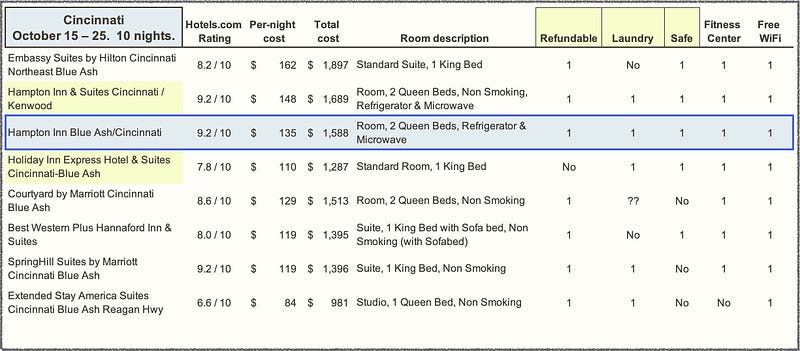
There are dozens of good/good enough mid-range hotel options in the Kenwood and Blue Ash areas 15–20 minutes north of downtown Cincinnati. Here are 8 hotels that seemed like decent potential candidates to me.
My 2nd and 3rd choices are highlighted in light yellow, and my top choice is circled and is highlighted in light blue: the Hampton Inn Blue Ash/Cincinnati. $1588 for the 10 nights, including tax.

Now for Tokyo hotel options!
Info and Context
You may be a bit shocked by how reasonable the pricing is for Tokyo hotels. As I mentioned in the first article in this series, some of the hype about super-high Tokyo prices back in the 80s and 90s was justified, but much of it was not.
It was somewhat true back in the 80s and 90s that hotels in Tokyo were more expensive than comparable hotels in America’s larger cities. However, today it is totally different.
Today you can easily find decent budget hotels pretty much anywhere in Tokyo for the equivalent of $30–$60 per night. Tokyo’s budget hotels will:
- be modern;
- have all of the amenities you would expect in a hotel room;
- be clean, comfortable, and generally quiet;
- be conveniently located and be near one or more subway and/or train lines;
- be totally fine as places to sleep, rest, clean up, and use as your “base of operations”; and
- usually range from 125 to 200 square feet. They won’t be huge rooms, but they generally won’t feel super-tiny, either.
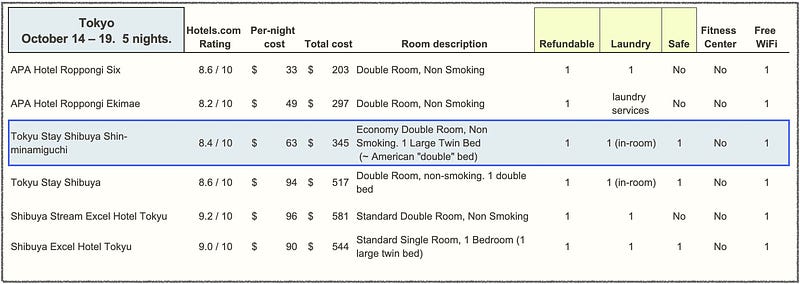
The APA Hotel chain is a good example of this BUDGET END of the hotel spectrum in Japan. You can find large numbers of APA Hotel locations around Tokyo where you can get a single room with a twin bed for $25–$40 per night; the APA Hotel Roppongi Six is a good example. Comparable budget hotel rooms in many parts of the U.S. — like Cincinnati, for example — would cost at least $75–$90 per night . . . and honestly, they’d would seem (and be) noticeably lower in quality than their Tokyo counterparts. To be clear, we are NOT looking for budget hotels for this trip — I’m just including this information for reference and to show you what the overall spectrum of hotels looks like.
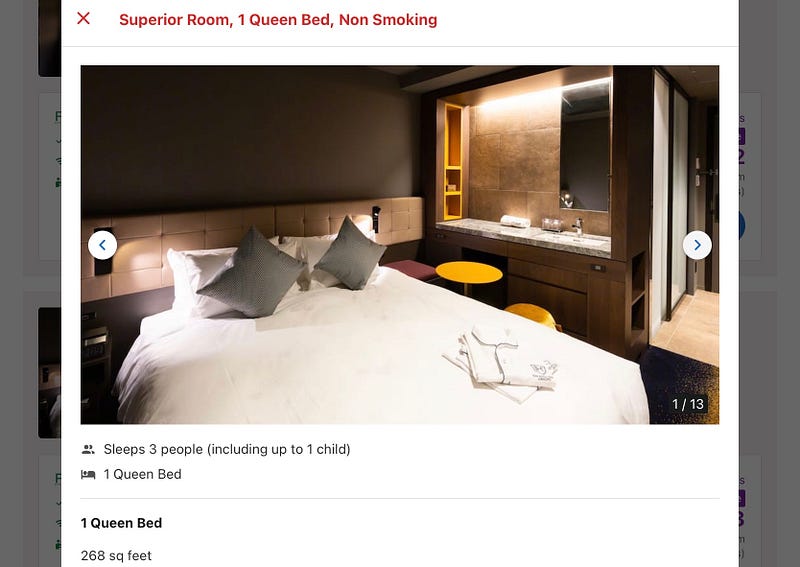
Tokyo’s MID-RANGE hotels tend to be in the $50–$125 range, depending on location and size of rooms. With mid-range hotels in Tokyo, you get a somewhat larger room, a few more amenities, more hotel services and/or facilities, often a higher-end location in the city, and often a bit “classier” or “classier-edgier” feel to the hotel. For instance, the “Royal Park Canvas — Ginza 8” hotel (see our choices below) falls into the high end of this mid-range — it definitely has that “classy-edgy” look to it, doesn’t it?
The lower range of Tokyo’s HIGH-END LUXURY hotels starts around $150–$250, while the top part of the high end starts around $350, continues on through $700–800, and generally hits its peak in the $1500–$2000 per night range.
Of course these prices can all move up or down depending on size of room, hotel occupancy, time of year, whether there is something big going on in Tokyo like the 2019 Rugby World Cup, etc.
Ok, a few details and Tokyo insider tips to set your expectations with:
- A vacation to Tokyo definitely does not require you to rent a car. The city’s public transportation infrastructure is probably the best in the world. There are incredibly extensive networks of subways, above-ground trains, and buses, in addition to a high density of taxis. You will probably end up taking subways and trains for most of your ground transportation. As a result, it’s going to be important to select your hotel so that you’re near at least one train or subway station.
- Because Tokyo is such a large city and because you are likely to want to explore a lot of different parts of it, I’m going to break up the 10-day stay into 2 separate hotel locations, with 5 days for each. Yes, it’s a little bit of extra hassle to pack up and move in the middle of your 10-day visit, but it’s good to have the opportunity to stay in two separate areas and get to know each area better.
- Fitness centers are not common in mid-range Japanese hotels. Even when they do have them, the fitness rooms tend to be extremely bare bones. They are common in higher-end hotels, though, and with highest-end hotels, the fitness centers can actually be excellent to work out in.
- Pay attention to how near you are to a subway station or train station AND what train line(s) the station is on. Are you looking at a hotel that is near a station on 2 or 3 subway lines that quickly gets you right into the heart of the subway system and makes it easy for you to go places? Or is the nearest station on a line that will require extra amounts of time and walking to get to other subway line(s) that will take you your ultimate destination?
- Don’t stay in Shinjuku. Just . . . don’t. Shinjuku is definitely worth visiting while you are in Tokyo, but that’s different from staying in a Shinjuku hotel and having Shinjuku be your base of operations for the time you’re in Tokyo. Shinjuku feels like its own megacity within the megacity of Tokyo. Unlike many other parts of Tokyo, it’s hard to say that Shinjuku has a lot of “classic Japanese charm” to it. And if you are new to Tokyo and Japan, Shinjuku Station is incredibly easy to get lost in. The station is massive, and it’s still the #1 train station in the world in terms of the number of riders passing through it each day. Unless you have a business or other reason to stay at a hotel in Shinjuku, there are dozens and dozens of better options than Shinjuku for areas that will be friendlier, easier, less expensive, and more interesting for you as a first-time visitor.
For the FIRST 5 NIGHTS you are in Tokyo . . .
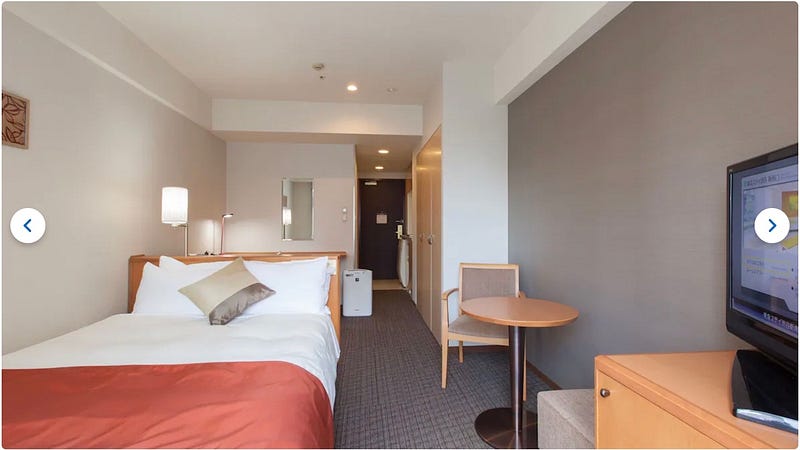
. . . I’ve chosen the Tokyu Stay Shibuya Shin-Minamiguchi Hotel, which is a 2-minute walk away from Shibuya Station,
Shibuya Station is one of the 4 largest train/subway hubs in Tokyo, with 2 Japan Rail (JR) train lines, 3 private railways, and 3 Tokyo Metro subway lines going through it. It’s hard to overstate what a major transportation hub Shibuya Station is for Tokyo.
It’s also a 12-minute walk to Daikanyama T-Site, far and away my favorite bookstore in the world. From Shibuya Station, you are no more than a 5–15 minute subway or train ride to a dozen or more neighborhoods in Tokyo that are all well worth your time and attention to visit. And that’s before we’ve even talked about what a cool, interesting area Shibuya itself is. In case you can’t tell, I think Shibuya is an excellent location to stay in.
A hotel this close to Shibuya Station is a wonderful springboard from which to start exploring Tokyo. I also like that it actually has a clothes washer and drier in the room. Finally, the price is not only hard to beat, it’s a little bit hard to believe if you’re coming from the U.S. — only $345 for 5 nights, and that includes tax.
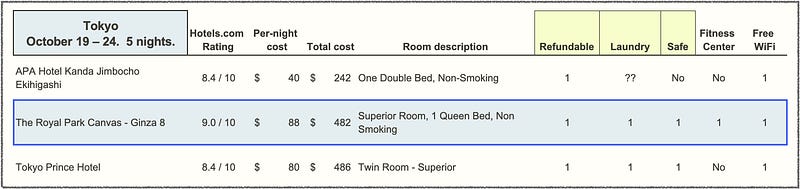
For your SECOND 5 NIGHTS, October 19–24, I have selected the “Royal Park Canvas — Ginza 8” hotel in Ginza.
It’s centrally located and only:
- a 15-minute walk to Tokyo Station;
- a 7-minute walk to Shiodome Station;
- a 4-minute walk to Ginza Station;
- a 5-minute walk to Shimbashi Station;
- a 10-minute walk to Hibiya Park or Hamarikyu Garden.
Really, you’re either a walk or a short train/subway ride away from pretty much everything in downtown Tokyo. This hotel is in an excellent location, and this is a reasonable price for this quality of a hotel in such a central location. The room is a “Superior Room, 1 Queen Bed, Non-Smoking,” and it is $482 for the 5 nights.
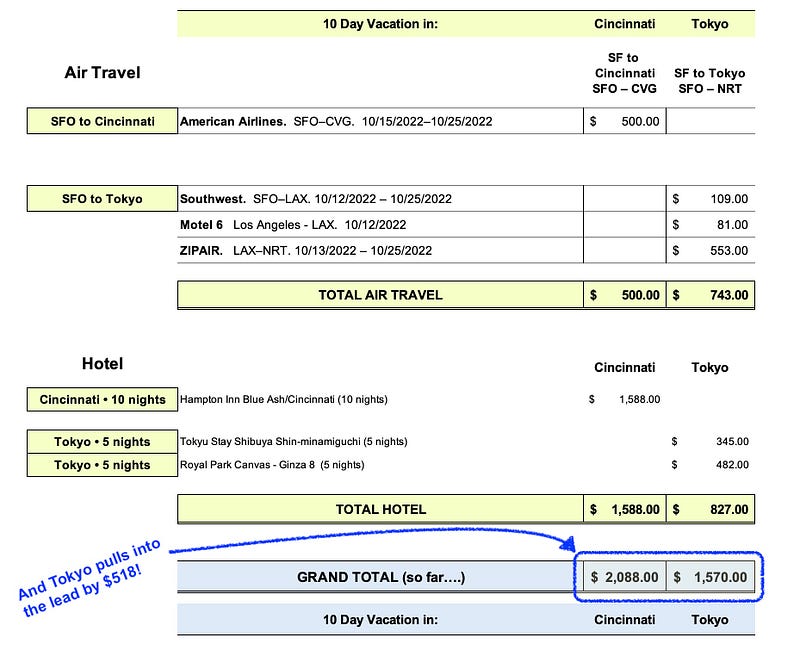
Ok, so how does the cost comparison look between Tokyo and Cincinnati now that we have added hotels to the airfares?
It turns out that these 10 hotel nights in Cincinnati cost about $750 more than 10 hotel nights in Tokyo.
I’d like to be clear about a few things here:
- I could have found hotel options in Cincinnati that would have dropped the price by a couple hundred dollars without giving up too much in the way of hotel quality or amenities. However, if I chose a hotel that was $750 less than the Hampton Inn location we’re going with — in order to match the Tokyo hotel costs — it would have been a big drop in quality. In that case, I would definitely feel as though we had shifted from (1) getting good quality at a reasonable price to (2) staying at a hotel I’d really rather not spend 10 days at just to get the much cheaper price.
- By comparison in Tokyo, I could have actually saved more money than I did with the 2 hotels I selected by either (1) going with another location that might not be as awesome as Shibuya or Ginza or (2) going slightly further downscale on hotel quality or room size.
- I’ve really done my best as much as possible here to make this an apples-and-apples comparison, but given all the differences between the two cities and the two countries, it is a challenge.
If you have any thoughts one way or the other about the hotels selected or your own experiences staying in Tokyo or Cincinnati, I would welcome your feedback — please share below.
Finally, one bonus section below.
Recommendation for a one-night Tokyo luxury hotel experience
In case you are interested in splurging for a night or two at a more high-end luxury hotel in Tokyo, I have a recommendation to make. (…although we will not factor this into the overall comparison.)
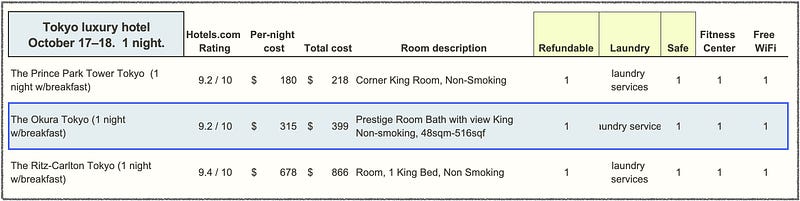
For the 3 high-end hotel options listed below — and there are at least a dozen other hotels in Tokyo in the same high-end luxury range — I have a clear favorite that I would recommend. That is The Okura Tokyo.
The Okura Tokyo just re-opened in 2019 after a multi-year $1 billion (that’s “billion” with a “b”) renovation, reconstruction, and re-imagining.
The original Okura Hotel was a “storied” and beloved hotel in Japan. It originally opened in 1962, and I can tell when I talk with Japanese friends the high regard and emotion they feel toward it.
I was fortunate to get to stay in the original Okura Hotel about 5 years ago, but I had first visited it many years before then and walked through it many times over the years.
More recently, I had the opportunity to walk through the new Okura Tokyo in late 2019. This “reimagining” of the original Okura Tokyo is stunning in every way. Modern, classical, classy, Japanese culture interwoven throughout the hotel.
If you want to have a memorable one-night stay that you can tell you Japanese friends about, go stay one night at the Okura Tokyo. Before the pandemic, the least expensive rooms there were priced around $500 (before tax), so the price below — $399 after tax and including breakfast — is reasonable.
The Ritz-Carlton Tokyo — also listed below as a potential option — is an amazing hotel too. I’ve stayed there before, and everything during that 3-night stay — literally everything about the hotel and every staff member I interacted with — was perfect for the time I was there.
But if someone were offering me a free night’s stay in either the Ritz Tokyo or the Okura Tokyo, I would choose the Okura Tokyo, regardless of the fact that a room at the Ritz-Carlton Tokyo costs twice as much as a room at the Okura Tokyo. No disrespect to the Ritz-Carlton Tokyo, it’s just that I feel the Okura Tokyo is more of a unique, perhaps once-in-a-lifetime experience.
Staying at the Okura would be the capstone on a visit to Japan that you just wouldn’t get by staying at any other luxury hotel in Tokyo.
And by the way, The Okura Tokyo is the definition of a “destination hotel.”
If you do stay here, plan to spend several hours exploring every bit of the hotel that you can get to. Walk through the grounds outside and the art museum, visit the shops and everything else that is in the hotel. For this one hotel, it’s ok if you spend the entire day there.
Questions or comments? Please leave them in the Replies section below!
Coming up in the next article — GROUND TRANSPORTATION in each city
Related articles:
• Tokyo or Cincinnati — Which City Is More Affordable for a Vacation? (Airfares • Hotels • Ground Transportation • Food) • How Did Japanese Society Improve in Recent Decades While the U.S. Declined? 1. Kaizen • 2. Shikata • 3. Peer Pressure • Ai Ninomiya’s 12 Best Japanese and English Cover Song Performances • Life Expectancy vs. Healthcare Costs in the U.S.
Recent articles:
• The 2 Reasons Populations Are Collapsing in Developed Countries • Fundamental Human Values Are Critically Important for Successful, Enduring Brands • Is It Up to Our Kids to Win the War Against Climate Change? • 3 Key Facts Everyone Is Missing About Biden’s Student Loan Debt Relief • The Terrible Damage We Do Voting Blue No Matter Who — (Part 1/9) Centrist Democrats Do Not Reflect the Will of their Voters
Want me to cover a topic? Please post suggestions in the comments, and I’ll use your input to help prioritize my writing and research.
If you appreciate my writing, please share it on social media.
Want unlimited access to all Medium articles? Become a member!
As always, thank you for reading, subscribing, clapping, and sharing — I appreciate you sharing your time and attention!