
Todays Immigration Issues Didn’t Start With Trump
We would be having an intellectually dishonest conversation about immigration if we didn’t acknowledge that the current problems in the United States are a culmination of decades of policies by previous administrations that grew harsher as time went on; thus laying the groundwork for what the Trump administration is doing today to migrants of color.
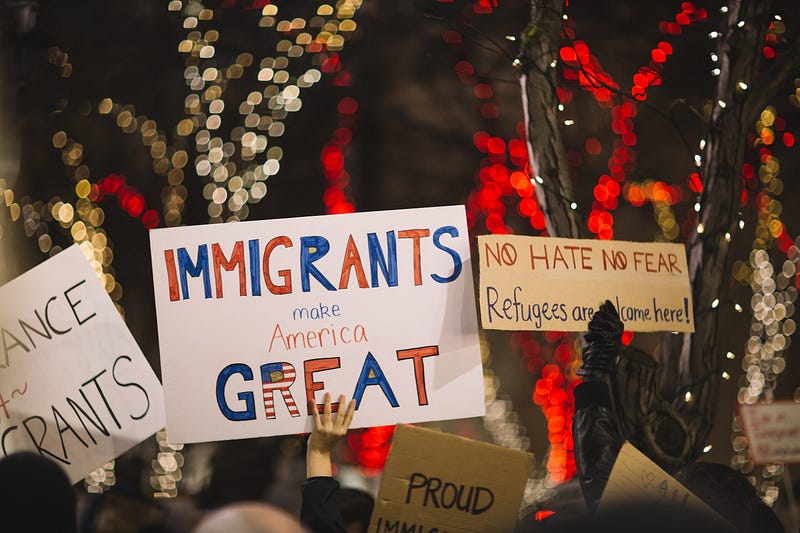
The legacies of past Presidents with regards to immigration will forever be remembered as contradictory by the Latin American communities. Obama was no different. On one hand, he had policies that were meant to bring immigrants “out of the shadows” while on the other hand, he seemed hell-bent on removing them from the United States.
Obama did protect 730,000 DREAMers who were brought to the United States as children. But as a leader who defended the importance of immigrants in American life, his missed opportunity at immigration reform, along with his own policies, paved the way for what the Trump Administration is doing today. It was his administration that enforced current immigration laws with a heavy hand leading to the deportation of more than 2.4 million people — nearly as many as his two predecessors combined.
“Immigration is not something to fear. We don’t have to wall ourselves off from those who may not look like us right now or pray like we do, or have a different last name.” — Barack Obama (June 2016)
Obama’s executive action attempting to expand protections for Dreamers — while temporarily protecting some parents of people with legal immigration status — was blocked by the Supreme Court in a 4–4 tie in 2016. While many will remember his legacy and define his good faith based on the last two years of his Presidency, had he acted sooner and with intent, we could be looking at much different immigration policy today. The harsh resistance he faced in Congress towards the end of his time as President was a successful attempt at stalling any progress until a new President was to be elected.
By failing to act sooner, it seems as though he weakened his position to negotiate, thus leaving millions of migrants already in the country — as well as those seeking asylum — vulnerable to the policies of a dehumanizing and immoral successor who would pick up the broken pieces of the U.S. immigration system and form his own much more oppressive agenda.
As the arrival of thousands of Central Americans fleeing violence in their home countries arrived in the United States, previous administrations over the last two decades did not treat the influx of Central Americans as a humanitarian issue, but rather as an enforcement issue. Instead of ensuring a fair process for refugees and asylees to present their claims, many were being placed in rushed deportation actions without access to legal counsel or support to help navigate the complicated legal process.
Mothers, families, and unaccompanied minors arrived along the southern border who turned themselves into Border Patrol asking for protection — were instead deported back to their home countries — some of the most violent countries in the world. After 9/11, reports began to emerge of Border Patrol agents denying asylees entrance at the U.S.-Mexico border. A practice that continues today and goes against U.S. obligations and international law.
Previous administrations began to respond to Central American arrivals at the Southern border by launching aggressive expansions to immigration policy that would be used to deter additional refugees from coming to the United States. These were policies that were, by design, oppressive and would inevitably result in the abhorrent policies of today. There were many documented conditions in family detention facilities that were notably poor and consistent complaints were filed by many immigrant rights groups against the government challenging those conditions in just the last decade.
Bill Clinton’s 1996 campaign invoked similar rhetoric to that of Donald Trump saying, “criminal immigrants deported after committing crimes in America, returned the very next day to commit crimes again,” a statement not based in fact, but one that would be used to justify what some would argue was the beginning of the immigration policy we see today.
In the same year, the United States saw the passage of the Anti-terrorism and Effective Death Penalty Act and the Illegal Immigration Reform and Immigrant Responsibility Act, when combined, would dramatically increase the number of immigrants in detention creating the horrific conditions immigrants are faced with in detention facilities today.
The 9/11 attacks also helped the U.S. government’s case of conflating national security and counterterrorism with immigration. It was then that we would witness a major shift in how the United States would handle immigration issues. With the creation of the Department of Homeland Security (DHS) by then-President George W. Bush — and with the help of Congress — moved management of immigration from the Justice Department to DHS thus framing it as a national security issue. It was then that ICE was created and would set out on a new opportunistic and ambitious agenda, titled “Endgame,” that had a goal of removing 100 percent of “removable aliens” making families, students, business owners, and many others targets of ICE’s deportation efforts.
The new federal immigration enforcement agency would set out on an agenda of “enhanced homeland security” without ever defining what that meant or how it would definitively enhance national security. Instead, it would embark on a campaign of stoking fear followed by aggressive tactics, thus creating a vicious cycle that continues to this day. Immigration enforcement would operate on a budget of $4.9 billion under Bush and would later balloon 300 percent under Obama to $18 billion annually (more than all other federal law-enforcement agencies combined) to help support the enforcement-first approach to immigration.
“He was facing an unprecedented, highly personalized opposition from Congress. We fault him, I believe correctly, for failing to recognize soon enough this intransigence by Congress and failing to use his authority sooner.” — Janet Murguia, president of the National Council of La Raza told PBS
By the end of Obama’s first term in office, the administration would take the small “Secure Communities” program developed by George W. Bush — that used local police as “force multipliers” — and expand it by 3600 percent. Under Bush, the program existed in just 14 counties. By the end of 2009, it spread to 88 counties and by the end of 2013, the program was active in all 3,181 U.S. jurisdictions. The program would eventually be scrapped in 2014 — at least on the surface — and be rebranded as the Priority Enforcement Program.
Then came Donald Trump.
There’s no question that Trump’s presidential campaign was fueled by anti-immigrant rhetoric — characterizing immigrants as threats to the sanctity and security of the United States with dehumanizing language. Upon taking office he immediately signed an executive order that more than doubled the number of ICE officers, deputized more local police departments to track down immigrants, broadened ICE’s priorities, and restricted due process as well as discretion.
ICE saw an immediate morale boost from the signing of sweeping new guidelines by former Homeland Security Secretary John Kelly. Those guidelines empowered ICE to detain and deport illegal immigrants more aggressively inside the United States and at the border. At one point Trump had declared during his campaign that he would create a “deportation force” to expel as many of the estimated 11 million undocumented migrants as possible. Many immigrant rights advocates were outraged at John Kelly’s new guidelines due to concerns that the new policies would result in widespread abuse. It comes as no surprise that Trump’s policies have amounted to horrifying abuses creating the argument for the abolition of ICE altogether.
But make no mistake. Trump’s immigration policy greatly differs from previous administrations. While some would argue that the rhetoric of previous administrations is similar, Trump’s actions are far more hostile and cruel; born of dehumanizing rhetoric and hate-speech.
The Obama administration did not intentionally target longtime residents of the United States for deportation as Donald Trump has; it did not crack down on legal immigration to satisfy his base; it did not use the separation of parents from their children to try and secure concessions from the opposing party; it was not motivated by the racist nativism that is so prevalent in Trump’s White House.
Immigration detention was never intended to be used as punishment. Families and children now spend extended periods of time incarcerated, receive substandard medical care, and individuals have been found to suffer from psychological distress including depression, anxiety, and difficulty sleeping as a result of current policies.
One thing is certain, by forcing such cruel acts on innocent migrants who seek asylum from the terrible conditions in their homelands, Trump is forcing Democrats to confront their roles in how immigrants and refugees have been treated in the United States. As the Republican Party heads further to the right and continues to demonize migrants, Democrats seemingly find themselves seeking to atone for their past sins towards immigrants of color who only seek a safer and better life.