
Today I Picked up a Spider With my Bare Hand
How I accidentally flipped a phobia on its head
I’ve never been particularly skittish around animals. If anything, I’m hopelessly curious when it comes to nature’s creatures. I used to dig for earthworms and catch frogs as a kid, and I had a lizard when I was a teenager that I held routinely (and whose feeder crickets I sometimes had to retrieve just when they thought they’d escaped their doom).
I never understood people who jumped onto chairs when they saw a mouse, or who killed snakes with shovels. I was far more evolved than those people.
But you’d have done well not to remind me of that when I saw a spider in my house.
No matter if it was the teeniest, tiniest, most harmless creature on the planet; to me, it was a venomous killing machine which, if I averted my eyes for only a moment, would pounce (probably on my face), wrap me in a human-sized cocoon, and liquefy my insides.
When I was little (okay, until I grew up and moved out) I would shriek and whine until my dad smashed the spider into oblivion with whatever shoe or rolled-up newspaper he had at hand. I would demand to see the carcass as evidence. This was the 80s version of “Pics or it didn’t happen.”
If the spider happened to be on the ceiling, out of arm’s reach (the worst possible scenario), I would flee to another corner of the room, from which distance it was unlikely the spider would drop or otherwise launch itself at me. From there, I would watch its creepy progress until it found a right angle and began crawling down the wall. When it was low enough for my dad to reach, I would shriek and whine and the rest would follow according to script.
While spiders were my target of choice, a few other invertebrates endured my wrath over the years, most notably insects that could both sting and fly. I’d tolerate one or the other: ants didn’t bother me at all, even the huge ones, and I’d happily allow a dragonfly or butterfly to perch upon me all afternoon. But something about three-dimensional movement paired with a stinger makes wasps and bees even more terrifying to me than spiders.
One day, I came face to face with a killer.
In July of 2015, I was in my backyard pool with my husband and very small kids, when something very large and with a very pointy rear end dive-bombed into the water, inches from my two-year-old.
“Umm, what was that?” my husband asked.
“I don’t know, but it was big,” was my response. “And loud.”
I handed the toddler to him, moving as slowly as possible, before realizing my folly. My husband now had one kid on each hip; as such, it had become my responsibility to investigate.
Of course, I am a parent now, and the main job of a parent is to act like you’ve got things under control, even if your pulse is racing and you think you might pass out and drown. Or else be attacked by a swimming-flying-wasp-thing. Or both.
I dispatched of the creature after a proxy battle with the pool skimmer and a flip-flop, but that wasn’t the end of things. Once I was certain it was dead, I needed to know what this beast was and if there were likely to be more of them. I didn’t want my children being attacked by four-inch killer wasps in the back yard, after all.
I searched the internet, but I’m a terrible Googler and I came up with insects that only vaguely resembled the one I’d murdered in the pool. I needed a better tool.
Naturally, I turned to Facebook.
It turns out that there is a Facebook group dedicated entirely to the identification of insects and arachnids. I joined and immediately posted a photo of the wasp which would certainly have murdered my entire family had I not killed it first.
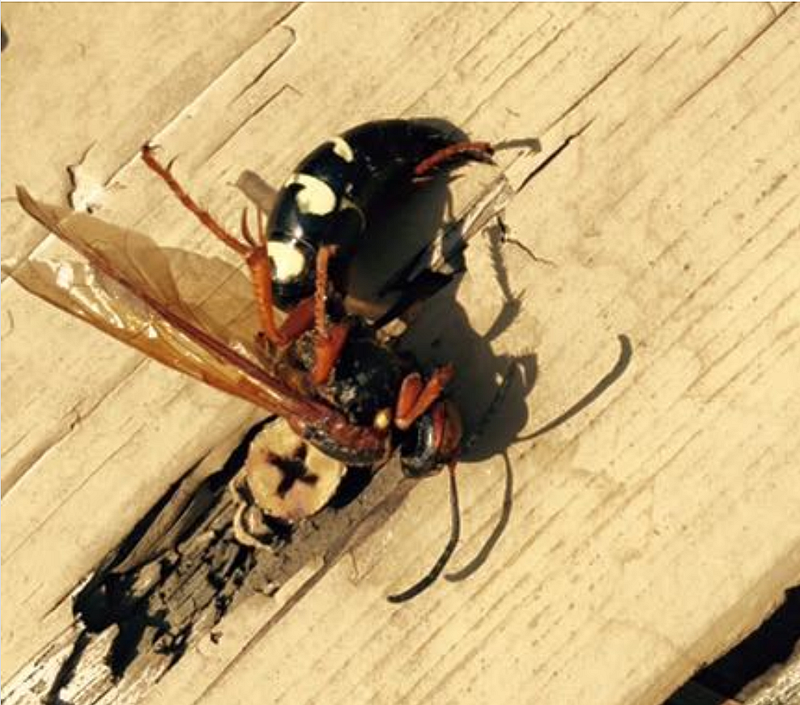
Within minutes, I learned the wasp I had assassinated in cold blood was called a cicada killer. These babies are big and nasty looking, and the females have a very painful sting. I was told, gently, though, that this species is about as likely to sting you as PCH is to show up at your door with a life-sized check. They actually protect your trees by killing cicadas (hence the name), and they also pollinate your flowers.
I had never felt guilty for killing a bug until that very moment.
The only conscious thought I gave to bugs at that time was to send up a silent apology for killing this beneficial creature and to remain a member of the Insect Identification group, which had thousands of members and a hundred or more daily posts. I’d probably have another bug-related question, I reasoned, and the group seemed a reliable place to find an answer.
Back in those days, I wasted a lot of time on Facebook, scrolling endlessly to see how many wedding and newborn photos I could passively consume at one time. Suddenly, though, I began seeing more bugs than babies and brides on my news feed. Some were grainy iPhone photos from a kitchen pantry, but many were true works of art. Gorgeous professional images from photographers who choose to shoot bugs of all sorts began downloading themselves into my brain, along with other art — hand blown glass and even crocheted caterpillars.
I slowly became obsessed with this group.
My photo library is now half-filled with bug photos, because each and every new bug I see, I feel the need to photograph from 24 different angles. A bug might be best identified by looking at its mouthparts, legs, or markings — or something else entirely. I just photograph all the parts I can, in the hopes that I can learn more about the bugs that surround me.
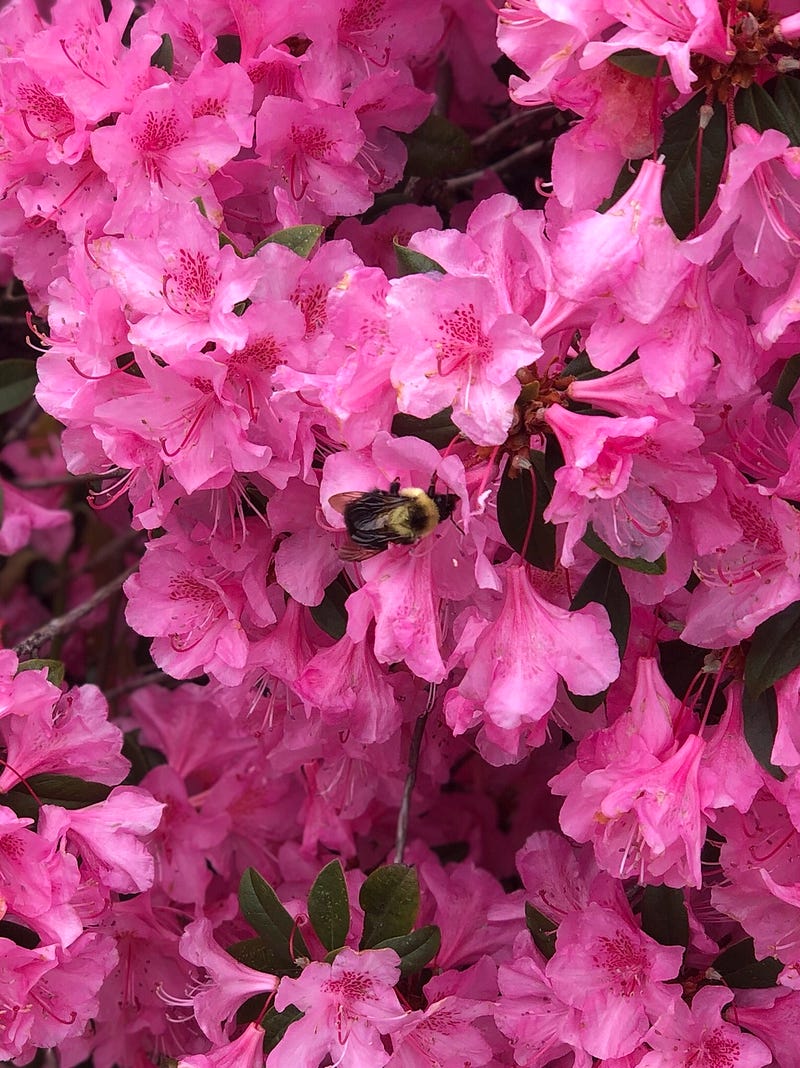
Wasps still make me nervous, especially in enclosed spaces. But I’ve made great strides in my relationship with bees. I get up close and personal with bumblebees each season, photographing them as they search for nectar in the rhododendron bush outside my house.
My kids call me when they see an interesting bug, and ask me to identify it. And, often, I can.
So, what about spiders?
I realize this will sound insane to some people, but I promise it’s true.
I now actually find some spiders to be *gulp* cute.
If you don’t believe that spiders can be cute, just watch this computer-animated spider named Lucas.
I’ve spent four years appreciating photos of all different kinds of spiders on my news feed. I’ve photographed dozens of spiders on my own from mere inches away. I even befriended a gorgeous mama spider who lived on my deck a couple summers ago. Each morning I would find her resting upside-down in the center of her orb web; I once got to watch her catch and wrap up a housefly.
I joined another Facebook group dedicated specifically to jumping spiders, because they are the cutest kind of spider, and I routinely see videos of members’ pet jumpers, who seem to be curious and strangely affectionate.
My family calls me when a spider that’s made its way into the house needs to be moved outside, and I dutifully grab a cup and a piece of card stock so I can move it without hurting it.
Before today, though, I had never touched a spider on purpose.
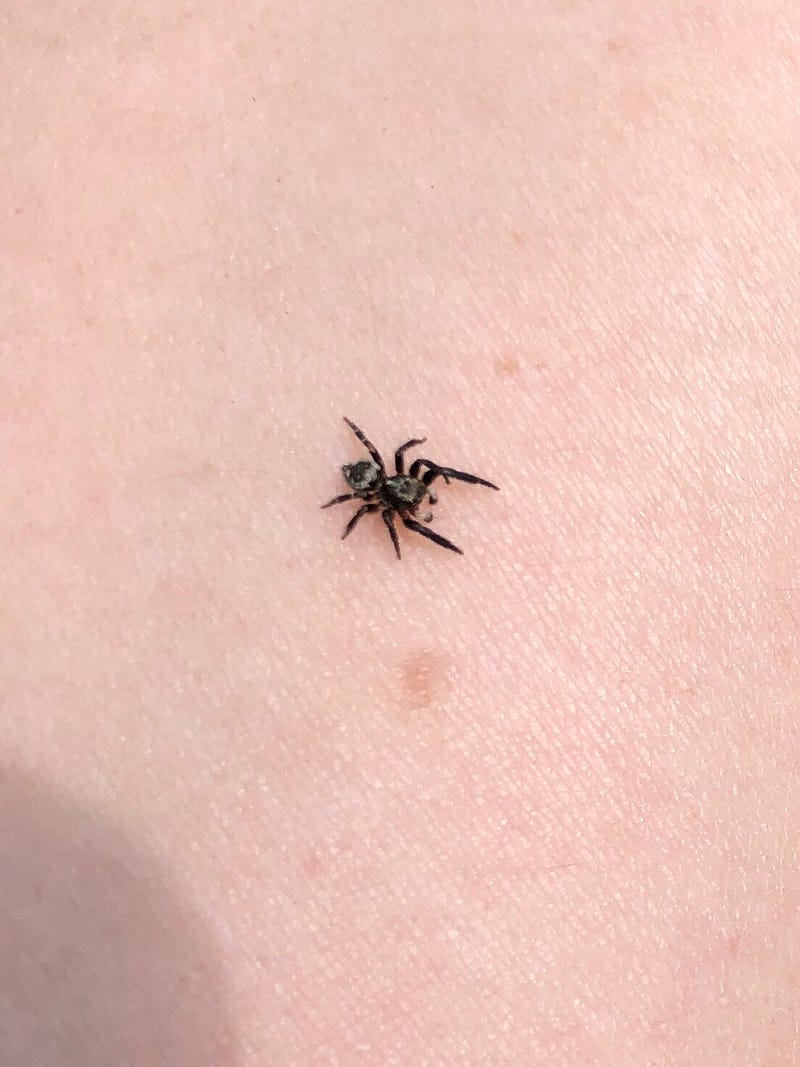
This afternoon, after doing some planting and weeding in the garden, I came inside to wash the dirt from under my fingernails. There was a cutting board in the sink, and after I’d turned on the water I noticed a little jumping spider on the board.
Aww, poor spidey, I thought. It must be scary to be so tiny and have that water rushing down and my big hands flailing around you. If I was that spider, I would have been bracing for that moment to be my last.
And, in someone else’s house — or even in my own house just a few short years ago — it might have been.
But I stand here a changed woman. I turned off the water and gently offered my hand to the cute little guy (or girl). The spider willingly crawled right onto my finger and I thought, Oh my God I’m holding a spider!
My heart didn’t pound, though, and I didn’t feel nervous. I brought the spidey outside, showed it to my five-year-old, and let it go.
But not before I got a photo.
Author’s note: I didn’t set out to do Systematic Desensitization on myself; it just kind of happened. However, I am aware of its applications for overcoming phobias. Apparently, I’m at 100 as of today. Read more here. And, if you’re the curious sort, join one of the bug groups linked above. I learned more there than I ever would have cared to on my own.
Here’s another story you might enjoy.
Subscribe to my newsletter to keep in touch. Tweet / Gram / Book