
Toccata and Fugue
Bach’s Northern Lights
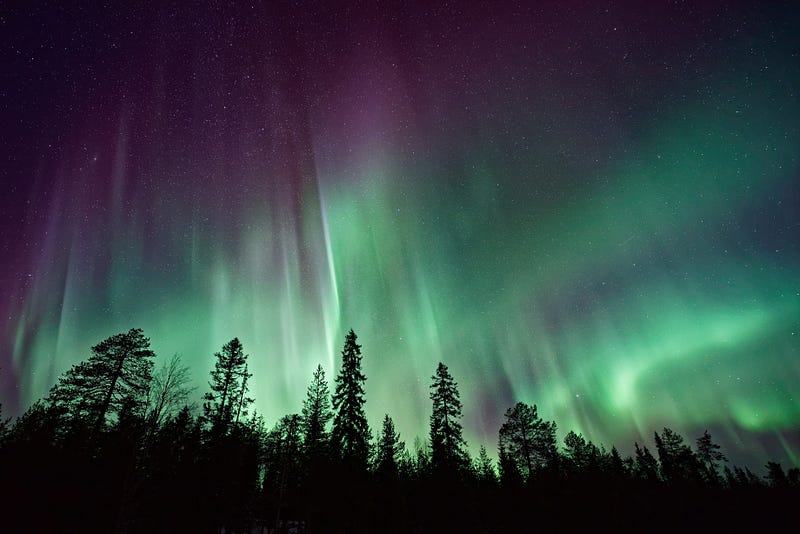
The Northern Lights of Bach’s Toccata and Fugue in D-Minor: My home
Did you know that the aurora borealis makes a sound? It emits a sort of electrical hiss, a subtle shifting of audible frequencies, as it both shapeshifts and colorshifts across the black, star-studded sky.
I count myself very fortunate to have been born and raised in northern Sweden where each winter we had vivid northern lights (norrsken — literally, northern shine) a dozen or so times a year.
These were gigantic, multi-colored church organ pipes covering half the northern sky, fluttering or shivering slowly in the sun-particle breeze while whispering its unoiled song to all little humans standing in the snow, head back in awe.
The first several times I saw the northern lights I had yet to hear of Bach or any of his music, but I was introduced to this god of music sooner than most in that we lived a five-minute walk from our local church which sported a very impressive (I’d go so far as to say magnificent) organ, and in that the church organist was also my music teacher and he had invited me to come hear him practice any time I wanted.
The keyboards to this organ were housed in the choir loft (some call it the church balcony) at the rear of the church which you reached by climbing a narrow and spiraling set of stone steps.
Sometimes of a quiet winter night I could actually hear him play even from our house (yes, I’d have to be outside, of course, and yes, it would have to be very quiet) and then I’d rush up to the church, climb the stairs and debouch into this wonderful space that housed not only the multiple-keyboard organ cockpit, but also the seats for the choir and (of course) the magnificent pipes.
And there he would sit (his name was Harald) both hands and both feet busy with their magic. He’d sense me arriving and turn and smile at me without stopping. Me, I’d sit down and just watch and listen.
Now, it was not that I knew that the music was written by Bach — yes, he may have mentioned it but that did not register at the time. What did register, however, was Bach’s Toccata and Fugue in D-Minor, which Harald played more than once (he obviously loved it, too). Those ten heavenly opening notes found two eager ears and a forever home in this young boy, listening in open-mouthed wonder to his music teacher’s conjurer’s trick.
The association between the northern lights and the grand pipes of the church organ is easily made — they do sport the same features — and it’s only a few short associative steps from there to seeing Bach up there in the winter sky (once I learned that he had written the Toccata and Fugue).
To be honest, perhaps it’s not so much that this stellar piece of music was my home (as I wrote in the Wolfku above); it’s more that I became a home for it, and from there on, looking up at the divine winter-night spectacle, there they were, both Harald and Johannes Sebastian, smiling down at me.
That said, let’s fast forward a few years, and I now live in Stockholm in a very cold little apartment with a very good stereo system. One night — and, yes, I must admit to being high on hashish this night — I put on Bach’s Toccata and Fugue in D-Minor, and as the heavens opened in those first ten notes, I saw the familiar northern lights right there in my room, real as anything, descending through the ceiling.
Fast forward a few more years, and I wrote a short story about just that night called “Bach Lights.” It tells of the wonder and why I still am a home for Bach, and he a home for me.
© Wolfstuff