
LOVE/FAMILY
Hibiscus — To the Woman Who Personified My Favorite Flower
To my Grandmother who wasn’t really my Grandmother
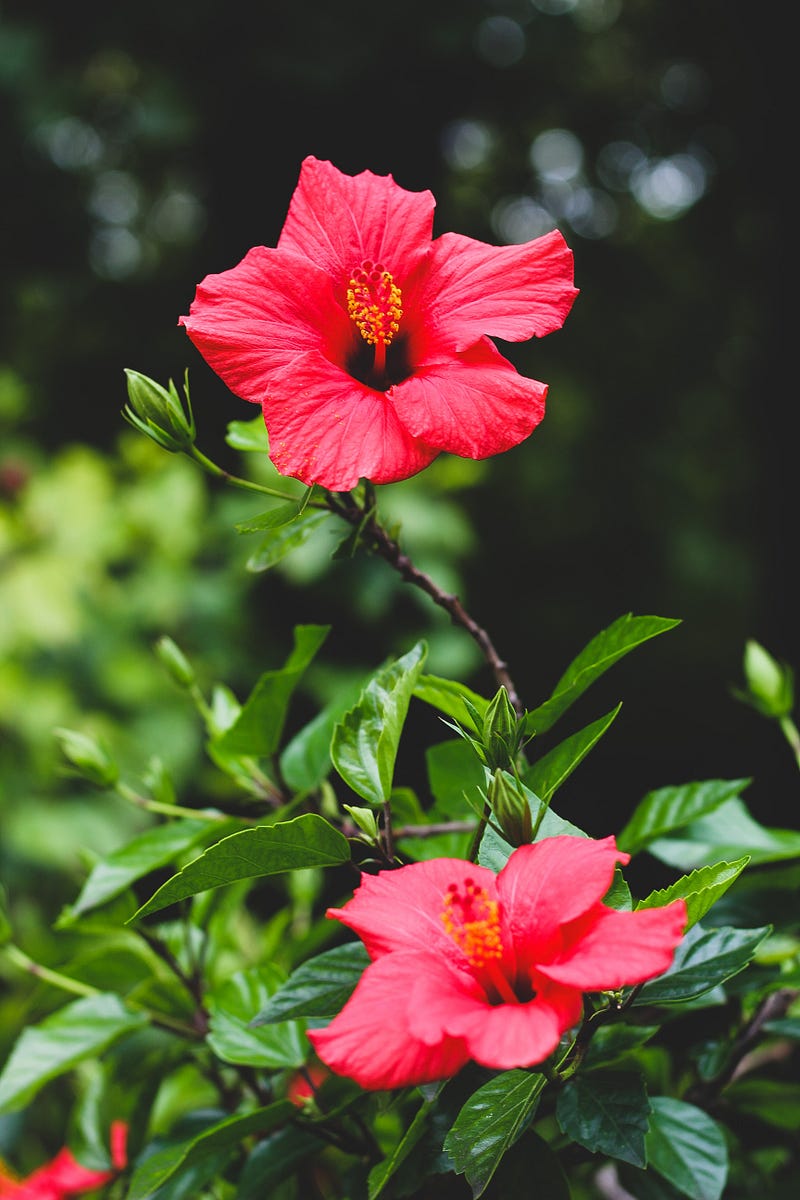
The sight of a ruby red hibiscus flower takes me back to my childhood. To a garden in Davur (a town in southern India), where this splendid flower grew in profusion. And to the house, which this garden adorned.
This grand ancestral home in Davur was my destination during the summer holidays when I was in school. The morning after exams ended, my mother, brother, and I would board the train. A fourteen-hour journey brought us to Davur station.
From there, we piled our luggage into a tonga (horse carriage). Fifteen minutes later, we found ourselves outside a small wooden gate set in the high brick wall that ran around my grandmother’s home.
At the horse’s clip-clop sounds and the jangling of its harness, my aunts and cousins spilled out through the always open front door, and onto the broad verandah that encircled the house. Some of my cousins ran down the steps to open the gate and help carry the luggage.
I was happy to see all of them, but until I laid eyes on Ammama (grandmother), I never felt as if I had come home to Davur.
“She was like a hibiscus flower, she looked attractive in all seasons” — Unknown
My grandmother wasn’t really my grandmother, but I didn’t know that until I was about nine years old. Like the rest of my maternal cousins, I called her Ammama. And like them, I spent every summer (until I was fourteen) in Davur.
My mother lost her own mother when she was four years old. After his wife’s passing, my grandfather placed his young daughter under her maternal grandmother’s care in Davur. The matriarch’s household included her son, daughter-in-law, and their children.
This daughter-in-law (my mother’s aunt through marriage) was the woman I went on to call Ammama.
When my mother came into her household, Ammama already had three daughters of her own to care for. (She went on to have two more daughters and a son.) But she took her husband’s four-year-old motherless niece under her wing and embraced her as one of her own.
Ammama was tall and willowy. She had a longish, straight nose, sculpted lips, and light brown eyes; she was considered beautiful. But at five, six, or even ten years of age, I didn’t see that. For me, her loveliness lay in the warmth of her smile. In her luminous demeanor.
Many years later, when my mother married and had my brother and me, Ammama became our de facto grandmother. She treated us the way she treated her “real” grandchildren — with overwhelming tenderness and concern.
I was nine years old when my mother told me that Ammama was not my biological grandmother. The revelation made no difference to my affection for her. If anything, it added a dimension of respect.
Gathering flowers — parijat, jasmine, and hibiscus…
Every morning, right after breakfast, my cousin Kaya and I would step out into the garden, armed with a basket. Our mission was to gather flowers for Ammama’s morning puja (worship).
Our first stop was at the Parijat tree, which I loved to shake until the small, creamy flowers with their saffron centers rained down like a benediction. From there, we wound our way to the pink-shading-into-yellow frangipani. And then on to its neighbor, the Rangoon Creeper with the coral-pink flowers, which my aunts taught us to braid into garlands without thread — using just the long, pliable stems.
A skip-and-a-jump took us to the fragile, peach-orange Crossandra and the perfumed Arabian Jasmine — which my mother and aunts strung into colorful garlands to adorn the deities. They kept some flowers aside to bind into gajras (hair garlands) that we wore in our braids.
Last of all, we picked the ruby-red hibiscus flowers that, when fully unfurled, were larger than my open palm. In size, shape, and color — utterly sumptuous.
Once we had gathered the hibiscus, our job was done. We took the basket into the puja room and placed it at the base of the platform where the deities sat.
Around mid-morning, Ammama entered the puja room, freshly bathed and wrapped in a ruby red anvaale (a special silk sari used for worship). She seated herself before the deities, lit the lamp and incense stick, and rang a silver bell to awaken the gods.
She adorned her beloved gods with the fresh, fragrant flowers we had picked. But the bloom that stood out in sheer size and vividness was the ruby-red hibiscus. And so I came to associate the hibiscus with the puja room in that grand old house in Davur. And with a serenely beautiful lady with kind eyes.
I knew that if I ever had a garden, I would plant a hibiscus that was the exact color as the one that grew in Davur.
Hibiscus in America…
Finally, decades later, and eight thousand miles from Davur, I planted a hibiscus in my garden in America.
I put it into the ground rather late in the season, but the hibiscus still rewarded me by putting out a bloom a month before the first frost. I was reversing out of my driveway when I saw the ruby-red flower. I stopped, got out, and walked over to the plant.
I traced the curly edge of a hibiscus petal — and the years fell away…
Suddenly, I was back in the garden in Davur, topping off an already overflowing basket with a couple of magnificent red blooms.
I tripped up the stone steps leading from the garden to the verandah. I crossed the verandah and stepped carefully across the broad wooden threshold into the house. I felt the coolness of stone floors beneath my feet as I walked through two more rooms before finding myself in the incense-scented puja room.
The sounds of my brother and cousins playing on the verandah drifted in through an open window. Then I heard a gentle voice urging them into the dining room, where my mother and aunts were slicing Alfonso mangoes for a mid-morning snack. And I knew that if I looked up — right about now — I would see Ammama walk in through the doorway clad in her signature ruby red anvaale —
Hibiscus and Ammama…
Across the street, my neighbor called out to her young son, who had driven his bicycle off the safety of the curb and onto the road. The sound jolted me back to the present. I had a laundry list of errands I needed to run. But I couldn’t leave the hibiscus — not yet.
My fingers whispered over the little globules of burnt-orange stigma that crowned the tall, milky stalk arching out of the flower. Lower down on this stalk, a miniature forest of filaments branched out, the tops dusted with honey-colored pollen.
A little to my right, I heard an impatient buzzing: a bee waiting its turn at the bloom. Tiny green-bodied ants hurried along the petals, drawn — like the bee — to the life-giving nectar that resided in the heart of the flower.
I felt my throat tighten. There was beauty here and a nurturing sweetness, all bound up in one glorious, ruby-red package.
Hibiscus.
Ammama…
Thanks for reading! 🌼
Some more of my stuff. A Haiku from my garden:
And this essay:
Thank you Marketa Zvelebil for publishing my story!


